




From Reports to Answers: How AI Is Changing Greenhouse Decision-Making
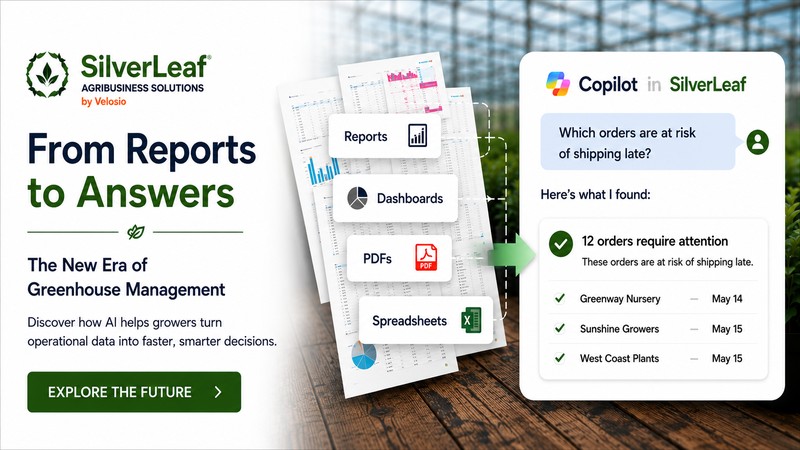
Greenhouse operations have never had more data at their fingertips. From sales orders and inventory levels to production schedules and shipping commitments, growers have access to a wealth of information that can help drive smarter decisions.
Yet for many organizations, finding answers still means running reports, exporting spreadsheets, and manually piecing together information from multiple systems.
As artificial intelligence becomes more accessible, that process is beginning to change.
Instead of spending time searching for information, growers can now ask business questions in plain language and receive answers instantly. With Microsoft Copilot and SilverLeaf, AI is helping greenhouse teams transform operational data into actionable insights, allowing them to work faster, respond sooner, and make better-informed decisions.
The Shift from Reports to Conversations
For years, accessing business insights required users to know where data lived, which reports to run, and how to interpret the results.
AI introduces a different approach.
Rather than navigating multiple screens and reports, users can simply ask questions such as:
- Which varieties are selling best this season?
- What orders are at risk of shipping late?
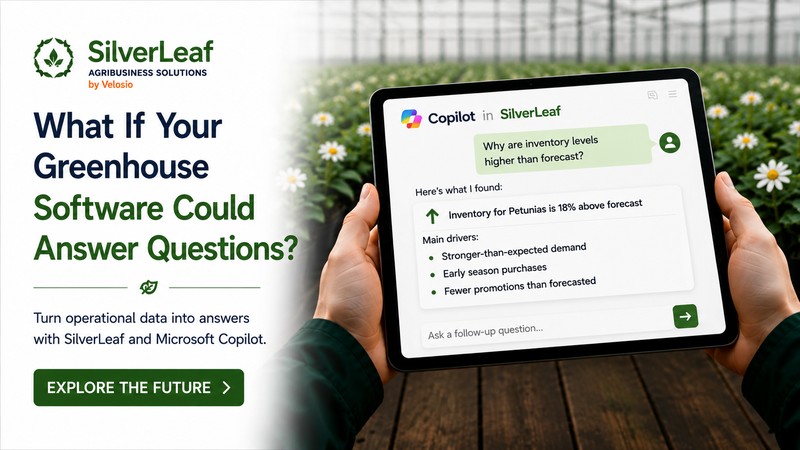
- Why are inventory levels higher than forecast?
- Show my top customers by margin.
- What production tasks are overdue?
Instead of searching through data, users receive direct answers based on information already stored within their business systems.
The result is faster decision-making and broader access to critical information across the organization.
“For years, we’ve asked greenhouse teams to become experts at finding data. AI flips that model on its head. Instead of spending time searching through reports, employees can simply ask questions and get answers, allowing them to focus on making decisions and taking action.” – Ben Marchi-Young, Industry & Product Manager, SilverLeaf
Turning Data into Actionable Insights
Modern greenhouse businesses must balance production, inventory, sales, labor, and fulfillment while responding to constantly changing operational and customer demands.
AI helps teams identify trends and exceptions before they become larger problems.
Improve Sales Visibility
Sales teams and managers can quickly identify what is driving business performance.
AI can help answer questions such as:
- Which products are generating the highest margins?
- Which customers represent the greatest revenue opportunities?
- How do current sales trends compare to last season?
- Which products are experiencing stronger-than-expected demand?
Having immediate access to these insights allows teams to react faster and make more informed decisions.
Gain Better Control of Inventory
Inventory issues can have a significant impact on profitability.
Too much inventory ties up valuable capital. Too little inventory can create fulfillment challenges and missed opportunities.
AI can help teams quickly identify:
- Excess inventory
- Slow-moving products
- Inventory shortages
- Products at risk of stockouts
- Variances between forecasted and actual demand
Rather than waiting for month-end reporting, potential issues can be surfaced when action is still possible.
Improve Operational Performance
Greenhouse operations generate thousands of daily activities across production, growing, fulfillment, and logistics.
AI can help managers quickly identify:
- Overdue production tasks
- Labor bottlenecks
- Shipping risks
- Order fulfillment issues
- Workflow inefficiencies
By highlighting exceptions and emerging issues, teams can spend less time searching for problems and more time solving them.
How Microsoft Copilot Enhances Greenhouse Operations
Microsoft Copilot brings conversational AI directly into the tools employees already use every day.
Integrated with business applications and operational data, Copilot enables users to interact with information using natural language.
Instead of asking IT, building custom reports, or waiting on analysis, employees can simply ask questions and receive relevant answers.
This capability helps:
- Reduce time spent gathering information
- Improve employee productivity
- Increase visibility across departments
- Support faster decision-making
- Enable more proactive business management
For greenhouse businesses facing increasing pressure to improve efficiency and profitability, the ability to access information quickly can provide a meaningful competitive advantage.
Beyond Insights: The Rise of AI Agents
Today’s AI tools are helping greenhouse businesses find answers faster. The next evolution is helping users take action.
“The real opportunity isn’t just using AI to find information faster. It’s using AI to identify risks, uncover opportunities, and eventually automate routine business processes. That’s where SilverLeaf and Microsoft Copilot can help greenhouse operations become more proactive, efficient, and responsive.” – Ben Marchi-Young, Industry & Product Manager, SilverLeaf
Emerging AI-powered agents will extend beyond answering questions and begin assisting with specific operational processes.
Future SilverLeaf AI capabilities may include:
| SilverLeaf Chatbot | Provide instant answers to operational, inventory, sales, and customer questions using natural language. |
| SilverLeaf Demand Forecasting Agent | Analyze historical trends and demand patterns to help improve forecasting accuracy and inventory planning. |
| SilverLeaf Inventory Reservation Agent | Assist with allocating and reserving available inventory for priority orders and customers. |
| SilverLeaf Product Conversion Agent | Recommend alternative products when availability issues occur, helping teams maintain customer commitments. |
| SilverLeaf Load Optimization Agent | Help improve shipping efficiency by optimizing truckloads, routes, and transportation utilization. |
Together, these capabilities have the potential to help greenhouse businesses move from reactive management to proactive decision-making.
The Future of Greenhouse Management
The question is no longer whether greenhouse businesses will use AI.
The real question is how quickly organizations can leverage AI to improve productivity, increase visibility, and make smarter decisions.
The growers that succeed in the years ahead will be the ones that can turn information into action faster than their competitors.
By combining operational expertise with AI-powered tools such as Microsoft Copilot and SilverLeaf, greenhouse businesses can empower their teams with instant access to insights, better visibility into operations, and a stronger foundation for growth.
Measure Your AI Readiness
AI can help greenhouse teams uncover insights faster, improve visibility, and make better operational decisions. But successful AI adoption requires the right data foundation, business processes, and organizational readiness.
- Our AI Maturity Readiness Assessment helps you:
- Evaluate your organization’s AI readiness
- Identify high-value AI use cases across operations
- Assess data and governance gaps
- Prioritize AI initiatives with measurable business impact
- Build a practical path from experimentation to adoption
Take the AI Maturity Readiness Assessment and discover where your biggest AI opportunities exist.
Final Thoughts
Greenhouse businesses are generating more operational data than ever before, but data alone does not improve performance. The real advantage comes from making that information accessible, actionable, and available now decisions need to be made. AI-powered tools such as Microsoft Copilot and SilverLeaf are helping growers move beyond static reports and toward faster, more informed decision-making. Organizations that build these capabilities today will be better positioned to improve efficiency, respond to market changes, and scale for future growth.
Frequently Asked Questions
How can AI help greenhouse businesses make better decisions?
AI helps greenhouse businesses quickly access operational data and identify trends, risks, and opportunities without relying on manual reports or spreadsheets. By using natural language queries, employees can receive immediate answers that support faster and more informed decision-making.
What types of business questions can Microsoft Copilot answer?
Microsoft Copilot can help answer questions related to sales performance, inventory availability, customer activity, production schedules, shipping commitments, and operational bottlenecks. Instead of searching through multiple reports, users can ask questions in plain language and receive relevant insights based on their business data.
Can AI help improve inventory management in greenhouse operations?
Yes. AI can help identify excess inventory, inventory shortages, slow-moving products, potential stockouts, and differences between forecasted and actual demand. This enables teams to take corrective action sooner and improve inventory planning and profitability.
What are AI agents, and how are they different from AI assistants?
AI assistants help users find information and answer questions. AI agents go a step further by supporting or automating specific business processes. Examples include demand forecasting, inventory reservation, product substitution recommendations, and load optimization to improve operational efficiency.
What should greenhouse businesses do before adopting AI?
Organizations should first evaluate their data quality, system connectivity, business processes, and overall AI readiness. Establishing a strong operational and data foundation helps ensure AI tools can deliver accurate insights and meaningful business value.