


Why the Future of Horticulture Is a Team Sport
 September 13, 2026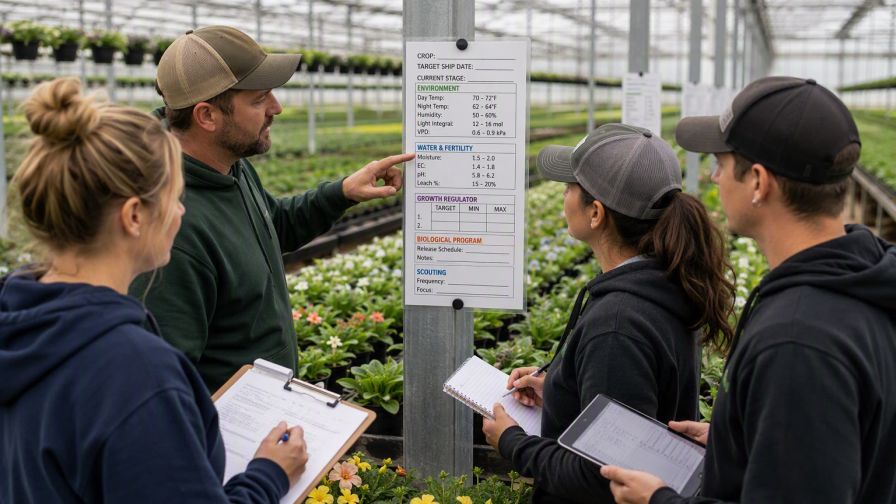
Photo: Jeff Neese
I was recently talking with a grower preparing to open a new 35-acre greenhouse facility. Like many expanding operations, the conversation eventually turned to finding a head grower. It wasn’t long before we found ourselves discussing a challenge that is common throughout the industry: What happens when you can’t find one?
The longer we talked, the more I found myself wondering if we were framing the problem incorrectly. Maybe the future of horticulture isn’t about finding head growers. Maybe it’s about building organizations that are less dependent on any single individual, regardless of how talented they are. That’s not criticism of experienced growers. In fact, it’s exactly the opposite. Great growers are incredibly valuable. They understand crop timing, irrigation management, fertility programs, environmental control, growth regulation, and all the subtle interactions that come from years of production experience. The challenge is that much of this knowledge exists as tribal knowledge, stored in their heads rather than within the organization itself.
What’s interesting is that we have already solved this problem in almost every other part of our business. Most medium and large greenhouse operations rely on ERP and MRP systems to manage production schedules, inventory, purchasing, shipping, labor planning, and forecasting. We no longer expect someone to remember how many 4-inch pots we have in inventory or keep track of production schedules on a legal pad and a clipboard. This information is documented, visible, and accessible because we understand that systems scale better than memory. Yet some of the most important information in the greenhouse still exists primarily inside someone’s head. We can instantly see how many plants are available for shipment, but in many organizations, we still need to find a particular grower to understand why a fertility recipe was adjusted six weeks ago or how we grew the 6-inch petunias last year.
The irony is that most organizations would never tolerate this level of dependency in any other critical business function. If the person responsible for inventory management retired tomorrow, the inventory system would remain. If the production scheduler left, the production schedule would still exist. Yet in many greenhouse operations, the departure of a key grower creates an immediate knowledge gap because the system was never designed to capture what that person knew. We have built businesses that can track every tray, pot, and order in real time, but often struggle to retain the knowledge that determines whether the crop succeeds in the first place.
Whenever the topic of written crop recipes comes up, I always hear the same argument: “You can’t grow plants from a recipe!” I agree — to a point. Plants aren’t widgets, and growers aren’t robots. But I think that statement misses the point. The purpose of a recipe isn’t to replace grower judgment. The purpose is to document grower knowledge. Very few growers that I know have well-developed, up-to-date recipes that are actually documented. Most are simply repeating what worked before, relying on memory rather than a system.
The question isn’t whether recipes exist. The question is whether the organization can benefit from them. In most cases, the answer is no.
Manufacturing organizations dealt with a similar challenge years ago through a concept known as centerlining. Rather than allowing operators to constantly adjust equipment based solely on personal preference, they establish operating ranges and guardrails that define the acceptable parameters for success. Operators still make decisions. They still apply their expertise. They simply work within a framework designed to reduce unnecessary variation and improve consistency. The goal isn’t to eliminate ownership. The goal is to create repeatable results while preserving individual judgment.
One of the best examples may be an integrated pest management program. Most successful IPM programs are not built around a single product, beneficial insect, or biological control strategy. They are built around knowledge. An experienced IPM manager develops a system of scouting, observation, recordkeeping, and decision-making that often becomes second nature. The recipes for releases and applications may be documented, but the true strength of the program comes from consistent execution. Weekly scouting reports, bench cards, sticky card counts, pest hot spots, treatment histories, and follow-up observations create a continuous stream of information that guides future decisions. Universities and Extension programs have long emphasized that regular monitoring and recordkeeping form the foundation of effective IPM because they allow growers to identify problems early, evaluate treatment effectiveness, and make informed management decisions.
When an experienced IPM manager retires, the biological control products remain. The scouting cards remain. The release schedules remain. What disappears is the ability to look at all that information and know what to do next. The value was never the recipe. The value was the judgment required to interpret the information, make the next decision, and teach the team how to avoid the problem before it occurred again.
I see tremendous potential for this philosophy in greenhouse production. Imagine a crop recipe that establishes target EC ranges, moisture level targets, scouting intervals, biological release schedules, and growth regulator guardrails. Instead of specifying a single PGR rate, perhaps the recipe establishes a minimum and a maximum rate range. The section grower still walks the crop. The section grower still evaluates weather, crop vigor, and shipping schedules. The section grower still owns the decision.
The goal isn’t to create 20 people who follow instructions. The goal is to create 20 people who understand the strategy. The organization benefits from years of accumulated experience, while the grower maintains the autonomy necessary to manage a living crop.
I also believe the future greenhouse will become far more visual. Lean manufacturing has long embraced visual management because people perform better when objectives, standards, and progress are visible. Standardized work helps create a shared understanding of success and reduces unnecessary variation. Imagine walking into a greenhouse and seeing a bench card that displays the crop strategy, target finish date, moisture parameters, fertility targets, biological program, and growth regulation strategy. Suddenly the crop isn’t being managed by one person. The entire team can see the plan. The irrigator understands the goal. The scout understands the goal. The section grower understands the goal. Everyone can see the score, and everyone knows how the game is supposed to be played.
As facilities become larger, production systems become more complex, and experienced growers become increasingly difficult to find, I believe successful organizations will focus less on building dependency around individuals and more on building systems that capture and distribute expertise throughout the team. Succession planning research within the horticulture industry consistently points toward strong management teams, reliable systems, and clearly defined processes as important drivers of long-term business resilience.
What makes this conversation interesting is that none of this diminishes the importance of exceptional growers. In fact, it elevates it.
The best head growers I have known were never valuable simply because they could grow crops better than everyone else. They were valuable because they made everyone around them better growers. They developed people. They communicated their thinking. They left behind systems, recipes, and teams that continued to improve long after they moved on.
A greenhouse that depends entirely on one expert remains vulnerable. A greenhouse that creates dozens of capable decision-makers becomes much more resilient. The first model relies on individual talent. The second creates organizational knowledge and repeatable results.
The greenhouse of the future may not be the one with the smartest grower.
It may be the one that figures out how to make every grower on the team better.
Because championships are rarely won by a single player. They are won by teams that know how to execute the same game plan together.
Subscribe to eNewsletter