


Sensor-Based Irrigation for Greenhouse Ornamental Crop Production
 August 31, 2026
 Agriculture accounts for 70% of freshwater consumption globally, and this demand is expected to increase by more than 50% by 2050 (Food and Agriculture Organization of the United Nations, 2017). However, only about 0.003% of global water is accessible as fresh water. Growing concerns over climate change and population-driven water demand highlight the urgent need for more efficient irrigation management practices in agriculture.
View all
Currently, many ornamental growers irrigate plants based on their experience, weather conditions, and intuition without a scientific approach or evidence, resulting in low water use efficacy and unnecessary large water usage.
Benefits and Limiting Factors of Sensor-Based Irrigation
Sensor-based irrigation poses potential to address water scarcity issues for nursery and greenhouse production as it employs moisture sensors in substrates to schedule irrigation based on water potential and keep plant-available water within a range of -1 to -10 kPa, saving water while preventing plants from water stress. However, sensor-based irrigation systems are not widely adapted due to high costs, low reliability, and/or technical difficulties.
Sensor-based irrigation delivers water based on the substrate’s volumetric water content (VWC), which could improve water use efficiency (WUE), thus largely reducing water usage. For instance, the total water usage of growing hydrangea (Hydrangea paniculata, ‘Silver Dollar’) over eight weeks was 20% lower by irrigating based on substrate moisture sensors than by conventional irrigation which delivered 1.8 cm of water in one event each day. Similarly, using a sensor-based irrigation system to cultivate lettuce (Lactuca sativa L. var. capitata cv. Mortarella d’inverno) in soilless substrate improved WUE from 25% to 70% compared with timer-based irrigation.
Sensor Types
There are many types of sensors available, and the appropriate choice depends on your monitoring needs. pH sensors measure substrate pH, EC sensors measure substrate electrical conductivity (EC), soil moisture sensors monitor substrate moisture content, and temperature sensors measure substrate temperature. Sensors can be purchased individually based on their specific functions, or integrated systems can combine multiple sensors into a single device, allowing you to monitor several parameters simultaneously. For irrigation management, soil moisture sensors are commonly used to monitor substrate moisture and guide irrigation decisions. In our case study, we used the CS655 soil moisture sensor from Campbell Scientific.
Sensor-Based Irrigation System Set Up and Trial Layout
Before initiating a trial, several steps are necessary to properly set up a sensor-based automatic irrigation system.
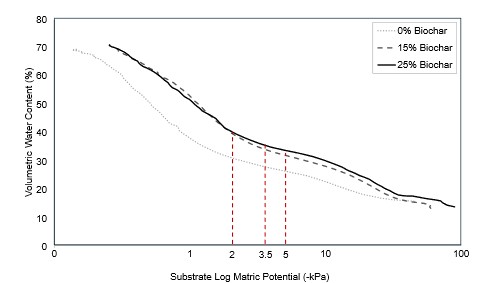
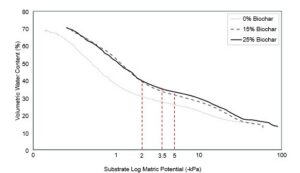
First, determine the substrate to be used in the experiment. Because different substrates have different volumetric water contents (VWC) and water-holding characteristics, identifying the substrate is essential for establishing appropriate irrigation thresholds. In our case study, the objective was to evaluate whether biochar could improve water-use efficiency (WUE) when used as a substrate component under different irrigation regimes. We used three substrates consisting of 0%, 15%, and 25% woodchip biochar (by volume) incorporated into a commercial substrate (Jolly Gardener Pro-Line HFC/25 Growing Mix). Because the water retention characteristics differed among substrates, irrigation thresholds were established separately for each substrate.
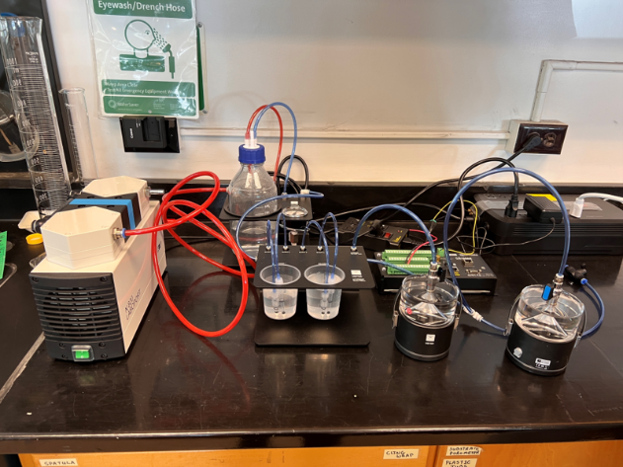
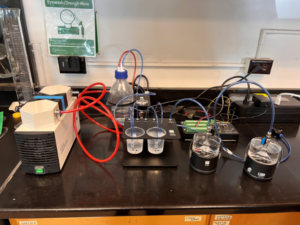
Second, determine the VWC characteristics of each substrate and establish appropriate irrigation thresholds. To accomplish this, we measured the moisture retention curve using a HYPROP system from METER Group. The moisture retention curves were used to identify appropriate VWC levels corresponding to matric potentials between −10 and −1 kPa. Based on these relationships, three irrigation levels—low, medium, and high—were established using the VWC values corresponding to −5, −3.5, and −2 kPa, respectively. These thresholds were selected within the range between easily available water and water-buffering capacity.
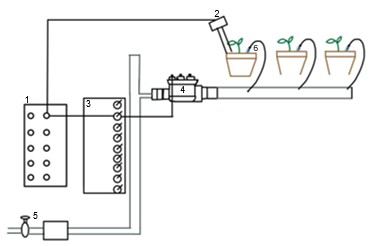
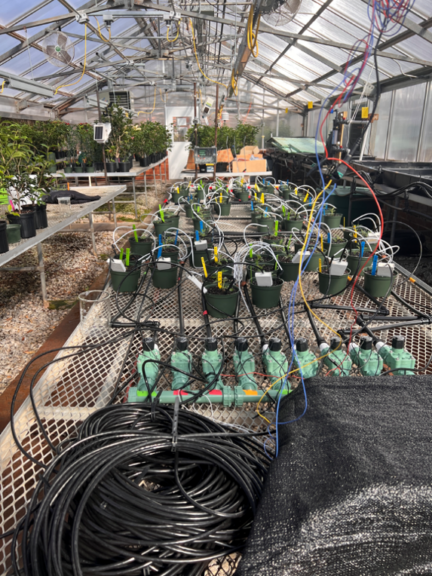
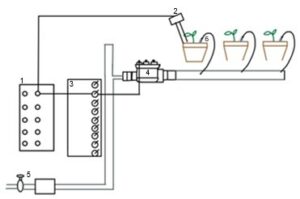
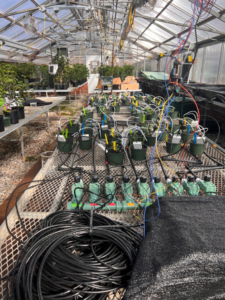
Once the substrates and irrigation thresholds were determined, the next step was to establish the automatic irrigation system. In our study, sensors were connected to a datalogger (CR1000X; Campbell Scientific) to continuously measure and control the VWC of nine irrigation treatments. The system used a relay controller (SDM16AC/DC controller; Campbell Scientific) to operate nine solenoid valves (3-Valve Inline Manifold Assembly).
Before installation, the sensors were calibrated separately for each substrate by relating sensor output to gravimetrically determined VWC. Gravimetric water content was calculated based on the difference between the wet and dry weights, divided by the dry weight. VWC was then calculated using the substrate bulk density and gravimetric water content.
The next step was sensor installation. Sensor placement is important because it can directly influence moisture readings and, consequently, irrigation timing. In our study, sensors were inserted 10 cm into the substrate at the center of each pot to ensure consistent placement across all treatments and to monitor moisture conditions within the root zone.
For tomato plants, VWC was measured every 5 minutes, whereas for kale plants, measurements were recorded every 10 minutes. When the VWC dropped below the predetermined irrigation threshold, the corresponding solenoid valve was activated. Tomato plants received approximately 5 seconds of irrigation, equivalent to 5 mL of water per irrigation event, while kale plants received approximately 10 seconds of irrigation, equivalent to 10 mL per event. The datalogger automatically recorded each irrigation event throughout the experiment.
Parameter Measurements
After the sensor-based automatic irrigation system was fully established, the plants were transplanted into their respective treatments. In this study, tomato and ornamental kale were selected because of their relatively high-water demand during production, making them suitable for evaluating plant responses to different irrigation regimes. Volumetric water content (VWC) was continuously monitored and recorded throughout the experiment. In addition, we measured key plant growth parameters, including growth index and biomass, to evaluate plant performance under different irrigation treatments. The total volume of water applied to each treatment was also recorded throughout the experiment. The water use efficiency (WUE) of the plants was then calculated by relating plant biomass to the total volume of irrigation water applied.
What The Research Results Tell Us
At the end of the experiment, no significant differences were observed among treatments in growth index, leaf greenness, as indicated by SPAD values, or physiological parameters, including maximum quantum efficiency of photosystem II (Fv/Fm), photosynthetic rate, transpiration rate, and stomatal conductance at eight weeks after transplanting in ornamental kale.
However, significant interactions between substrate composition and irrigation level were observed for shoot fresh weight and water-use efficiency (WUE). Under the low irrigation regime, the substrate containing 25% biochar resulted in the highest WUE. In contrast, under the medium and high irrigation regimes, the substrate containing 15% biochar had the highest WUE. In addition, the substrate amended with 15% biochar produced the greatest shoot dry weight and total dry weight across all irrigation levels.
For tomato plants, different responses were observed. Under the low irrigation regime, the substrate containing 0% biochar had the highest WUE, whereas no significant differences in WUE were observed among substrates under the medium or high irrigation regimes. The substrate containing 25% biochar produced the greatest total dry weight among all treatments, while irrigation level did not significantly affect total dry weight. Under the low and medium irrigation regimes, the 25% biochar substrate increased total dry weight in tomato plants; however, this positive effect diminished under the high irrigation regime.
From this trial, we learned that sensor-based irrigation systems can be successfully adapted for greenhouse ornamental crop production. However, proper sensor calibration is essential before initiating a trial or implementing the system in commercial production. Because different substrates have distinct physical properties and water-holding characteristics, they may require different irrigation thresholds and management strategies. Therefore, to develop an effective irrigation management plan, it is important to understand the properties of the substrates being used and conduct small-scale trials to establish appropriate irrigation thresholds.
In addition, different plant species may respond differently to irrigation regimes and have varying water requirements. Grouping plants with similar water requirements may therefore help improve irrigation efficiency and support more effective irrigation management in commercial production.
As sensor technology continues to advance, more reliable, user-friendly, and affordable products may become available. Before selecting a sensor-based irrigation system, however, it is worthwhile to consult with multiple vendors and compare products based on factors such as cost, installation requirements, maintenance needs, accuracy, reliability, and technical support. Carefully evaluating these factors before making a decision can help growers select a system that best fits their production needs and management goals.
You can find the full article here.
Subscribe to eNewsletter