



Automation for the People: Technology for Small- and Mid-size Producers
 July 21, 2026
 Saving minutes saves hours. And how many of you could use a few more hours to get done what needs to be done in the greenhouse?
The greenhouse world is replete with automation and technology, but it can sometimes feel like those tools are reserved for large growers with numerous acres. However, this is not true. This article highlights technology and automation appropriate for greenhouses that do not require a bike or golf cart to get around.
Propagation and Planting
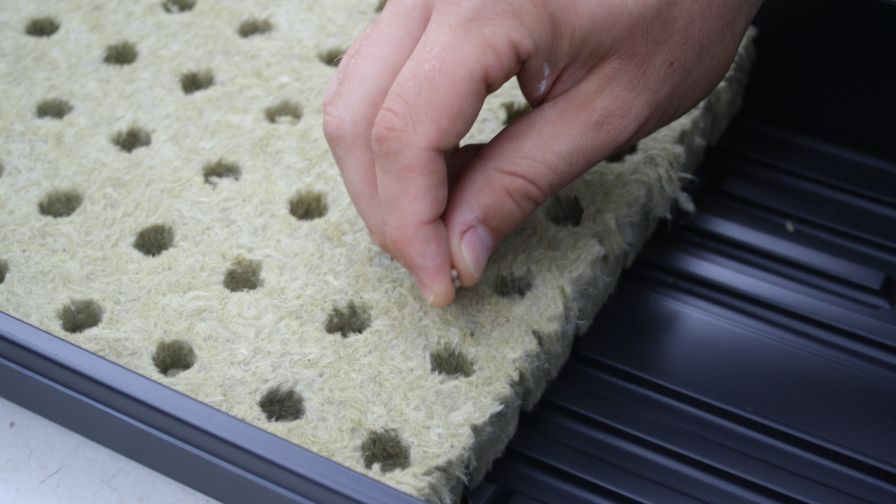
Handheld manifold and plate vacuum seeders can make sowing plug trays faster, more uniform, and more labor-efficient than hand sowing. | Christopher J. Currey
Growing seedlings in-house is an excellent way to control crop timing and quality while keeping a handle on the entire production timeline. While there is a bit of a learning curve to growing seedlings, it is very achievable for growers.
I still see some greenhouses sowing seeds in rows in open flats, then teasing apart individual seedlings when it is time to transplant them. Using plug trays to produce singularized young plants is a much better approach when producing seedlings. The major benefit is that when plugs are pullable and ready to transplant, the roots encircle the growing substrate. There is little to no disturbance when planting, and transplanting shock is eliminated.
However, sowing seeds by hand in plug trays can be time-consuming compared to sowing them in open flats. Using a hand-held vacuum seeder makes sowing plug trays go much more quickly. Some hand-held vacuum seeders use a manifold that sows one row at a time, while others use a plate that can sow a whole tray at once. For manifold seeders, different-diameter needle tips are used to accommodate different seed sizes. Plate seeders require different plates with different-diameter holes.
When plugs are ready to transplant, we often refer to them as “pullable.” While it is true that plugs can be pulled out of trays when they are transplantable, sometimes you end up with the seedling shoot between your fingers and roots and substrate still in the tray.
Plug poppers are a great way to remove seedlings from plug trays much more quickly, while minimizing any casualties. Like seeders, poppers come in different models, including handheld manifolds that pop rows one at a time and models where an entire tray of plugs is popped in one fell swoop.
Growing Environment
One of the most powerful tools at your disposal in the greenhouse is the ability to control the growing environment. Whether you are manipulating air temperature to control crop timing or plant size, using lighting to enhance crop quality or promote flowering, or reducing humidity to promote transpiration and prevent pathogens, modifying the growing environment is essential for greenhouse success.
Thermostats and timers are certainly useful for basic control of greenhouse equipment, but they have limitations. First, every piece of equipment requires its own controller. Additionally, there is no “cross talk” between equipment, and everything operates independently. This can result in inefficiencies, such as when heaters are running and cooling equipment turns on.
While computer controllers may be top-of-the-line with respect to their capabilities, they can also be cost-prohibitive for many greenhouses.
Dave Bartlett, President of Bartlett Instrument Company, which manufactures step controllers, puts it best when he says, “My goal is to replace the thermostat.”
Step controllers are an excellent tool for controlling heating, cooling, and ventilation in greenhouses. Integrating control of this equipment maintains tighter control of target air temperatures, while reducing overlap in control. Furthermore, as the name implies, step controllers minimize excessive corrections and temperature swings by using a series of smaller interventions, or “steps,” instead of hitting the throttle with maximum heating or cooling.
Not only does this help reduce dramatic swings in temperature, but it also reduces energy costs. Think of it like using a scalpel instead of a hatchet: greater precision while wasting less energy.
Irrigation
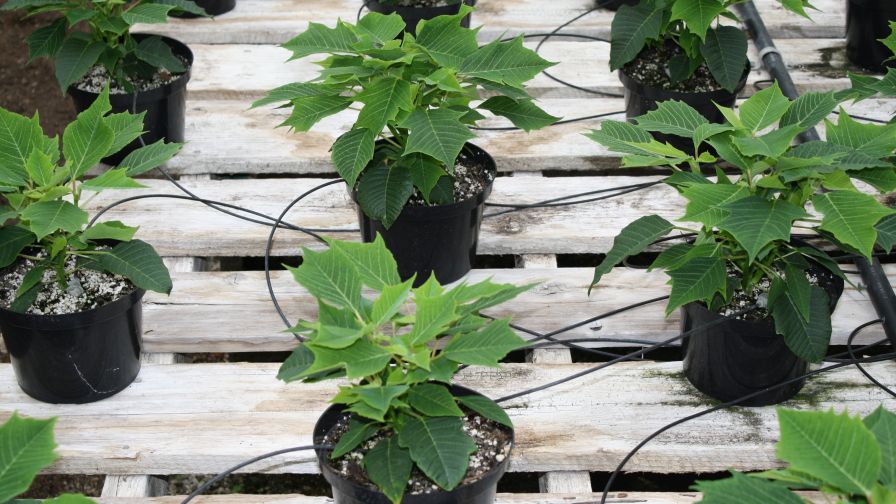
Drip irrigation is one accessible way for small- and mid-size growers to automate watering while improving crop uniformity. | Christopher J. Currey
Watering is arguably the most important task in the greenhouse. However, for growers who are hand-watering, it can also be one of the most labor-intensive and therefore expensive tasks.
To save on labor costs, hand-watering is frequently assigned to employees with less experience than others and, therefore, lower wages. Instead of this approach, consider using one of several irrigation technologies to automate watering and reduce labor use.
Some irrigation technologies, while extremely efficient and effective, can be sizeable investments, such as flood floors. However, there are several more affordable options that can provide many of the same benefits as more expensive systems, including capillary mats, drippers, and even booms.
Capillary mats are a great option for subirrigation, allowing for crops to be grown with lower fertilizer concentrations since leaching is eliminated. As a bonus, capillary mats are adaptable to a variety of container sizes and spacings, and foliage stays dry when crops are irrigated.
Another efficient irrigation option is using drippers and drip stakes placed on or in the substrate surface of each container. While this is not an option for plug trays, flats of bedding plants, or quarts in shuttle trays, it works very well for 6-inch and 1-gallon containers and larger. Like capillary mats, foliage remains dry during irrigation. Unlike capillary mats, there is an opportunity to leach containers when needed.
Finally, while some booms are designed for big bays, they can also be used effectively in smaller greenhouses, such as double-poly Quonset huts. Booms work best when container sizes are similar, resulting in comparable irrigation requirements. They are also useful for applying insecticides, fungicides, and plant growth regulators.
In addition to being labor efficient, these irrigation systems provide uniformity. Even when trying our best, the human element in irrigation can introduce variation in watering. This can become especially problematic when the person handling the hose is not giving it their all.
Fertilization
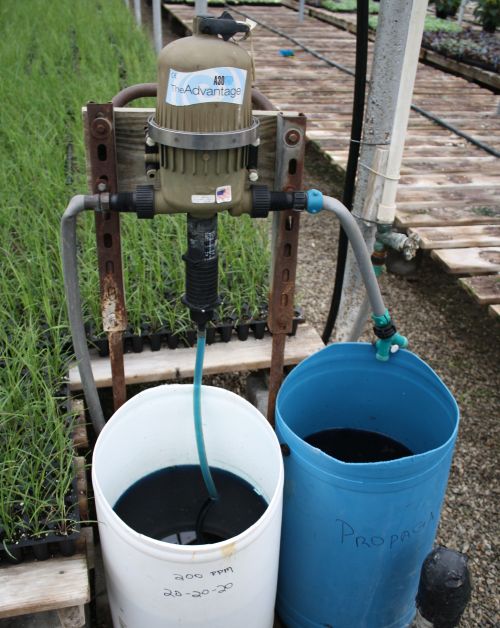
Fertilizer injectors give growers flexibility in nutrient delivery, especially when multiple injectors are used in line to manage different fertilizer blends. | Christopher J. Currey
I will admit this for all to read: I love fertilizer injectors. They are an incredibly useful tool for helping meet the mineral nutrient requirements of crops while saving time and space in the greenhouse. Instead of mixing fertilizer solutions to their final concentration, making a stock solution ranging from as low as 50 to as high as 400 times the final concentration saves the same magnitude in nutrient solution volume.
And don’t forget the flexibility of being able to change the ratio of fertilizer stock to clear water. For example, a fertilizer stock mixed to provide 100 ppm N at a ratio of 1:100 (concentrated fertilizer to clear water) can provide 200 ppm at 1:50 or 50 ppm at 1:200.
While many growers are already using an injector in their greenhouse, I strongly encourage you to think about adding one or more injectors in line with one another. By using multiple fertilizer injectors, you can blend different fertilizers together and uncouple nutrients from one another.
When we look at complete, water-soluble fertilizer formulations, all nutrients are fixed in their proportion to one another. As you provide more nitrogen, you are also providing more phosphorus and micronutrients. Alternatively, at low concentrations, less phosphorus and fewer micronutrients are provided.
By using multiple injectors, perhaps one providing macronutrients and the other micronutrients, or one providing everything but phosphorus and the other providing phosphorus, you can manipulate them differently and independently to better meet the nutrient needs of your crops.
The Automation Takeaways
Size does not matter when it comes to adopting automation. Regardless of your operation’s scale, there are ways to improve consistency and crop quality while reducing labor needs.
Embrace tools that give you back time — time you can reinvest into other aspects of running and expanding your business.
Subscribe to eNewsletter