



6 Things Growers Should Know About the Dümmen Orange/Syngenta Flowers Joint Venture
 July 15, 2026
 In May, global plant breeding leaders Dümmen Orange and Syngenta Flowers signed an agreement to establish a strategic joint venture designed to bring together both companies’ complementary variety portfolios, R&D capabilities, production processes, and commercial networks.
That’s the corporate description. The bigger question for ornamental growers is: What does this partnership mean for them?
To find out, we caught up with Dümmen Orange CEO Ellen Mackenbach-Lakeman and Mark Schermer, Global Head of Syngenta Flowers. Here are six themes that emerged from the conversation.
1. The Portfolios Are Largely Complementary
Dümmen Orange and Syngenta Flowers each bring strengths in different product categories, and their combined portfolios should complement each other well, Schermer says. “Dümmen Orange has a large cut flowers product line, which is a space that Syngenta Flowers is not active in,” says Schermer. “On the other hand, Syngenta Flowers brings in a seed portfolio, something that Dümmen Orange has yet to develop.”
There will be some overlap. For example, both companies have large geranium portfolios. In those cases, Schermer says choices will need to be made. “But overall, I think both companies are quite complementary in what we can bring to the market,” he says.
2. Technology Will Play a Bigger Role in Breeding
Mackenbach-Lakeman says she’s looking forward to how the new company can use emerging technologies in future breeding efforts.
One area of opportunity is predictive breeding, where breeders can use data to evaluate parent plants and better understand what traits may come from specific combinations. She also points to the possibility of bringing breeding combinations together in ways that may create more opportunity for seed, rather than relying only on cuttings or vegetative materials.
“We don’t want to bring the two companies together to do more of the same,” Mackenbach-Lakeman says. “We want to leverage our institutional knowledge and the new technology at our disposal to do things differently.”
3. Grower Needs Will Guide Development
Mackenbach-Lakeman says grower needs have been, and will continue to be, at the heart of the company’s breeding efforts.
“If we have conversations with our grower customers and understand the issues they are facing, we can tailor our research and development and breeding to address those issues,” she says. “It’s not about coming up with another nice new color; we’re trying to solve grower issues that may be coming three or four years from now.”
Schermer echoes that focus. “We can only be successful when growers are successful,” he says. “The grower is at the heart of everything we do, and that is definitely something that we’ll continue to emphasize.”
4. Market Research Will Shape Long-Term Planning
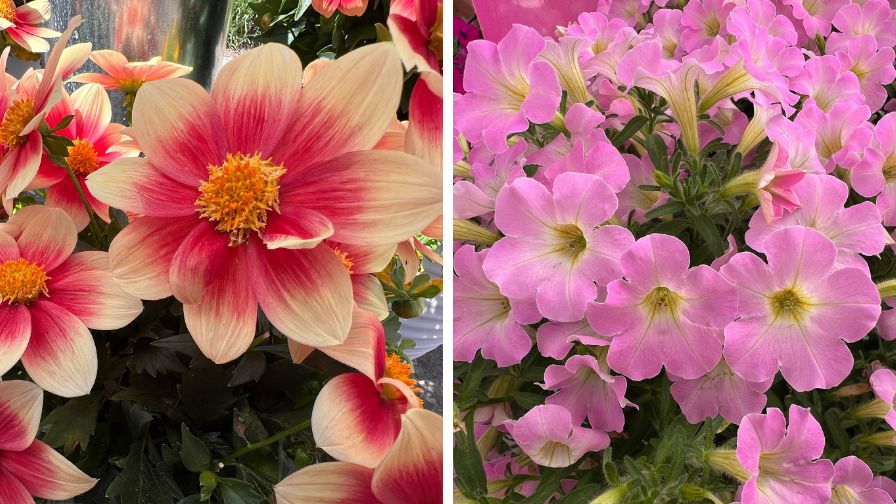
Dahlia Summer Bees Salmon Bicolor (Dümmen Orange) (L) and Petunia hybrida ‘Itsy Pink’ (Syngenta Flowers) (R). | Robin Siktberg
Both companies bring different strengths and approaches to long-term planning, but Mackenbach-Lakeman says market research will remain central to future breeding decisions.
“We gather a lot of data from talking to our customers, and based on that, we work with product-market combination files to try and position where the markets are, what the market opportunity is, and if there would be an opportunity to expand our genetics to bring new things to the market,” she says.
The traits that matter most depend on the crop and market. For cut flowers, that may include vase life and transportability. For potted plants, it may include heat resistance or cold tolerance.
“Depending on the needs that are there, we can track them through our breeding processes in order to make sure we get where we need to be,” Mackenbach-Lakeman says.
That information gathering extends down the supply chain to the retail level, Schermer says.
“We have a very good relationship with the retailers in the market, and some of those partners are willing to share their insights on consumer data,” he says. “It takes about 10 to 15 years to build a successful breeding program for one variety, which means anything that is going to be successful in five to seven years is already in the pipeline.”
5. Employees Will Be Part of the Integration
Customers are the first focus. But Mackenbach-Lakeman says employees are also central to the integration process.
“Both of our companies have had strong levels of engagement from our teams for years, and we want to continue that,” she says. “We want to give our employees the opportunity to get involved in integrating the two companies and generate new ideas.”
Schermer says it will be important to define a clear strategy for the new company, then build an organization that supports that direction.
“We are in a position of defining our long-term vision, and we’ll make sure that we continue to inform our team what the organization is going to look like and how that’s going to work for them,” he says.
6. Both Companies Will Be at CAST in 2027
Schermer confirms that both Dümmen Orange and Syngenta Flowers will participate in the 2027 California Spring Trials, with location details still to come.
Beyond that, the team behind the new company, which will also have a new name at some point, will evaluate how the purpose of CAST continues to evolve and what role the event can play in the future.
Subscribe to eNewsletter