

The Next Growing Media Opportunity May Already Be in Your Greenhouse

 October 31, 2026
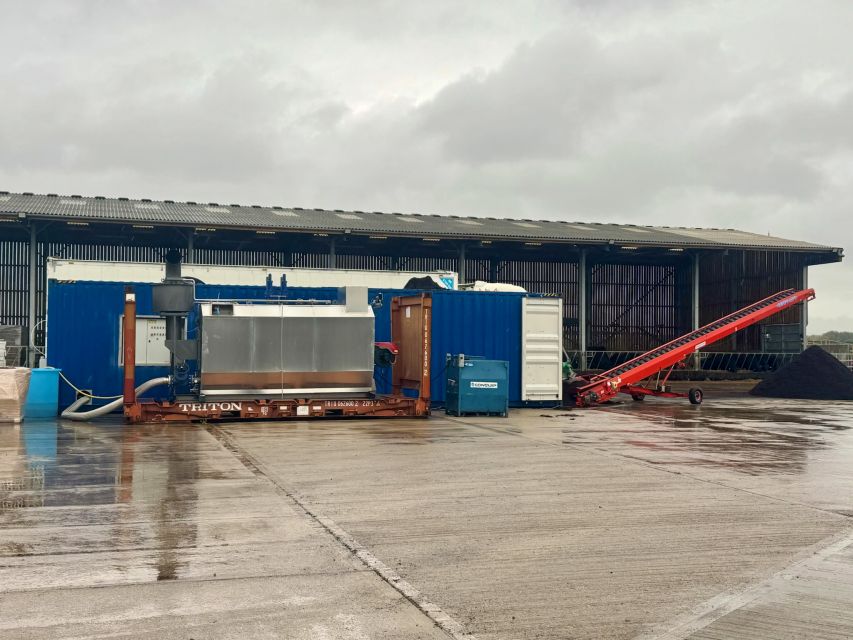
The containerized Konflex superheated-steam treatment system at Overland, used in the growing media recovery process. Photo: Jennifer Neujahr/Next Step Solutions
The North American growing media industry is preparing for significant change. Demand is increasing, raw material availability is becoming more complex, and growers are considering a broader range of substrate ingredients.
Much of the conversation has focused on what materials we will use next. But there is another question worth asking: What happens to the growing media we are already using when the crop is finished?
In many operations, the crop comes out, the material is removed, and a new substrate goes in. What if some of that material could be recovered, processed, and used again?
That is a question Henry Miles and his team at Overland in Kent, UK, have spent years working to answer.
Ted and I visited Overland in October to see commercial superheated-steam technology supplied by Konflex. We expected to learn about the equipment and how it might be applied in other markets. What we found was a business that had developed an entire system around recovering growing media and getting it back into production.
A Business That Started by Solving a Grower’s Problem
Overland did not begin as a growing media manufacturer. The business started providing mechanised crop-removal services to greenhouse growers in 2010, initially working with tomatoes, cucumbers, and peppers.
As the company expanded into soft fruit production, Henry and his team encountered large quantities of used coir grow bags that needed to be removed at the end of a crop. The material still had potential value, but separating it from plastic bags, roots, and plant residues was not simple.
Overland began developing equipment and processes to recover the coir, clean it, treat it, and return it to commercial use. Today, its operation brings together collection, separation, processing, and sales of recovered growing media.
Henry is not asking growers to become recycling specialists. He is building a service that allows them to concentrate on growing crops. “We’re here to supply you a good quality, good value material, and just take care of that headache for you,” he explained during our follow-up conversation.
A technology can be interesting, but if it adds complexity without delivering a clear benefit, adoption will be difficult. Overland has approached the problem by trying to make recovery commercially practical.
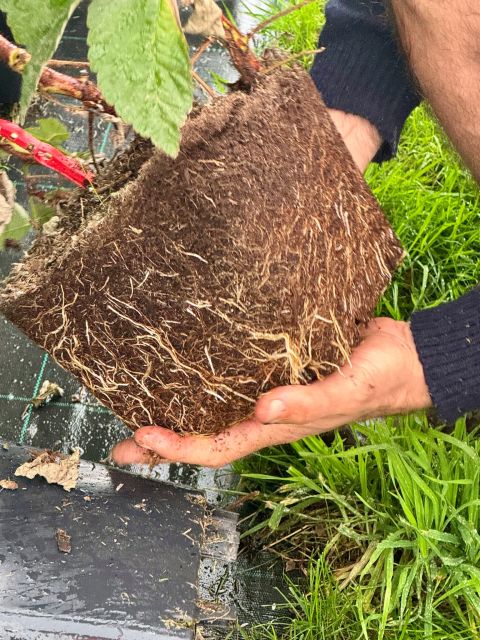
A berry plant root ball showing root development in coir in its third growing season of reuse at Overland. Photo: Jennifer Neujahr, Next Step Solutions
The Real Test is What Happens in the Next Crop
Recycling growing media sounds appealing, but growers have good reasons to be cautious. A substrate is not simply a material that holds a plant upright. Its physical structure influences water availability, air-filled porosity, and root development. Its chemical properties affect nutrient management, and its biological condition can influence crop health.
Overland has worked with NIAB, the UK-based agricultural research organization, to investigate whether recovered coir can be processed and reused successfully in commercial strawberry production. The research includes laboratory analysis, biological testing, and commercial growing trials.
Results have shown that appropriately processed recycled coir can produce yields comparable to virgin coir. Some commercial trials have also reported water savings of approximately 8% to 10%. Those findings are encouraging, but they do not mean recycled coir behaves exactly like new coir.
Research has identified differences in water-holding capacity and air-filled porosity, which may require irrigation adjustments. The objective should not be to find a material identical to the current one, but to understand what the crop requires and whether another material can consistently deliver it.
During our visit, we also saw raspberry plants growing in reused substrate. Seeing the root development in an actual production setting added a practical dimension to the research. It was not a controlled comparison, but it reinforced why commercial validation matters.
As Henry put it, “You want to build confidence.” Confidence comes from performance, consistency, and understanding how to manage the material.
Steam Treatment: One Piece of the System
One of the greatest concerns surrounding substrate reuse is the potential carryover of pests, pathogens, and other biological risks. Recovering the material and removing visible plant residues does not necessarily address those risks.
Overland has incorporated a containerized superheated-steam treatment system supplied by Konflex. The technology uses superheated steam to pasteurize recovered growing media under controlled conditions, with the objective of reducing biological risks at commercial scale.
Pasteurization is not sterilization. Treatment needs to be validated for the target organisms, material characteristics, and intended application.
For Ted and I, the interesting part was seeing the technology within a larger commercial system. Steam treatment alone does not create a market for recycled media. The material still needs to be collected, separated, processed, tested, and delivered in a form growers can use. Each step influences quality and economics.
Could This Work in North America?
North America has a different growing media landscape from the UK. Greenhouse and nursery operations use peat, coir, bark, wood fiber, and other components, with substantial geographic differences in availability, transport costs, cropping systems, and waste-management requirements.
A recycling operation that works in Kent may not make sense in every North American growing region. The first question is whether enough suitable material is available within a practical collection distance. The second is whether it can be recovered and processed economically. The third is who will purchase and use the finished product.
Ted raised this point with Henry: volume matters, but volume alone does not create a viable business. Reliable customers, consistent product quality, and a commercial model that works for all parties are equally important.
Partnerships among growers, substrate manufacturers, processors, and technology providers may offer a way forward. A large grower might generate enough used substrate for a dedicated programme; elsewhere, several growers might collaborate with a local processor.
Henry is open to partnerships and franchise-type arrangements. “We’d like to be part of something than part of nothing,” he told us. That flexibility may be important as the concept moves into new markets.
Start With Economics, Then Prove Performance
Environmental benefits alone rarely justify a major change in commercial production. Growers need to know what a material costs, how it performs, and what adjustments it requires.
Before considering recovery, we would encourage growers and suppliers to ask: How much used media do we generate, and what does disposal cost? How have its physical, chemical, and biological properties changed? Could it be recovered and treated locally? Which crops are appropriate? What trials would establish performance and safety? Who will own the material, process it, and buy the finished product?
These questions distinguish an interesting idea from a viable commercial opportunity.
A Different Way to Think About Growing Media Supply
In a previous Greenhouse Grower article which you can find here, we discussed building flexibility into growing media supply strategies. We will continue to need new raw materials, processing capacity, and resilient supply chains. But perhaps we also need to think differently about materials already moving through our production systems.
Could some growing media have a second or third useful life? Could recovery become part of a grower’s long-term supply strategy? Could local processing reduce the need to transport new materials long distances? These are questions worth investigating, not conclusions already reached.
Next Step Solutions is working with Konflex to explore commercial applications for its superheated-steam technology in North America and other markets. Our visit to Overland showed how that technology can fit into a functioning substrate recovery business.
What stayed with us most was Henry’s approach. He started with a problem growers needed solved and built a business around finding a practical answer. As we work to secure the growing media we will need in the future, it may be worth another look at what we are already throwing away.
Subscribe to eNewsletter