



California Nursery Industry Struggles with Sustainability and Climate Challenges
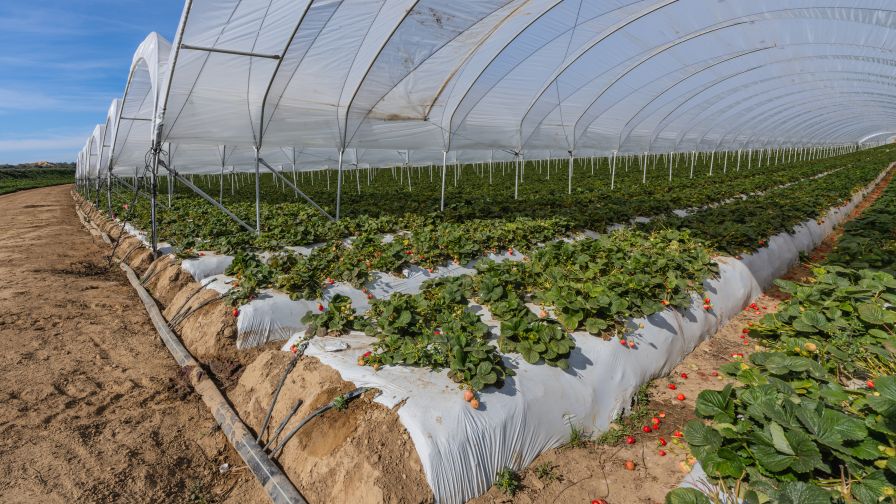
Outdoor production of strawberries in a California nursery. | Nature, Food, Landscape, Travel library via iStock
Nursery owners and landscapers in California are anticipating a slew of new laws to roll their way over the next few years. These rules are poised to alter business as usual in all sectors of the horticultural industry, from cut flower operations to native plant nurseries.
The new rules encompass a variety of environmental topics, including single-use plastic pots, water use, and nutrient management.
Meanwhile, looming over the nursery industry is the warming climate, forcing business owners to adopt strategies that protect their plants – and profits – from record-breaking heat waves.
Scientists from the University of California Agriculture and Natural Resources brought these hot topics, and many others, to business owners’ attention at the 2025 California Nursery Conference. For the first time in years, the conference and accompanying farm tours were held in Ventura County.




“Growers from Ventura County were happy to have the conference in their backyard…to be able to have the industry come to them,” says Emma Volk, UC Cooperative Extension Production Horticultural Advisor for Ventura County and one of the lead organizers of the conference.
Plastic Pollution Prevention
Rows of plants in black plastic pots are a ubiquitous sight at California nurseries, but according to a new state law, the reign of those containers is coming to an end.
One of the topics at the California Nursery Conference was Senate Bill 54, a sweeping law passed in 2022 that’s meant to curb pollution by targeting the sale of single-use plastics – like those containers for growing plants. The law requires that 100% of single-use packaging sold in the state be recyclable or compostable by 2032.
“It’s going to take a lot of money to comply with what they’re trying to do,” says attendee Manuel Morales from Los Arroyos International Wholesale Nursery in Watsonville. “Some containers we reuse, but sometimes we can’t because we don’t want contaminants with the plant. And if you don’t have a place to recycle, what do you do with the plastic?”
No More Potable Water on Non-Functional Turf
Native plants and low-water landscaping stole the show at this year’s conference, recurring as a theme in multiple presentations. Climate-adapted plants featured prominently in a discussion about a new law that’s set to reform water use on certain California landscapes.
In this drought-prone state, lawns are a luxury that soak up precious potable water. While parks offer recreational and environmental benefits, lawns in other settings may be considered “non-functional,” like those covering medians or incorporated into an office’s landscaping.
Starting in 2027, California Assembly Bill 1572 outlaws the use of potable water to irrigate non-functional turf in commercial, industrial, and institutional settings. That means governments and business owners may turn to nurseries for help crafting alternative landscapes.
Irrigation and Nutrient Management Plan
Diligent fertilizer management is key for growers to conserve resources while protecting the environment from harmful runoff. Those management considerations are now an official requirement – the State Water Resources Control Board mandates growers complete irrigation and nitrogen management plans to monitor various inputs and outputs at their facilities.
Several UC ANR horticultural experts gave presentations to support local growers working through these new expectations. That included Bruno Pitton, UC Cooperative Extension Environmental Horticulture Advisor for Nevada and Placer counties, who shared his research quantifying nitrogen outputs from a nursery system. He found that only a small fraction of applied nitrogen – just 3% – had the potential to leach into groundwater, with the majority remaining in the potting soil.
According to Pitton, accurately measuring the nitrogen removed from the wide variety of crops typically sold by a single nursery is cost-prohibitive. He hopes the state will take that into consideration and develop guidelines suited to the diversity of the nursery industry.
Hot Tips for Heat Wave Management
In addition to gearing up for new policies, growers have other challenges weighing on their businesses. For Justina Gutierrez of Sakaida Nursery, the changing climate is at the top of that list. Her family runs their wholesale nursery in Rosemead, part of Los Angeles County.
“It’s getting hotter,” says Gutierrez. “Our production is outside, and we do experience plant burn… the summer’s pretty hard for us.”
Gutierrez took careful notes during the presentation on heat waves from Don Merhaut, UC Cooperative Extension Nursery and Floriculture Crops Specialist serving Riverside County.
Merhaut’s talk infused heat wave data with personal discoveries he made over his 26-year career at UC ANR. He let the audience in on a tip he picked up from observing nurseries in his neighborhood – the local growers had affixed each stake to the plants’ southwest side. To Merhaut’s trained eye, that practice was clearly a heat management strategy, casting the stake’s shadow on the plant, affording it a break from the sun.
For additional information on topics discussed at the 2025 California Nursery Conference, as well as pictures taken at and during the conference, please read the original article written by Caroline D. Champlin and found on the University of California Agriculture and Natural Resources website.
Subscribe to eNewsletter
