



Have the Conversation: Why Family Succession Talks Can’t Wait
 December 20, 2025
Big diverse family celebrating the holiday at dinner table with raised glasses. | Gorodenkoff via Adobe Stock
If you own a family business, the hardest conversation is often the most important one. Every day you delay talking about succession, you risk leaving your family — and your legacy — unprepared for the future. Life doesn’t wait for perfect timing. Illness, unexpected events, or market shifts can force decisions when emotions are high, and options are limited. Starting now, even if it feels uncomfortable, is the best gift you can give your family and your business.
The holidays — the most wonderful time of the year when family gathers around the table — are more than a time for celebration. They’re also the perfect moment to talk about the future of your business while sipping eggnog and hot chocolate! It may feel awkward, but avoiding the conversation can cost far more than a few uneasy minutes.
Why Owners Delay — and Why That’s Risky
Our 2nd Annual State of Succession and Exit Planning in the Horticulture Industry survey revealed that while 46% of respondents have family interested in taking over their business, only half of those owners have started succession conversations. Why? Because it’s hard. It’s emotional. And it’s easier to put off.
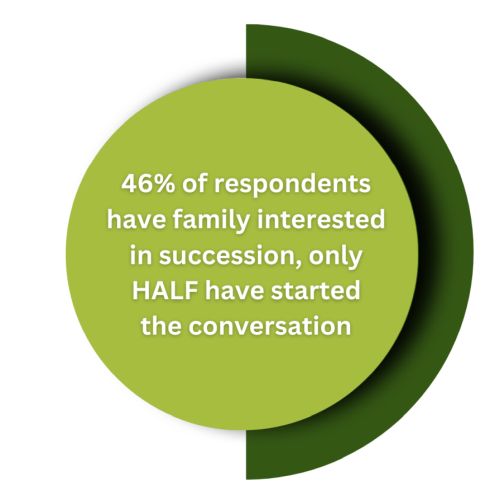
46% of respondents have family interested in taking over their business, but only half of those owners have started succession conversations. | PivotPoint Business Solutions





But silence isn’t neutral. According to the Exit Planning Institute, here’s what’s at stake:
- 70% of family businesses have no succession plan.
- Only 30% survive to the second generation; less than 15% to the third.
- 25% of failed family business transitions occur because the heir is unprepared.
- 60% of failed transitions stem from poor communication and low trust.
When owners don’t share their intentions, uncertainty grows. Family members wonder where they stand. Employees sense instability and may leave — often at the worst possible time. Planning early protects relationships, wealth, and continuity.
When to Start?
If you didn’t start at launch, the next best time is now. Get a succession plan in place. Ideally, succession planning begins 3–5 years before transition, but even starting today is better than waiting. In our work with business owners, here are common triggers we see for starting the conversation:
- Approaching retirement or major life changes.
- Reaching significant business milestones like expansion or revenue goals.
- Family gatherings like the holidays, when everyone is together, are natural.
How to Begin
Start with clarity. Ask yourself:
- Why did I start this business?
- Why did I say yes to continuing the legacy?
- What do I want next — retirement income, legacy preservation, family involvement, or monetization?
Then, frame the conversation as an opportunity, not an obligation or entitlement. Avoid assumptions. Ask and listen. Not every family member wants to take over, especially after witnessing the blood, sweat, and tears mom and dad poured into the business over the years — and that’s okay. Your business is a family asset, not a family mandate.
Tips for a productive discussion:
- Share your intentions honestly and emphasize the importance to you of keeping the business within the family.
- Make no promises you can’t keep, and be prepared for questions.
- Involve spouses and children early.
- Consider a neutral facilitator or an objective advisor for emotional topics.
- Hold regular family meetings to discuss business performance and update plans as circumstances change. Succession isn’t a one-time discussion.
Remember: what’s right isn’t always fair, and what’s fair isn’t always right. Active family members deserve compensation and equity for their role in preserving wealth and continuing the legacy.

Why It Matters
Succession planning isn’t just about business — it’s about family harmony. The concept of a “family enterprise” is one in which the family’s assets (including the business), investments, philanthropy, and leadership are guided by the family’s shared values and vision. Without transparency, confusion and resentment can linger for years. With it, you create alignment, reduce stress, and protect what you’ve built.
Once your family is on board with your succession plan, sharing it with your leadership team can provide twofold benefits. First, you need your managers to work with your family to execute your plan. It cannot do it alone. Second, it deepens loyalty by signaling trust. When team members are included in exit conversations, they shift from simply executing day-to-day tasks to actively contributing to the family and business’s long-term vision.
Give Yourself and Your Family a Gift
Start the conversation this holiday season. It may feel uncomfortable, but it’s the most important step toward a smooth transition and a healthier, happier, and prosperous future. In the end, we work to live — not live to work. Make sure what you’ve built continues to serve your family for generations to come.
Get the Survey

2025 State of Succession and Exit Planning in the Horticulture Industry Report QR Code
View and download a digital copy of the 2025 State of Succession and Exit Planning in the Horticulture Industry report by clicking HERE or scanning the QR code above, and ask us about the new, complimentary PeerReview, a customized report comparing your responses to the full 2025 survey data. It shows where you’re ahead, where there’s room to grow, and what steps others are taking to prepare for transition.
Subscribe to eNewsletter
