



What Made Hampshire Farms Our 2025 Operation of the Year
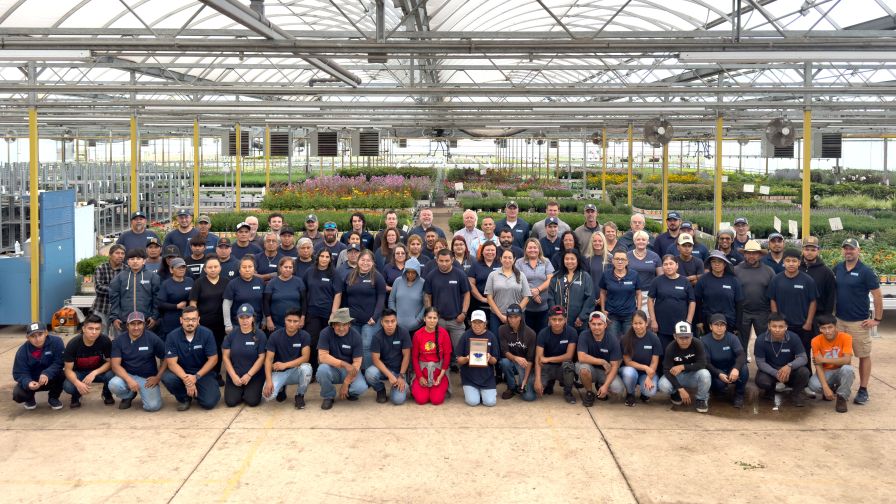
The Hampshire Farms team in Hampshire, IL — the people behind the success recognized in this year’s Operation of the Year award. | Melinda Taschetta-Milane
When Hampshire Farms was announced as Greenhouse Grower’s 2025 Operation of the Year winner during the Evening of Excellence at Cultivate’25, President Fred Wacker says the recognition came as a complete surprise. “It’s a feather in the cap for our whole team,” he says. “Even our merchandisers out in the rain, cold, and heat, they’re just as much a part of this as the people working in the greenhouse every day. We’re tremendously honored.”
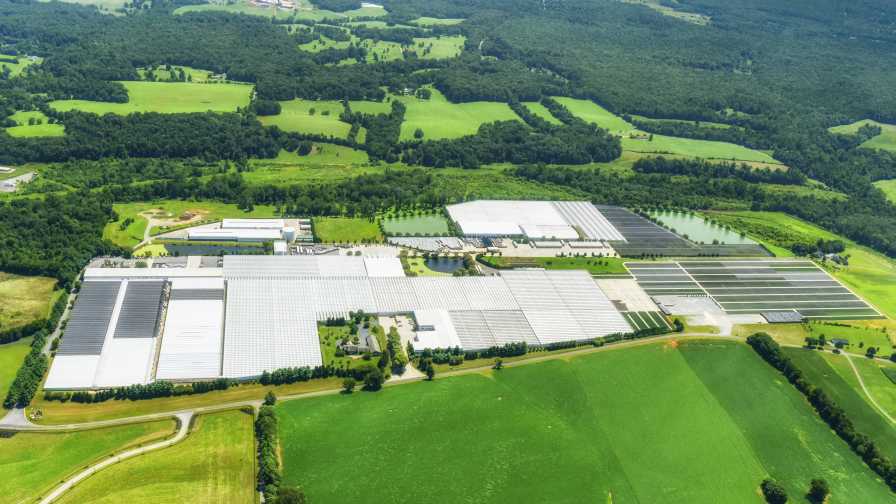
That emphasis on “we” is more than humility; it’s the foundation of how Hampshire Farms operates. Based in Hampshire, IL, the wholesale greenhouse spans 50 acres and nearly 1 million square feet of combined indoor and outdoor production space. About half of that footprint is devoted to greenhouse growing, while the rest supports outdoor production areas and the infrastructure needed to move plants efficiently from propagation to shipping. With this capacity, Hampshire Farms produces more than 3.5 million plants each season, using climate-controlled greenhouses to fine-tune growing conditions for a wide range of crops, from high-quality perennials to houseplants and seasonal holiday décor for Home Depot locations across the Upper Midwest.
Empowering the People Who Power the Plants
For Wacker, every success story at Hampshire Farms begins with its people. “People aren’t on the balance sheet, but they’re the most important asset we have,” he says. They like to think about the company’s organizational chart as drawn like an inverted pyramid — placing frontline staff such as merchandisers, growers, drivers, and crew leaders at the very top. “Management and ownership’s job is to make sure they have everything they need to succeed.”
This commitment to people shows up in the way Hampshire runs its day-to-day operations. Leadership meets regularly to review key metrics, address challenges, and align priorities. Merchandising teams hold weekly meetings to share sell-through rates, product flow updates, and feedback from the field. In the greenhouse, production crews gather with their leaders to track progress, plan next steps, and exchange ideas. Staff input isn’t just heard, it directly shapes decisions, from refining crop mixes to choosing new equipment. “If a change is going to impact their daily work, they should be part of choosing it,” says Vice President of Sales and Merchandising, Bob Whiteside.

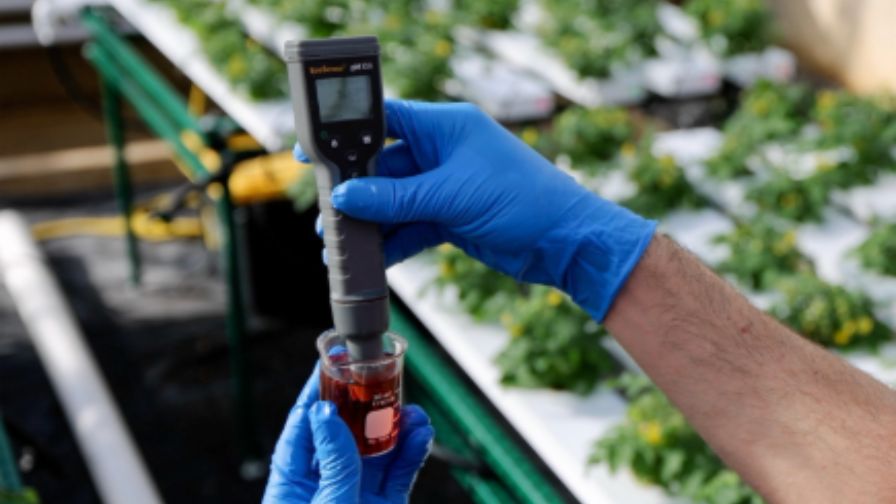
One of Wacker’s favorite reminders of that shared ownership hangs in the lunchroom: a photo from the groundbreaking of their most recent expansion, with crew leaders and team captains holding shovels. “This is their facility,” he says. “They’re the ones who make it all happen.”
Smart, Shared Decisions on Technology and Growth
Hampshire Farms takes a measured but proactive approach to investment. The company recently completed a 2.5-acre climate-controlled expansion, a 10% increase in greenhouse capacity, after first testing the market opportunity with contract growers. “We’re conservative to start, but once we prove the opportunity, we put the hammer down,” says Wacker. Whiteside says they expect the expansion to start paying dividends as soon as next year.
The decision-making process for technology upgrades starts with listening. “We listen to the team and hear what the problems are,” says Matt Fredrickson, Director of Production Operations. “As a management team, we’re constantly seeing what needs to be improved and what challenges are in the way. The best way to implement new technology is to work with the team so they understand the need. That helps them want to implement it.”
Fredrickson believes getting out of the greenhouse is just as important as fine-tuning it. “Touring is a big part of that,” he says. “Everyone in the industry is growing plants, but we all do it somewhat differently. What works for you might not work somewhere else. It’s good to get out there so the staff can get that exposure and get ideas and inspiration. If we can take part of what we’ve seen and integrate it into something we already have, it’s an eye-opening experience for the whole team.”
Whiteside says, “If it’s going to impact their daily work, they should be part of choosing it. Bring the crews into the purchase and implementation. If they’re part of the process all the way through, they really take ownership of it.”
Director of Sales for House Plants, Susan Castellanos, says that technology also helps connect Hampshire’s widely distributed teams. “We manage a very remote staff in the field, and tech allows us to stay connected, even if it’s just using a phone to show us something in real time.” The team also uses Microsoft Power BI for instant access to sales and operational data, helping everyone make timely, informed decisions.
Hampshire categorizes capital expenditure into two buckets: essential replacements to keep the operation modern, and productivity improvements designed to boost efficiency. Fredrickson says, “We spend a lot of time discussing if we need or want something, and we put together detailed spreadsheets — how many plants can we fit in a square foot, what’s the average margin on each size, how many turns can we get a year, and how will that increase our revenue?”
To keep track of facility maintenance, the team utilizes a Computerized Maintenance Management System (CMMS) that catalogs and documents every piece of equipment, tracks assets, and automatically generates work orders for the maintenance department. This proactive system ensures issues are addressed before they become costly problems, helping the team stay ahead rather than reacting to breakdowns.
ROI is measured not just in dollars saved, but in people supported. Labor-saving investments, from improved potting lines and irrigation booms to efficient seeding equipment, allow Hampshire to maintain stable staffing levels while increasing output, a critical advantage in a tight labor market.
Staying Ahead of Consumer Trends
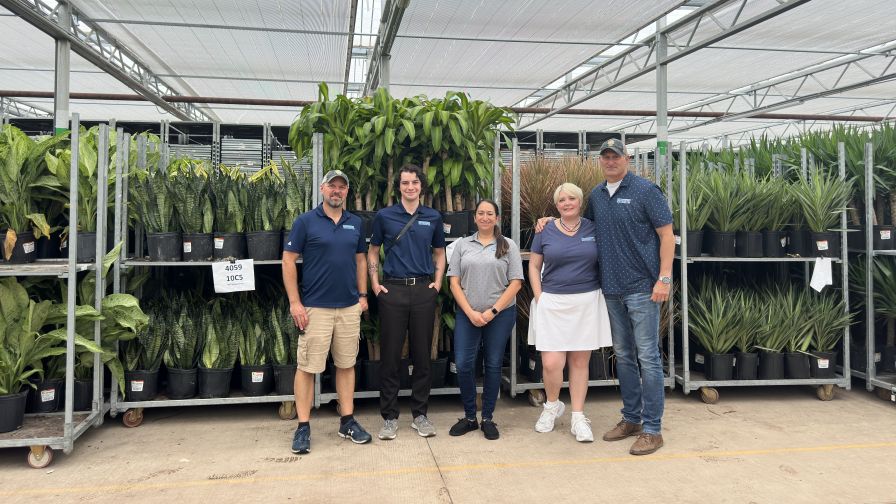
(Left to right) Matt Fredrickson, Director of Production Operations; Lucas Ellis, Sales Coordinator; Susan Castellanos, Director of Sales for House Plants; Livia Glatz, Houseplant Buyer; Bob Whiteside, Vice President of Sales and Merchandising.
Hampshire Farms’ crop mix is constantly evolving, with around 800 SKUs in play at any given time. Decisions on what to trial, expand, or retire are made collaboratively by key team members.
A standout example is Castellanos, who transformed the houseplant program from a small sideline into a powerhouse that now accounts for roughly 40% of the company’s total revenue. By cultivating strong supplier relationships in Canada and Florida, she ensures a steady flow of unique and high-quality varieties. “What we do really well is data collection,” Castellanos says. “We can think we know what customers want, but the SKUs tell us exactly what’s selling. We also pay attention to what’s trending in home décor magazines.”
Her work keeps Hampshire’s houseplant displays fresh year-round in Home Depot stores, appealing to a wide audience of both seasoned collectors and first-time plant buyers. “The behavior of the customer is the same every year; it’s the color that’s always changing,” Castellanos says, highlighting the importance of seasonal freshness and visual impact in driving sales.
On the perennial side, Hampshire takes a design-focused approach, offering a wide palette of colors and textures to create standout displays. Perennials are trialed extensively in real-world Midwest conditions before being rolled out at scale, ensuring that new introductions perform as beautifully in a customer’s garden as they do in the greenhouse. This process helps strike a careful balance between novelty and reliability by introducing exciting new varieties without sacrificing the tried-and-true performers that customers count on. “We’re getting so granular now that we’re putting together product lines by color,” says Whiteside. “How many purple plants do we really need? How many blue? We dissect that information, check out the competition to see if any mixes are similar, and then figure out how to stay ahead. This makes all the difference in terms of satisfying our customers.”
Fredrickson says each potential introduction is evaluated through three lenses:
- Production Benefits: Does it require fewer plant growth regulators (PGRs) or pesticides? Is it easier to transplant, does it have a shorter crop time, or better shelf life?
- Marketability: Will it generate new sales, expand an existing color line, or tie into promotions like Proven Winners’ or Perennial Plant Association’s Plant of the Year?
- Customer Success: Will it perform well in the garden, meet disease resistance expectations, and offer good value for the price?
“We want plants that will make our customers successful,” Fredrickson says. “If they aren’t, they won’t come back.”
Hampshire also benefits from The Home Depot’s robust feedback loop. “They have access to incredible trend data, and they share it with us,” Castellanos says. “That allows us to make decisions based on real numbers.”
Financial Discipline with an Open Book
One of Hampshire’s defining practices is open-book management, which pulls back the curtain on the company’s finances so associates can see and understand the full picture. Each month, financial statements are reviewed by the management team, then discussed openly with staff in a way that connects the numbers to day-to-day operations. “It gives everyone a sense of ownership,” Wacker says. “They understand where the dollars come from and where they go, and how their role impacts both. The fact that our company owners fully embrace the open book philosophy is wonderful.”
This transparency builds trust and accountability, while also empowering associates to make smarter, more informed decisions in their own work areas. For example, when teams see how production efficiencies directly affect profitability, they’re more likely to embrace changes in workflow or invest extra effort in quality control.
Beyond internal reporting, Hampshire recently began participating in Dr. Charlie Hall’s industry benchmarking program, which compares their operational and financial performance to other greenhouse businesses across the country. The data provides a reality check, highlighting strengths as well as areas for improvement. Management can’t see that the benchmarking results are already shaping strategic conversations, from pricing strategies to capital investments, and offering a broader perspective beyond Hampshire’s own numbers. “It keeps us from operating in a bubble,” says Wacker. “We can see where we’re ahead, where we’re behind, and what best practices we can adopt from the wider industry.”
Collaboration and Continuous Learning
Wacker believes the future of horticulture depends on a culture of openness and shared knowledge. “Sharing best practices helps everyone place smarter bets on what’s next,” he says.
Hampshire maintains close working relationships with suppliers, retail partners, and fellow growers, exchanging ideas on everything from crop timing and pest management strategies to merchandising displays and logistics. They actively participate in industry events, trade shows, and grower groups, ensuring that the team is exposed to new technologies, plant varieties, and market insights on a regular basis.
Their willingness to say “yes” to opportunities has opened doors to expansion into new Home Depot markets like St. Louis, the launch of innovative perennial trials, and the implementation of staff-driven solutions that make greenhouse operations more efficient. The team understands that while no single person has all the answers, the collective knowledge of a network can move an entire business forward faster.
Wacker sees this approach as both a business advantage and a moral imperative. “We don’t succeed in a vacuum,” he says. “If the industry thrives, we thrive. The more we collaborate, the stronger we all become.”
Subscribe to eNewsletter