



Finding and Maintaining the Perfect Substrate pH for Your Plants
Substrate pH directly affects nutrient solubility, which determines how available essential nutrients are for plant uptake. Roots can only absorb nutrients that are dissolved in solution, and pH controls whether certain nutrients stay dissolved or form other compounds, making them chemically unavailable for plant uptake. Outside a moderate pH range of roughly 5.5–6.5, some nutrients become too available, leading to toxicity, or not available enough, leading to deficiencies.
However, things aren’t that simple. Substrate pH is dynamic and changes throughout production, as it’s a reflection of the amount of hydrogen ions H+ dissolved in water. When certain chemical reactions take place, for instance, when dissolved alkalis (e.g., carbonate or bicarbonate) are introduced, the hydrogen ions present combine with the alkalis to form water and carbon dioxide. Or to put this chemically:
H+ + HCO3 → H2O + CO2
This type of reaction causes substrate pH to increase or become more basic. Similarly, when certain forms of nitrogen are used as fertilizer, namely ammonium sulfate (NH4)2SO4 or urea CO(NH2)2-based fertilizers, a chemical reaction takes place that causes pH to drift lower. The ammonium is converted to nitrate NO3-releasing hydrogen ions into solution. Chemically speaking:
NH4+ → NO3– + 2H+ + H2O
A chemical reaction also occurs with the sulfate to create sulfuric acid, H2SO4, which further lowers pH.
Problems with pH Extremes
High pH (too basic)
At high pH, generally 6.5–7.0, micronutrients become less soluble and harder for plants to absorb. Most often, iron, manganese, and/or boron become deficient. Petunias provide a classic example of deficiency symptoms and are often touted as iron-inefficient. Even when enough nutrients are present in the substrate, they are inaccessible to the plants, which prefer to grow in more acidic conditions.
Low pH (too acidic)
When substrate pH drops too low, typically below 5.0 for many crops, micronutrients such as iron (Fe), manganese (Mn), zinc (Zn), and boron (B) become more soluble. The classic example of this is with geraniums, also known as iron-efficient plants. They can more easily absorb iron, so when it is available in excess, this can lead to issues with toxicity.
The Goldilocks Zone: What pH is Just Right?
For most greenhouse crops, the goal is to maintain substrate pH in a range where nutrients are available — but not excessive. A general guideline is to target a pH of 5.5–6.5, making adjustments for specific crops that fall into either iron-efficient or iron-inefficient groups. There is no universal pH target, since the ideal pH range is going to be crop-specific.
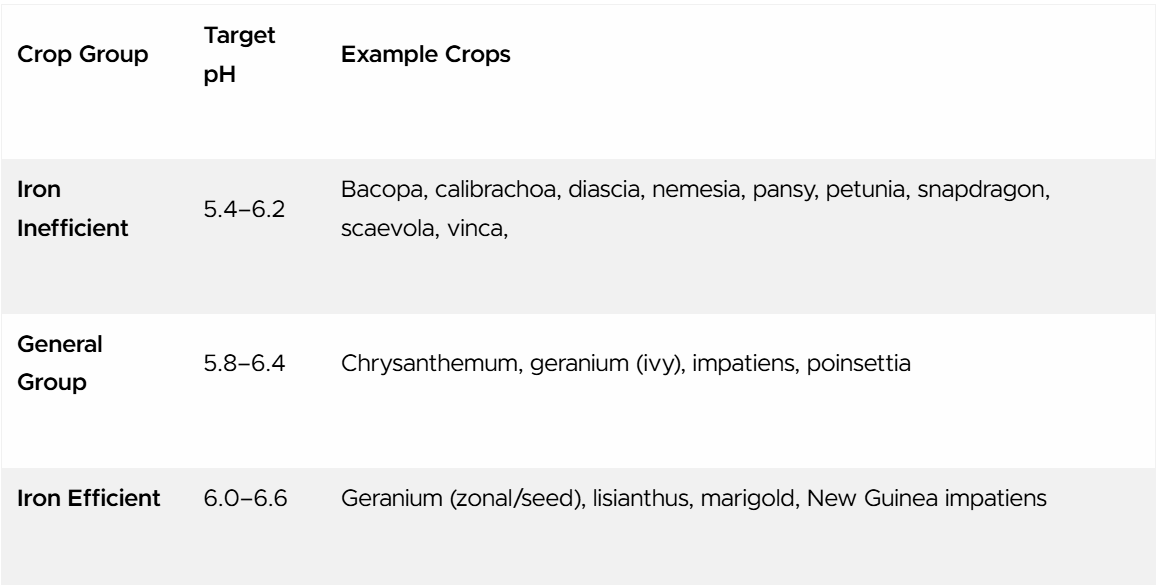
Crop Groups and Target pH Ranges. | MSU Extension
What Do Toxicities and Deficiencies Look Like?
Before you turn to tissue and media testing, you might try to do a visual assessment of your crop to get an idea of the nutritional issue you’re dealing with. You’ll first want to determine if symptoms are appearing on lower leaves or upper leaves since certain deficiencies and toxicities will show up on different parts of the plant. You’ll also need to pay attention to the pattern in which the symptoms appear on the leaves. For instance, is there chlorosis or yellowing that occurs uniformly on the leaves, or only between the veins (interveinal) or on the leaf’s edge (marginal)?

For additional information on getting substrate pH just right, including additional factors that cause pH changes in need of continual monitoring, read the original article from Caitlin Splawski on the Michigan State University Extension website.
Subscribe to eNewsletter