



SustainaGuides Offer Practical Tools to Strengthen Sustainable Production
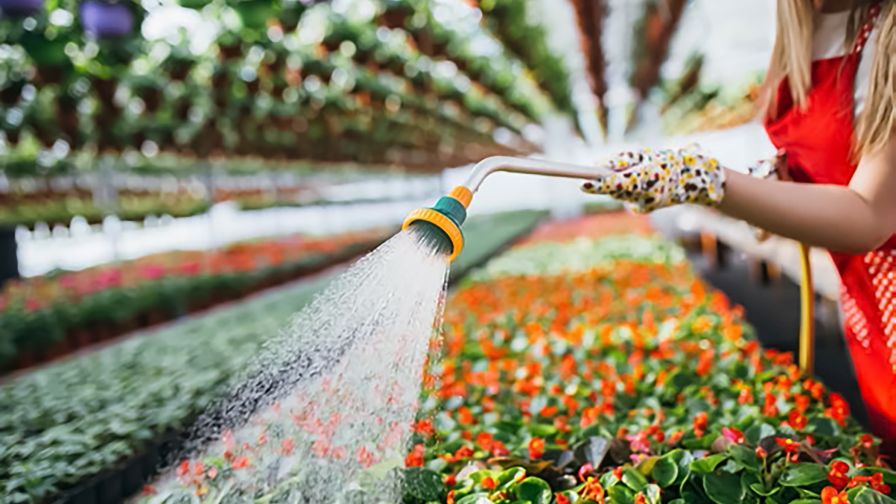
A gardener watering flowers in a greenhouse. | American Floral Endowment
Sustainability is showing up everywhere right now: in buyer conversations, consumer expectations, and long-range planning. But on the production side, the pressure often boils down to a simpler question: What should we do differently this season, and how will we know it’s working?
That gap between big-picture goals and day-to-day decision-making is what American Floral Endowment’s Sustainabloom SustainaGuides aim to close. The guides are designed to be practical, topic-based resources that help greenhouse teams evaluate options, prioritize improvements, and build a clearer plan around sustainability.
Below are examples of four SustainaGuides that address everyday greenhouse priorities:
Each guide is structured to help growers identify practical starting points, understand why the topic matters, and track progress over time.


1. Water Conservation
SustainaGuides frame water conservation as a step-by-step process: assess current practices, prioritize improvements, and implement changes that fit your operation. A practical starting point is tightening existing systems through routine inspection and maintenance to reduce leaks, pressure issues, and other avoidable losses. The guide also emphasizes improving distribution uniformity and matching irrigation strategy to crop needs and growth stage.
From there, the focus shifts to measurement and visibility. Tracking water use by crop or area, adding tools to monitor usage in real time, and identifying inefficiencies can help growers make more confident decisions. Where feasible, the guide also discusses recapture and reuse strategies, including the need for water quality testing, appropriate treatment, and protocols that reduce pathogen risk.
The practical takeaway is that water conservation rarely depends on a single overhaul. Instead, progress typically comes from incremental, measurable improvements that add up over time.
2. Energy Efficiency
Energy is a major and growing expense for greenhouse operations, and efficiency improvements can deliver immediate, measurable results. SustainaGuides position energy efficiency as both an equipment and management issue, with practical attention to maintenance, control settings, structural considerations, and operational scheduling.
The guide encourages growers to start by identifying where energy is being lost or overused. Reviewing heating and ventilation strategies, confirming environmental control settings, improving insulation or energy-saving coverings where appropriate, and maintaining equipment at peak performance can all reduce demand. Even modest adjustments can translate into meaningful savings when scaled across greenhouse square footage and production cycles.
Finally, the guide emphasizes tracking progress over time. Using simple operational metrics, setting goals, and monitoring results helps ensure gains are verified, repeatable, and maintained season after season.
3. Substrates and Growing Media
Substrates are both a sustainability consideration and a production performance variable. As availability and pricing shift, growers are evaluating how to maintain crop quality while reducing reliance on constrained or higher-impact inputs. SustainaGuides position growing media as a sustainability lever because substrate decisions influence irrigation and fertility management and can affect leaching and runoff risk.
The guide encourages fit-for-purpose substrate selection, with attention to key physical properties such as air porosity and water-holding capacity, along with how media choice interacts with irrigation scheduling and nutrient delivery. It also reinforces the value of trials when evaluating alternative components or blends across crop types and container sizes.
Operationally, the guide offers clear starting points: reduce packaging where possible, ask suppliers about sustainability indicators, and explore regionally available options. It also addresses reuse and recycling, noting that recycled media can reduce footprint and inputs, but reuse can change physical properties and increase pest and disease risk if not managed carefully. Strategies such as blending recycled material with new media and building sanitation protocols can help. The guide also points to circular approaches, including partnerships that divert used substrates into reuse, recycling, or composting pathways.
The most sustainable substrate strategy is one that maintains production performance while improving consistency, supply reliability, and overall input efficiency.
4. Nutrient Management
Fertilizer efficiency is a major opportunity because it affects cost control, crop quality, runoff risk, and regulatory exposure. SustainaGuides frame nutrient management as both a production priority and an environmental responsibility, especially when excess nutrients move with water and contribute to runoff and water pollution.
The guide emphasizes precision over habit. It encourages growers to calibrate injectors, verify EC and pH targets, and use testing to guide adjustments instead of relying on fixed recipes. It also reinforces aligning nutrition programs with irrigation strategy, since overwatering and nutrient loss often occur together.
Operationally, the focus is consistency and documentation. Calculating appropriate rates, monitoring performance, keeping clear records of applications and crop response, and training teams help make nutrient decisions repeatable across staff and seasons. The goal is to reduce waste and cost while maintaining strong production outcomes.
Turning Guidance Into Action
One of the strengths of SustainaGuides is their emphasis on implementation. The guides are designed to support day-to-day decision-making, helping growers set priorities, identify near-term improvements, and plan longer-term investments that align with facility constraints and budgets. They also give teams a shared framework, reducing reliance on informal or inconsistent practices.
To put the guides to work quickly, start with one measurable improvement and one process improvement from each topic. For example, quantify water use and formalize irrigation inspection routines; define a simple energy metric and track it consistently; standardize substrate reuse handling; and tighten fertilizer monitoring and recordkeeping. Over time, these small, documented changes make it easier to evaluate ROI, maintain progress, and communicate sustainability efforts with confidence.
Subscribe to eNewsletter