



Growing Media Companies on Best Practices to Maximize Growing Media Use
 November 13, 2025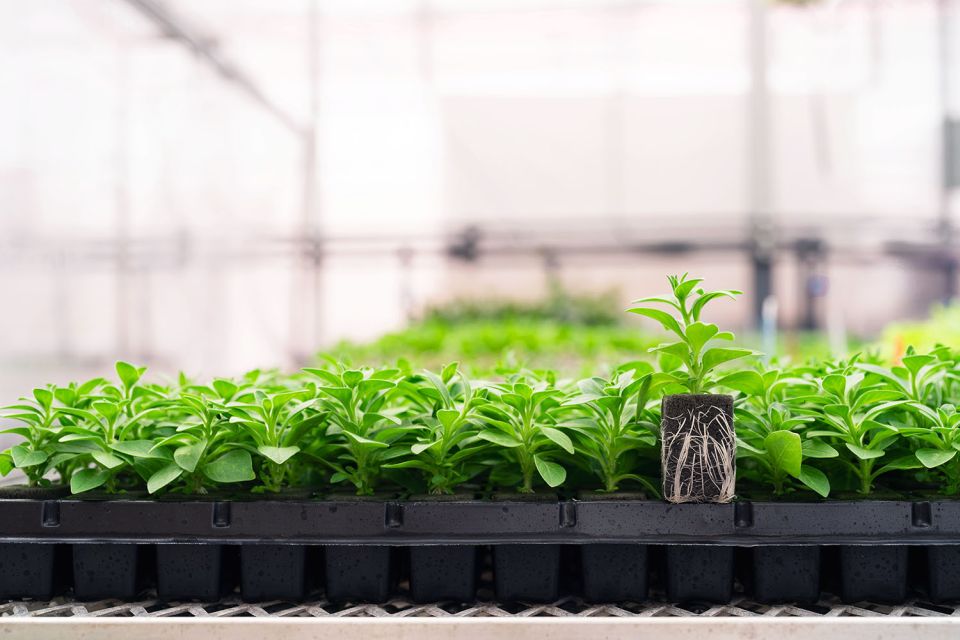
Petunia RhizoPlug Tray | Oasis Grower Solutions
The right growing media can make or break your greenhouse crop. Beyond achieving reliable performance, growers today must also navigate sourcing challenges, material availability, and shifting expectations around sustainability.
We reached out to growing media suppliers to get their perspective on many of these concerns. In this Part 4 of a series of articles, we look at recommendations on how to get the best performance out of your material. You can check out previous parts of the series, covering topics such as the current peat status), potential tariff implications, and factors to consider when weighing peat alternatives, here.
Frederic Gagnon, Agronomist, Lambert Peat Moss: “Don’t use stocks before using up your currently inventory. Also, it’s important to premoisten the mix instead of filling pots with product straight from the bale. Sometimes smaller growing operations don’t know if they have time to add that extra step, but adding moisture should be easy. It will also create less dust, and you can also gain volume and get a better quality of mix. You don’t need big equipment to do this — just add a few extra nozzles.”
Vijay Rapaka, Ph.D., Director of Global Grower Operations and Research, Smithers-Oasis/Oasis Grower Solutions: “Follow the instructions provided by your vendor. As we continue to develop new substrate materials and growing media options expand, this becomes even more important. Following instructions thoroughly can significantly improve your results. In some cases, it may be an extra step up front, but it may be one that pays back again and again. Also, do your due diligence to make sure if you have to adjust or tweak your plant protection and plant growth regulation programs. You have to really watch the interactions. Sometimes you need to do repeated or multiple trials to make sure your performance is there. That’s very critical. Even when you follow the manufacturer guidelines, your crop is still unique. Your production program is unique. Your environment may be unique. So, see how it all fits in. Trialing should always happen constantly.”
Søren Møller Nielsen, Sales Director Americas, Pindstrup: “My best advice is to be open to changes and, when the time comes, do the testing and make adjustments with your growing media. The demand for peat moss and substrates in general keeps increasing, and there will be a much higher degree of alternatives that will be used worldwide.”
Jennifer Neujahr, Senior Director, Global Business Development Horticulture, Profile Products LLC: “My advice includes: pre-conditioning and hydration of compressed substrates to unlock porosity; precise fertigation to match EC/pH targets and crop stage; customizing mixes (peat, coir, wood fiber) to crop sensitivity; and recirculation systems to cut water use by 50% and nutrient use by 60%”
Subscribe to eNewsletter
