



Troubleshooting Greenhouse Crops That Fall Behind

Fruit quality issues can be early indicators of stress—use them as a prompt to check irrigation uniformity, rootzone stability, and climate consistency before making major system changes. | Brandan A. Shur
Most greenhouse growers recognize the moment a crop starts to lag. It’s rarely dramatic at first. Canopy development slows, leaves expand a little more cautiously than expected, and uniformity becomes harder to ignore. Fruiting crops may look slightly stalled in development, with a subtle delay in flowering, set, or sizing. The crop isn’t failing, but it’s no longer tracking to the pace you expect for that time of year and stage of production.
That’s also when troubleshooting can either help quickly or make things worse. In greenhouse production, many of the tools that can correct a problem (irrigation, nutrition, temperature, humidity, and crop load management) can also create new stress when they’re adjusted too aggressively or too frequently. The goal is not to avoid making changes; it’s to make the right change for the right reason, and to preserve cause-and-effect so the response is repeatable.
A practical troubleshooting approach starts with three steps: Define what “behind” means, identify whether the issue is localized or systemic, and verify the basics of delivery before changing strategy.
Define What “Behind” Means in Your Operation
“Behind schedule” can mean different things depending on crop type and market goals. For leafy crops, lagging often shows up as slower canopy closure, lighter head weights at a given age, or a delayed harvest window. For fruiting crops, it may appear as slower truss or node development, delayed flowering, reduced set, or a shift toward smaller fruit size and uneven maturity. In both cases, uniformity is often the earliest warning sign. When a crop is truly falling behind, variability tends to increase before a clear “symptom” appears.
Rather than trying to interpret everything at once, anchor your assessment to one or two indicators that represent progress in your system to ensure the concern is tied to a clear trend instead of a general feeling. Once the lag is defined, the troubleshooting becomes much more focused.
Is the Issue Localized or Systemic?
Before changing fertilizer rates or climate settings, take a short walk with one purpose: Determine whether the slowdown follows a pattern in the space.
If the lag is clustered in certain bays, near end walls, under specific vents or fans, along certain irrigation zones, or in areas that experience different traffic, shade, or temperature behavior, then distribution and microclimate effects rise to the top of the list. Localized issues often trace back to irrigation uniformity, pressure differences, clogged emitters, bench-to-bench variation, edge effects, or pockets of high humidity and low airflow. They can also signal early pest or disease hot spots.
If the lag is broadly consistent across the greenhouse, the cause is more likely systemic: related to overall climate strategy, nutrition delivery, irrigation frequency and volume relative to crop demand, water quality changes, or sensor and control drift. This distinction is one of the most time-saving moves you can make, because it prevents facility-wide corrections to a problem that’s actually confined to a zone, and it prevents chasing a localized “ghost” when the entire system has shifted.
Sort Likely Causes Into a Few Practical Buckets
Once the pattern is clear, it helps to sort the problem into a small set of common limitation types. Many lagging crops are primarily limited by one of these, even if secondary issues are also present.
Rootzone Limitation
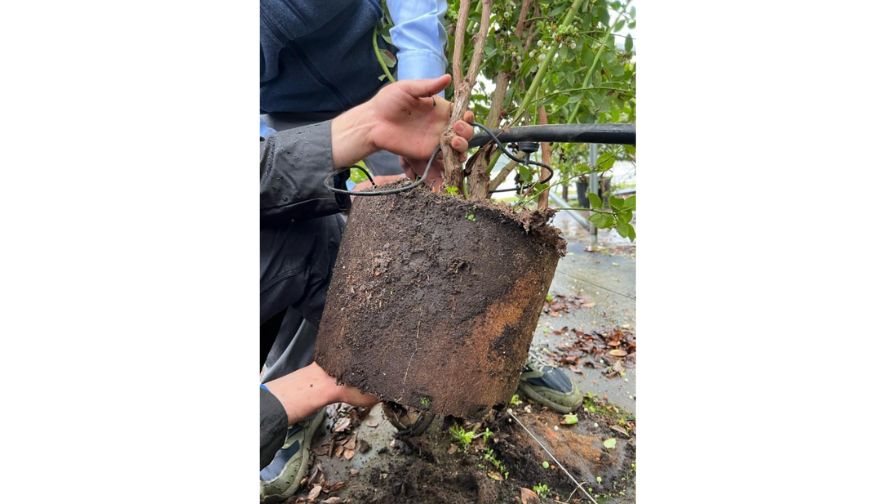
Root and rootzone inspection is one of the fastest ways to determine whether a slowdown is driven by water management, salinity stress, or biological decline. | Brandan A. Shur
In greenhouse produce, a surprising amount of “falling behind” starts below the canopy. Whether plants are in substrate, bags, or soil, root function can be limited by overly wet conditions, excessive dry-back, poor oxygenation, salinity concentration between irrigations, or temperature effects in the rootzone. When roots are not performing well, the crop becomes less responsive to adjustments, and the pace slows even if the recipe and environment look reasonable.
Water Management and Distribution
Sometimes the issue is not the amount of water, but the consistency. Uneven distribution, pressure variability, clogged emitters, or zones that don’t match crop load can create plant-to-plant differences that show up as uneven growth and stalled development. In these cases, the crop may appear behind because part of the house is effectively being managed differently than the rest.
Nutrition Delivery and Availability
It’s tempting to interpret slow growth as a need for more feed. However, nutrient limitation in greenhouses often results from delivery and availability problems rather than insufficient fertilizer in the plan. Mixing errors, injector drift, pH that affects availability, water alkalinity shifts, and accumulation of salts in the rootzone can all create nutrient stress without obvious red flags in the tank. A crop can also be “over-fed” in a way that increases salinity stress and slows development.
Climate Limitations
Even small deviations in temperature patterns, humidity behavior, and airflow can influence crop pace. Many greenhouses can maintain acceptable averages while still creating conditions that suppress growth because of daily swings, stagnant canopy air, persistent humidity, or temperature stratification. Crops respond to what they experience where the leaves are, not necessarily what a single sensor reads.
Biological Pressure
Pest and disease issues often intensify when the crop is stressed by water, rootzone, or climate limitations. The biological problem may not be the first cause, but it can become the dominant cause if it’s not recognized early. This is why scouting and root inspection remain essential when a crop starts to lag.
This categorization is not meant to replace technical diagnosis. It’s meant to keep troubleshooting disciplined, so the response aligns with the most likely limiting factor.
Verify Fundamentals Before Changing Strategy
In greenhouse production, the crop is only as consistent as the systems delivering water, nutrients, and climate control. When a crop slows, it’s worth verifying the basics before making a steering change.
Confirm that irrigation is actually occurring as scheduled and that distribution is uniform. Check for pressure issues, clogged emitters, uneven wetting patterns, and any zones where dry-back is sharper than expected. Verify mixing and injection accuracy if fertigation is used and confirm that pH and EC are within your intended range. If you track runoff, leachate, or soil solution, use those measurements to understand rootzone trends and salt accumulation over time. On the climate side, confirm that sensors are accurate and that airflow is doing what you think it’s doing at the canopy level. A greenhouse can “hit the number” at the sensor while the crop experiences something different.
Many problems that appear to be strategy problems are actually delivery problems. Correcting delivery often improves the crop without a major change to the management plan.
When the First Warning Sign is Fruit Quality
In many greenhouse crops, the first thing that signals a lagging system is not a leaf symptom, but it is a quality shift. Fruit may size unevenly, soften faster, show patchy color development, or develop defects that were not common earlier in the season. It can be tempting to treat the defect itself as the problem, but more often, fruit symptoms are the result of stress that occurred days or even weeks earlier.
That’s why quality issues should be treated as a diagnostic clue, not a diagnosis. When a defect appears, the most useful next step is to look upstream: confirm irrigation uniformity and timing, check whether the rootzone has been cycling too wet or too dry, verify nutrient delivery and pH management, and consider whether recent humidity, temperature, or airflow patterns created stress during critical stages of fruit development. In other words, use the fruit as a record of what the plant experienced, then trace the most likely stress points in water, climate, and root function before making major corrections.
Match Intervention to the Trend, Not the Anxiety
Not every lag requires a strong correction. Short-term slowdowns after spacing changes, weather shifts, or transplant establishment can improve with stable management and closer monitoring. In those situations, maintaining consistency while confirming trends can be the most productive decision.
When the lag is persistent and clearly progressing, aim for a controlled adjustment rather than multiple simultaneous changes. Choose one lever that matches the diagnosis, define what improvement should look like, and give the crop time to respond. This protects you from chasing noise and preserves learning.
If the crop is declining quickly — especially if roots are failing or pest/disease pressure is increasing — the priority shifts from optimization to containment. Targeted action and early escalation often outperform broad, reactive changes.
Avoid the Trap That Compounds Problems
A manageable lag becomes a season-defining problem most often when multiple major variables are changed in quick succession. When irrigation frequency, fertility strength, and climate settings are all adjusted at once, the crop experiences instability, and the team loses clarity on cause and effect.
A useful rule is to avoid changing a major variable unless it’s tied to a clear observation or measurement. When more than one change is unavoidable, separating adjustments in time and documenting intent can reduce unintended consequences and improve decision-making in future cycles.
Putting It Into Practice
When a greenhouse crop starts falling behind, the most productive response is disciplined troubleshooting. Define the lag using one or two clear indicators, determine whether the issue is localized or systemic, verify delivery fundamentals, and make a measured intervention that matches the evidence.
In most greenhouses, stability and consistency do more to restore crop momentum than aggressive steering. The goal is not to react less; it’s to react with clarity so each adjustment is scientifically grounded, operationally practical, and repeatable.

This article was first published on our sister site CEAg World. To read the original article, click here.
Subscribe to eNewsletter