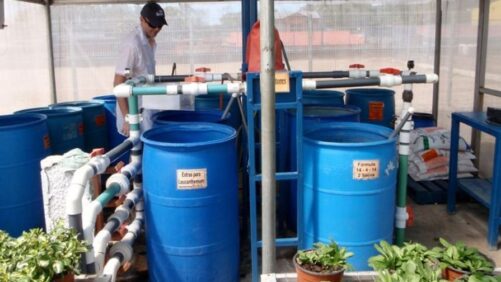
By creating cannabis fertilizers from scratch, commercial growers can decrease their operating costs and enjoy the flexibility of customizing their own nutrient recipes.
“Nutrient Management Level 1” is the second course of the Greenhouse Online Training program offered by the University of Florida.
Experts from Griffin highlight why the choice of fertilizer formulation should be made based on water quality, irrigation equipment and growing media, and type of production system.
Proper plant nutrition is vital to growing a healthy crop, so fertilizer selection should be a key consideration for every cannabis business.
Calcium and magnesium, two secondary plant nutrients, play important roles in plant development and productivity.
Knowing which nutrient combination is right for your soilless or hydroponic system can completely influence your crop growth.
The ever-increasing cost of fertilizer inputs is just one reason why greenhouse growers have found it necessary to take a closer look at their application rates and practices.
Hydroponics represents an opportunity to regulate nutrition in a very precise way, providing opportunities to improve crop quality and yield.
Potassium deficiency of greenhouse cucumbers can be initially observed as chlorosis (yellowing) of the older lower leaf margins.
In the second of a two-part series, learn why cannabis needs adequate nutrients not only for the rapid growth of inflorescences, but also for accumulation.

Designing a hydroponic replenishment solution that matches nutrient supply with plant uptake demands is easier said than done.
Magnesium deficiency symptoms can be tricky to identify, especially late in the growing season.
Learn how cannabis interacts with nutrients naturally, and how you can use those natural principles to guide cannabis nutrition during cultivation.