



European Research Aims to Use Sensors to Manage Fertilizer Waste
 September 24, 2026
 In a modern greenhouse, water draining from beneath the plants is often collected, filtered, treated with UV light, and returned to the plants with a mixture of nutrients, including nitrate, phosphate and magnesium.
Even so, greenhouses periodically discard the water and start again with a fresh mixture. The problem is that existing measurements typically show only the total concentration of dissolved salts in the water. They do not reveal which nutrients are present in excess and which are running low. As a result, water that still contains usable and costly fertilizer may be sent down the drain.
Researchers from the University of Southern Denmark (SDU) and Kiel University hope to change that through a new Danish–German project: NutriCycle. Working with the horticulture industry and Danish water utility VandCenter Syd, they plan to develop an automated sensor system that can measure individual nutrients in greenhouse water.
“Plants take up different nutrients depending on factors such as their variety and stage of growth. Today, growers can see the overall salt concentration in the water, but not exactly what is missing,” says Casper Kunstmann of the Mads Clausen Institute at SDU, who leads the project. “If we can measure the individual nutrients, they could add, for example, phosphate or nitrate instead of discarding the entire mixture.”
A Miniature Laboratory for the Greenhouse
The researchers will develop a compact device that automatically takes and analyses small water samples. SDU will contribute its expertise in microfluidics, which makes it possible to move and examine tiny amounts of liquid on a chip.
Inside the system, small droplets of water will undergo chemical reactions that change their color according to what they contain. Optical sensors developed by Kiel University will then read the colors to determine the concentration of each nutrient.
The aim is to bring these steps together in a robust, relatively inexpensive device that can be connected to existing greenhouse irrigation systems.
“Equipment that can measure the different nutrients already exists, but integrating it can be costly. We want to develop a smaller, more efficient solution from the ground up that is also simple enough to use in the day-to-day running of a greenhouse,” Kunstmann says.
The plan is to connect the system to the digital platform InfoGrow, which is already used to monitor and control greenhouse conditions, including temperature, heating, windows and screens. In time, nutrient levels in the water could become part of the same automated control system.
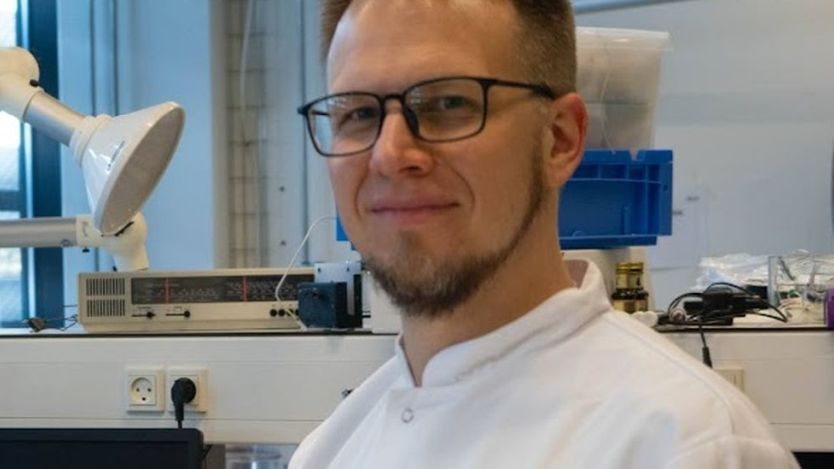
Casper Kunstmann of the Mads Clausen Institute at SDU
Benefits for Growers and the Environment
More precise control could help growers save both water and fertilizer. Unlike crops grown in fields, greenhouse plants are typically supplied with mineral nutrients added directly to the water. That makes it costly to discard a mixture that still contains nutrients.
“The green transition also has to make economic sense for growers. If they can keep water circulating for longer and add only the nutrients the plants actually need, they can save resources and reduce their costs,” Kunstmann says.
The technology could also reduce the amount of nutrients entering wastewater. Excessive amounts of nitrogen and phosphorus can contribute to algal growth and oxygen depletion if they reach rivers, lakes or coastal waters.
This is one reason why VandCenter Syd is taking part in the project. The company will help test the technology for use in wastewater treatment. In the longer term, the partners hope the system could also monitor treated wastewater and help make it possible to reuse more water in agriculture.
Testing in a German Greenhouse
The three-year project is led by the Mads Clausen Institute at SDU. The other partners are Kiel University, VandCenter Syd, the Danish horticultural consultancy HortiAdvice, and the German plant breeding and horticultural company NPZ Innovation.
In the first phase, the researchers will establish how much water and fertilizer is currently lost and develop the measurement method. They will then assemble the technology in a prototype and test it under real conditions at NPZ Innovation in Germany.
“The crucial thing is to develop something that works in a laboratory and can also withstand everyday life in a greenhouse. Growers need to be able to rely on the system without it creating a lot of extra work,” Kunstmann says.
Subscribe to eNewsletter
