


How AI Is Transforming Greenhouse Operations
 May 27, 2025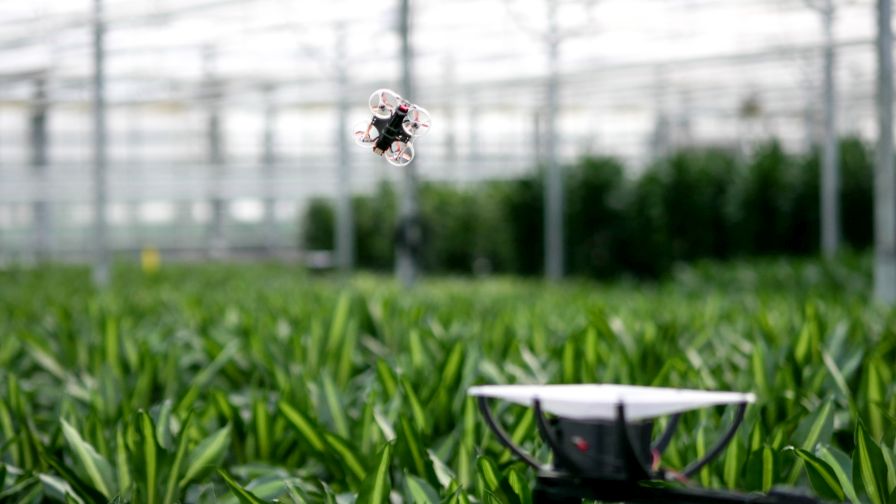
“By sampling a little bit of the airspace, you can tell a lot about the pests that are present. We were able to spot a pest sometimes three generations earlier than can be done with trap scouting efforts.” – Bram Tijmons, CEO and co-founder at PATS Drones. | Daniël Eikelenboom / PATS
Artificial intelligence (AI) technology in agriculture is still in its early stages. Cannabis and leafy green growers were some of the first to adopt it, but the use cases for floriculture are already expanding. Not every AI system is designed to control the physical parameters of the grow house. New applications in pest scouting, yield forecasting, inventory management, and labor optimization are arriving almost daily.
AI in Daily Growing Operations
Like any new tech rollout, it hasn’t been all roses. Challenges exist with data integration, system interoperability, and change management, which is a fancy way to say humans. A long list of movies has taught us to distrust smart machines.
Like many others, Costa Farms has been working with some of the new AI tools, finding what works for them.
“Change management is a key component of it, and that has probably slowed progress a little bit, but we’ve found some gains,” says Chauncy Jordan, Vice President of Innovation at Costa Farms. “AI can automate redundant tasks. Counting and grading, those technologies have been around for a little while, and we’re seeing some gains there.”

With more growers trying AI tech, we asked Will Justis, Lead Software Engineer for Wadsworth Control Systems, about the ROI for these early adopters. Is anyone yet to the point of adding heat with these tools?
“Yes, growers are already seeing a net ROI with AI, whether that’s with advanced control systems, computer vision, or planning tools. But there’s inherent risk involved. AI for all industries is still in early development, and models are constantly being improved,” Justice explains.
Jordan shares his view of the issue: “It’s been key to quantify what’s going to move the needle. For example, if a grower implements a vision-type system, maybe now they don’t have to do germination checks. That’s immediate labor reduction that is quantifiable very quickly. One grower’s business case might be asset utilization. For us, it’s how this affects labor and, in some cases, crop quality.”
Inventory
Jordan and others have mentioned automating inventory as an early adopted task, what some might call low-hanging fruit. It’s often a labor-intensive and error-prone process for many growers, especially in the potted plant and floriculture space.
“The AI can do a better inventory on a plug tray than a human because it’s going to give you individual cell counts back. At scale, counting 72s versus what’s actually there makes a difference. There’s definitely meat on the bone with that. We found more use for it in young plants than finished plants at this point,” Jordan explains.
Inventory management usually requires a walk in the greenhouse, counting and entering data into an app or a clipboard daily or weekly, whatever your frequency is. We asked Jordan, how has that changed now?
“Well, we’re still having to do that to a point. The short-term goal is to be able to take data directly from the AI system into our ERP [Enterprise Resource Planning] system. We’re not there yet, but I’m hoping that’s in the short run.”
Scouting
Costa Farms has been using the scouting capabilities of AI systems to augment its human talent and streamline efforts.
“Whether it can identify the problem based on what it has been taught or, more importantly, which one of these is not like the other — and where the grower needs to go look — from those standpoints, it’s functional,” Jordan says. Sometimes, it identifies the issue; other times, it flags a problem for a grower to go check out. “I would say the biggest thing we’ve noticed is that it’s starting to allow our people to focus on that 20% that we need to.”
Growth Curves and Forecasting
“All that data is starting to come in,” says Jordan. “The question is, what’s actionable, and is it economically viable to act on it?” Growth curves and crop forecasting may provide information that a batch of ornamentals is three days behind, but if you operate on a weekly schedule, it may not be worth acting on. Or, it may be information for a future turn.
“Over time, you’re building growth curves based on historical data and then looking for anomalies within the curves. We’re not there yet. But I think that technology is absolutely accessible. It would give us the knowledge to explore why the production schedule is off. Are we overusing resources or underusing resources from a fertility, heating, or cooling aspect?”
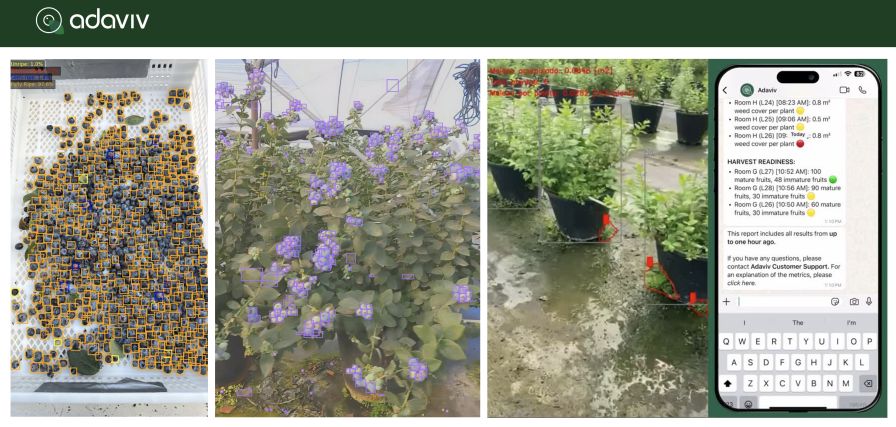
Adaviv’s AI system evaluates harvested blueberry baskets (left), providing real-time feedback on ship-ready fruit to reduce waste and ensure pack quality. In the field (center), mobile vision tools assess flower and berry development to predict harvest readiness and treatment effectiveness. A natural language chatbot (right) delivers these insights to managers and workers, guiding labor allocation and continuous quality improvement. | Adaviv proprietary information. Unauthorized reproduction or disclosure is prohibited.
When AI analyzes computer vision imagery, it can distinguish between different pest species.
“By sampling a little bit of the airspace, you can tell a lot about the pests that are present. We were able to spot a pest sometimes three generations earlier than can be done with trap scouting efforts,” says Bram Tijmons, CEO and co-founder at PATS Drones. The system monitors the airspace rather than plant surfaces, using sophisticated cameras and AI to track flying insects. It can distinguish between different moth species based on size, flight patterns, and wing beats while accounting for geographical location and crop type.
Adaviv has been developing systems to make working in the greenhouse more efficient. “What we try to do is make the tech simple and agnostic to the crop,” says Ian Seiferling, CEO and co-founder at Adaviv. “We’re building a continuous improvement process, like a lean agent for the farm, specifically the cultivation side. In essence, we help growers standardize quality measurements with computer vision mobile apps and software we build. The concept is, how do we drive continuous improvement and reduce waste in the processes for these farms?”
Mobile phones are used to gather images for analysis by AI to provide insights on pests, weed pressure, and yield forecasting. A worker in the greenhouse pulls their phone out, logs into the app, snaps three pictures, and it gets uploaded to the data feed for the system.
“That’s a feature I think has a direct application for floriculture. We provide growers a platform to digitize their plant health program. In weeding, for example, we’ll help them assess the weed pressure throughout the farm, and then we help them allocate the labor,” Seiferling says.
“We use computer vision to track and measure quality metrics that are very subjective and make them objective and scalable, then generate insights about where your labor needs to be.” Seiferling explains that he views the power of AI, in that sense, is in making those insights more on demand, as opposed to a grower having to navigate a complicated dashboard and look at a bunch of reports. “You can now ask the system, what’s my top priority today?”
Computer vision is no longer new in many greenhouses, but using AI to analyze the data gathered across the greenhouse and predictively make adjustments is still pretty cutting edge. Justis helps to lay out how AI solutions are transforming many areas of greenhouse operations: “One prominent area for AI is irrigation — precisely controlling how frequently to water specific growing zones to prevent exhausting water pressure or supply tanks.”
Justis explains that AI solutions have greater potential value in optimizing larger systems with complex variables. “At the high end, computer vision is making its way into greenhouses to reduce human error. Cameras are being placed on individual plants, set up to look at groups of plants, or even put on wire systems to move from plant to plant. This vision data is used to inspect overall plant health, detect early signs of pests and diseases, adjust nutrient schedules, and forecast the optimal harvest time.”
Subscribe to eNewsletter