



The Evolving State of Sustainability through MPS Certification
 June 15, 2024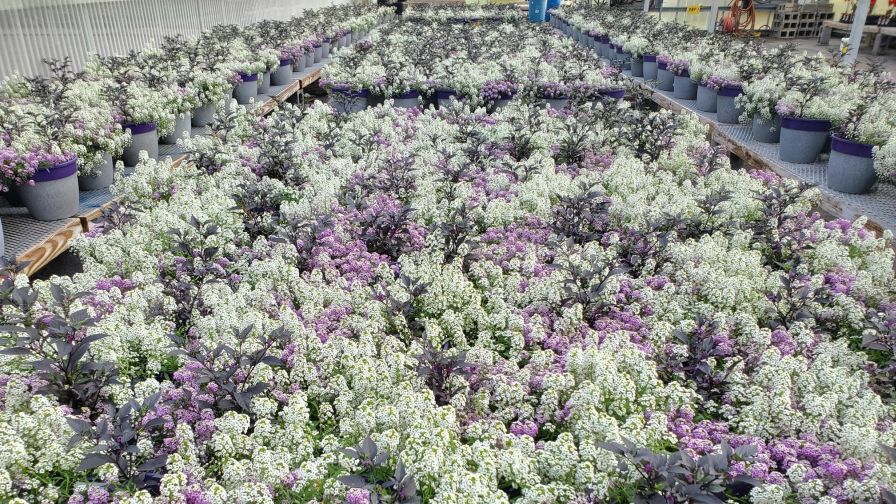
Banker plants at Costa Farms offer a home and food source to beneficial insects. | Costa Farms
Editor’s note: This is the fourth installment of a four-part series on MPS certification and sustainability. Find the third installment here.
MPS has been making strides in sustainability for 30 years. It originated in Europe and caught on quickly. Many growers have found the benefits of MPS certification, ranging from improving their bottom line to using environmentally-friendly products to promoting their sustainable practices to retailers and consumers. MPS is newer to the U.S., and D.S. Cole Growers in Loudon, NH, was the first to give it a go.
D.S. Cole Growers Shapes MPS in the U.S.
Doug Cole, President of D.S. Cole Growers, says the company joined MPS in 2009. He learned about MPS from his trips to Europe, where MPS originated. While Cole was president of the Ohio Floricultural Association (OFA), MPS approached the board to see if OFA would be interested in working with MPS. Cole decided to be a guinea pig and take on the program at his own operation.
In the beginning, Cole says it was challenging to receive a high rating from MPS, such as an A, because his operation works in propagation. In comparison with pot plant growers, it looked like propagators were using a lot of heat, but it was clearly required for that stage in a young plant’s life.
A similar situation came up with pesticides, according to Cole. His operation may have to spray for pests, such as thrips and mites, on every crop going out the door. In the case of liners, some crops are going out every four to six weeks. When compared to a begonia grower, noting that begonias are a 12-week crop, Cole says it looked like his operation would use more pesticides.
“There was no one else in the U.S. to compare us to, so it wasn’t apples to apples,” says Cole. D.S. Cole Growers is proud to be the first MPS-certified grower in the U.S., and their feedback helped shape some of the guidelines that U.S. growers are following now.
Costa Farms Shapes Benchmarks for South Florida
Cesar Martinez, Senior Director of Environment, Health, and Safety at Costa Farms in Miami, FL, says the company was the first MPS-certified grower in South Florida. For this reason, the operation has worked with MPS to benchmark certain environmental conditions unique to South Florida.
“We’ve been helping MPS develop its model for the environmental conditions for this region of the country,” says Martinez. “Even in the mid-Atlantic states — we have a perennials farm in South Carolina that grows year-round. In some regions, perennials are not grown at all in certain months.”
Environmental and Sustainability Manager Maria Giudici says Costa Farms follows the MPS guidelines, but also brings up new ideas from its point of view. For example, Costa Farms holds eight MPS certifications — one for each site. This gives Costa Farms the unique opportunity to compare MPS insights across various locations.
“Understanding the MPS standard was critical in making this work for us,” says Giudici. “There was some ambiguity in the beginning. We weren’t seeing much improvement. Now, the team is using MPS reports as a tool. We try to figure out which chemical is driving these scores, and start chipping away to lower that chemical use.”
Giudici says Costa Farms started out reporting data every four weeks. However, she found that the billing cycle for utilities did not align with the MPS reporting tool. In order to avoid reporting the same utility bill in more than one cycle, Costa Farms started reporting its data monthly instead.
MPS Evolves for the Future of Sustainability
Maik Mandemaker, Area Manager for MPS, says there is now an option to join MPS without becoming certified. Some growers see certification as too big of a jump into sustainability, so this gives growers an alternative to dip their toes in and see how their operation stacks up compared to MPS benchmarks.
“We are trying to have a product available for every grower, no matter how far they are into their sustainability journey,” he says. “That’s what we’re doing for growers who are facing difficult market conditions, but they are still intrinsically motivated to be sustainable and benchmark their data without certification.”
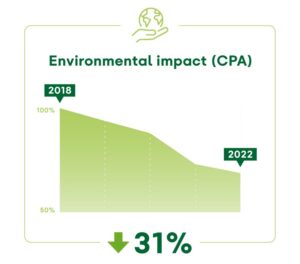
This graph, based on verified data from MPS-certified growers, shows that there has been a 31% decrease in the use of crop protection agents from 2018 to 2022 | MPS
Mandemaker says MPS is looking at two goals in the near future. First, it is focusing on the return on investment (ROI) for growers — not just from a sustainability standpoint, but also from a financial perspective. As MPS gathers more data to link the reduction of crop protection products to better margins, for example, growers will see more benefits to certification.
Second, MPS is part of the Floriculture Sustainability Initiative (FSI). FSI is working to reach a goal of 90% sustainably produced and traded flowers and plants in the EU, including exporting countries, Mandemaker says. This initiative offers various certifications for environmental practices, good agricultural practices, and social sustainability.
“This makes it even more attractive for growers to meet minimal sustainability requirements,” Mandemaker says.
Frank Lammers, Regional Coordinator North America, says MPS collects a lot of data. The organization is working on extracting more useful information for growers to make it easily accessible.
“We don’t want to make things more complex. Growers should be able to get more out of it,” says Lammers. “Besides providing certification, transparency, and audits, this is an important role that we see.”
The most common certification, MPS-ABC, is a relative comparison — comparing apples to apples. Mandemaker says MPS sees an increasing demand from the EU and African growers for an absolute score.
“That means that throughout the chain, people would be able to compare different kinds of crops to each other,” he says. “With the current MPS-ABC system, that is not part of the calculation, but it would theoretically be possible to make an absolute comparison.”
MPS offers MPS-ABC as a relative score to reach the largest group possible, according to Mandemaker. MPS does not want to exclude growers with crops that require higher energy usage or more crop protection products. However, in several years, MPS may offer benchmarking tools as an absolute rating due to increased demand for such a tool from growers.
Sustainability has come a long way over the years. Many growers have incorporated biologicals into their integrated pest management (IPM) programs, they have switched to more energy-efficient boilers, and they recycle plastic and cardboard at their operations.
If growers keep making small improvements over time, the horticulture industry will continue to make great strides. MPS is here as a support system as growers begin their sustainability journey. With measured data to review and a network of other growers to consult, the green industry could always be a little bit greener.
Subscribe to eNewsletter