




Mycorrhizal Fungi Return on Investment: Nutrients
At the beginning of every growing year, growing operations set goals for improving the next season. Many of these operational goals are centered around production efficiency. Every grower wants to get better value for every production input cost. Fertilizer usage is an important production input cost that needs to be appropriately managed to maximize operational profitability.
Return on Investment (ROI) is an important financial tool growers can use to determine the value of each production input. This article aims to help greenhouses and nurseries determine the ROI from mycorrhizal fungi use, and its positive influence in helping your operation be more efficient in its use of fertilizers, leading to increased profitability.
What do Mycorrhizal Fungi Do?
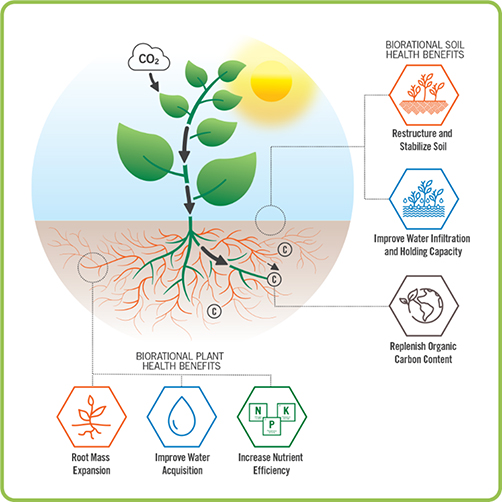
Mycorrhizal fungi are fascinating microbes that form a symbiotic relationship with plant roots. They seek out water, nutrients, and other resources that would otherwise be unavailable or difficult for the plant to access. Their primary goal is to connect to the plant’s roots and then send hyphae into the soil to expand the plant’s root mass and increase nutrient and water absorption. They do this in exchange for the plant’s excess carbon and sugars.
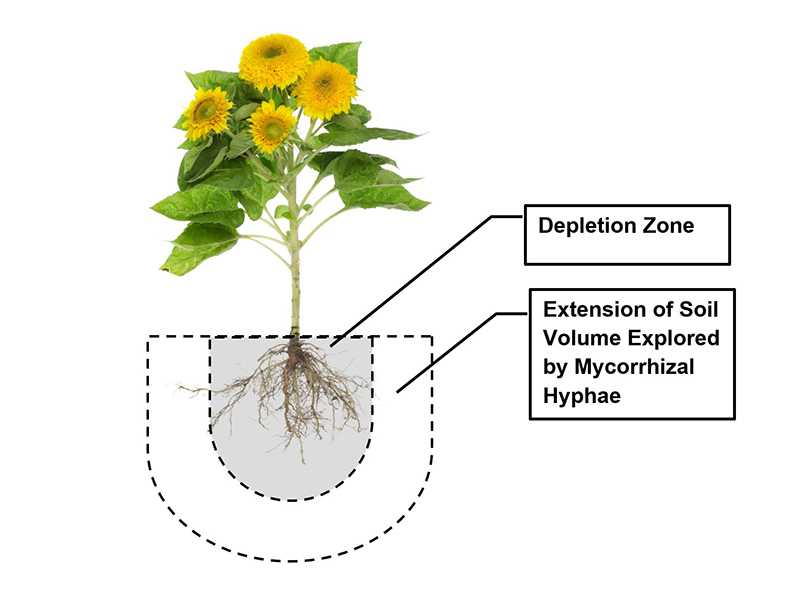
The hyphal network extends both beyond the current root’s area of influence as well as in areas within the current root’s volumetric area, but are not accessible by the roots themselves. Over time, the mycorrhizae impacted root mass can expand up to 50 times the original root mass. This can mean an extension of up to 2 feet beyond the dripline for plants grown in the landscape or as B&B nursery plants. Mycorrhizae also capture more nutrients and water within the existing root zone. The increased absorptive area is difficult for most of us to image unless we see it in a 3-D root image. You cannot always see mycorrhizal fungi when you “pop” a plant out of a pot.
An important thing to note is that mycorrhizal hyphae are better than roots at absorption. Nutrients and water can be absorbed along the entire length of the hyphae compared with just the tip for roots and root hairs. On top of that, mineral nutrient uptake through hyphae can come from both the soluble and insoluble pools of nutrients. Mycorrhizal hyphae allow for greater inflows through their system to ensure uptake efficiency. Plants with mycorrhizal relationships develop better root absorption systems that benefit the plant.
Check out this “How It Works” video, which provides a visual explanation of how mycorrhizal fungi work and how they can improve your fertilizer use efficiency.
Improved Fertilizer Use Efficiency
The development of the expanded root mass helps plants to be more efficient at the uptake of nutrients. Mycorrhizae can store nutrients during times of excess and make them available during times of need by the plant. Since the long-term livelihood of the mycorrhizal fungi is linked to the long-term livelihood of the plant, the mycorrhizal fungi will act as a nutrient buffer, moderating the supply of nutrients available to the plant, and releasing them when needed.
In addition, mycorrhizal fungi can reduce the stress of high EC conditions or water. One of the more valued traits of mycorrhizal fungi is their ability to find and modify nutrients found in the soil and transform them into a form the plant can use. Mycorrhizae can accomplish this task alone or with beneficial bacteria. Many nutrients become unavailable once they are applied to a growing mix. Mycorrhizae can transform locked-up nutrients and less available organic nutrients into forms the plant can readily use.
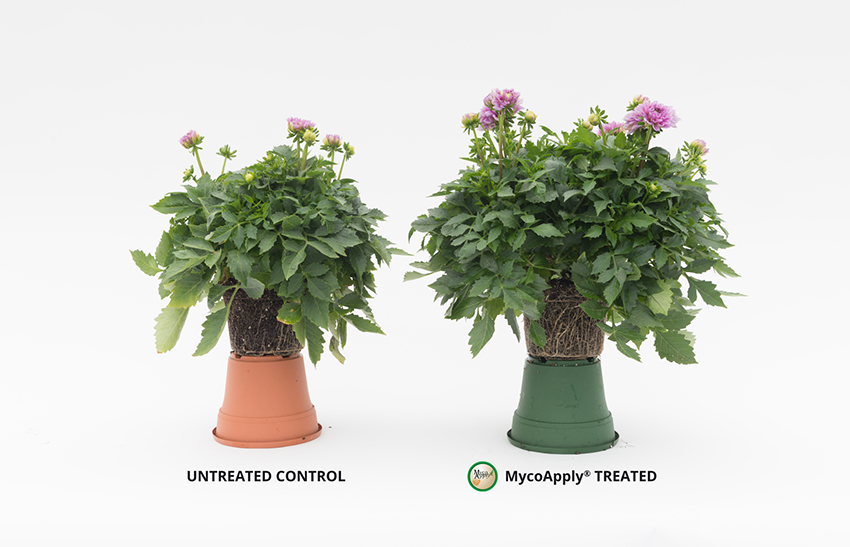
Mycorrhizae allows plants to better access and utilization of fertilizer. You get greater value for the applied nutrients and access to those in your mineral soil. This concept applies whether you feed with soluble water, controlled release, or organic nutrients. As an important note, Nitrogen & Phosphorus runoff is also reduced because the plant utilizes more of what you apply.
Nutrient Use Efficiency Example (with the math to go with it)
Suppose a grower is growing/purchasing 1,000 seventy-two cell propagation trays. This same grower is using MycoApply Injector Endo Organic. Each 100-gram bag of MycoApply Injector Endo Organic produces 500 gallons of drench when used at the suggested dilution rate. Each one hundred gallons drenches approximately 330-335 seventy-two cell propagation trays. The grower would need to use three scoops (60 grams) of one bag of MycoApply Injector Endo Organic to drench the one thousand seventy-two cell propagation trays.
The material costs to treat a tray would be less than a dollar to treat a seventy-two-cell propagation tray. The cost per plant would be less than $0.003 per plant or $0.009 per 10” basket. That is less than a penny per basket. This example works for both a self-propagator and a grower that purchases plugs and drenches them before they are planted into the baskets.
Take a look at this crop-specific example:
| Crop | Calibrachoa in 10-inch baskets |
| Crop Duration | 10 weeks |
| Planting | 3 liner plants per basket |
| Crop Time | Ten-week crop |
| Fertilization Rate | 200 ppm constant feed |
| Average Water Applications Rate | 0.35 gallons per basket per day |
| Fertilizer of Choice | 20-10-20 |
| Application Rate | 1:100, 13.4 ounces of fertilizer per gallon of stock |
| Estimated Fertilizer Cost | $60 per twenty-five-pound bag |
Calculations:
- Fertilizer usage per basket over the entire crop time (70 days x 0.35 gallons per day) 24.5 gallons per 10-inch basket per 10-week crop time.
- Cost to treat 100 gallons of fertilizer: (13.4 ounces per 1 gallon of stock per 100 gallons of final product/400 ounces per 25 lbs.) *$60 per 25 lb. bag, $2.01 per 100 gallons of fertilizer.
- Material cost to treat a basket over the entire crop (24.5 gallons/100 gallons) X ($2.01 per 100 gallons): $0.49245.
- Breakeven Point: 1.8% fertilizer reduction: $0.0088, approximately equal to the cost of MycoApply mycorrhizae application, $0.009 per 3 plants per 10” basket.
Conclusion: The use of mycorrhizae can increase your fertilizer use efficiency. If your nutrient use efficiency is more than 1.8%, based on fertilizer cost alone, a grower saves money using MycoApply mycorrhizal fungi.
These numbers were developed for illustration purposes. Your operations numbers will vary (particularly the volume of fertigation you apply). Historically, growers can improve their fertilizer use efficiency by 5-20 percent (depending on crops, cultural practices, and crop time) compared to when the grower does not use MycoApply mycorrhizae. We suggest you compare tissue analyses of treated and untreated plants to ensure your plants are getting sufficient nutrition.
Beyond Fertilizer Use Efficiency
The use of MycoApply mycorrhizae can go beyond increased fertilizer use efficiency; it can also improve the plant’s overall health, water use efficiency, and stress tolerance. There can even be labor savings involved. Check out the Mycorrhizal Applications blog to discover more in a series of articles on Mycorrhizae ROI.
Next Steps: Set Up a MycoApply Trial
Understanding the role of Mycorrhizal Fungi in your operation is crucial. A well-planned MycoApply mycorrhizal fungi trial is the best way to confirm this example will work in your operation. Increased profitability could be in your future when you partner with MycoApply mycorrhizae.
When you are ready to set up a trial or if you have questions about anything covered in this article, please get in touch with your local Mycorrhizal Applications Representative. Or contact us by calling 866-476-7800 or emailing us at [email protected].
Article written by Blair Busenbark, Key Accounts Manager, [email protected]
Mycorrhizal Applications