



Biochar Effects on Plant Disease
 November 20, 2025
 Note: This is the third of a four-part series on biochar. You can find the first two parts of the series here.
Have you ever checked your plants and found brown/yellow/white, soft tissue spots either on roots, stems, or foliage? Those non-green spots symptoms indicate plant disease. The definitions of plant diseases can be broadly classified according to the nature of their primary causal agents, either infectious or noninfectious. Infectious plant diseases are caused by a pathogenic organism such as a fungus, bacterium, virus, or nematode. Infectious plant diseases can spread from plant to plant and may infect all types of plant tissues. Noninfectious plant disorder is not caused by living agents but by environmental conditions such as nutritional deficiencies, salt injury, sun scorch, or ice damage. Noninfectious plant disease cannot spread from plant to plant (Shurtleff et al. 2022).
How do pathogens infect plants, and how do diseases develop? A pathogen is a type of microorganism that enters plants and interferes plant growth. For a disease to occur, we need an environment favor pathogen growth, a susceptible host plant, and a virulent pathogen (Graber et al. 2014). In any given soil sample, there are two types of microorganisms: pathogenic microorganisms (“bad guys”) and beneficial microorganisms (“good guys”). These microorganisms maintain a balanced relationship under normal conditions. Once the environment favors the “bad guys”, they can outgrow the “good guys”. Under this situation, where the environment is favor for the pathogen, the pathogen is virulent, if the plant is susceptible to the pathogen, then the plant disease may start to develop.
Biochar and Plant Disease
As mentioned before, every element in the disease triangle needs to be present for disease to occur. Therefore, any interference in the disease triangle could affect disease development.
How does biochar play a role in plant-disease system? Briefly, before the pathogen infects the plants, biochar can improve plant growth by increasing water and nutrient uptake; a healthier plant is less easy to be attacked. On the other hand, after the pathogen infects the plants, biochar can absorb the toxins, enzymes, and other compound produced by pathogens, reducing the infection.
Certain types of biochar could contain chemical compounds, which is bad for pathogen growth. When incorporating this biochar into the substrate, the growth environment become toxic to pathogens, so they cannot grow well enough to attack plants. For instance, eucalyptus biochar water extracts were found to inhibit Pythium growth in petri dish. This finding indicates that substrate containing certain chemical extracts can impede plant infection by inhibiting the growth of Pythium (Bonanomi et al. 2015). After a pathogen infects a plant, biochar’s porous structure can absorb the toxins, enzymes, and other compounds produced by pathogens, making pathogens less virulent to attack plants. As we discussed in the previous article, many types of biochar can improve plant growth, making the host plant stronger to fight against pathogen, thus reduced disease occurrence.
Some studies have shown that incorporating biochar can suppress plant disease. For instance, amending 30% softwood bark biochar produced from 475°C in the substrate reduced disease development. In addition, mixing 3% of pine biochar produced from 550-600°C reduced the pepper blight caused by Phytophthora capcisi (Gravel et al. 2013). Reports indicate that biochar influences other plant diseases, such as asparagus root rot, tomato bacterial wilt, red oak and red maple seedings stem canker, and strawberry gray mold caused by different pathogens. Biochar’s effect on plant-disease systems has been summarized in the table below.
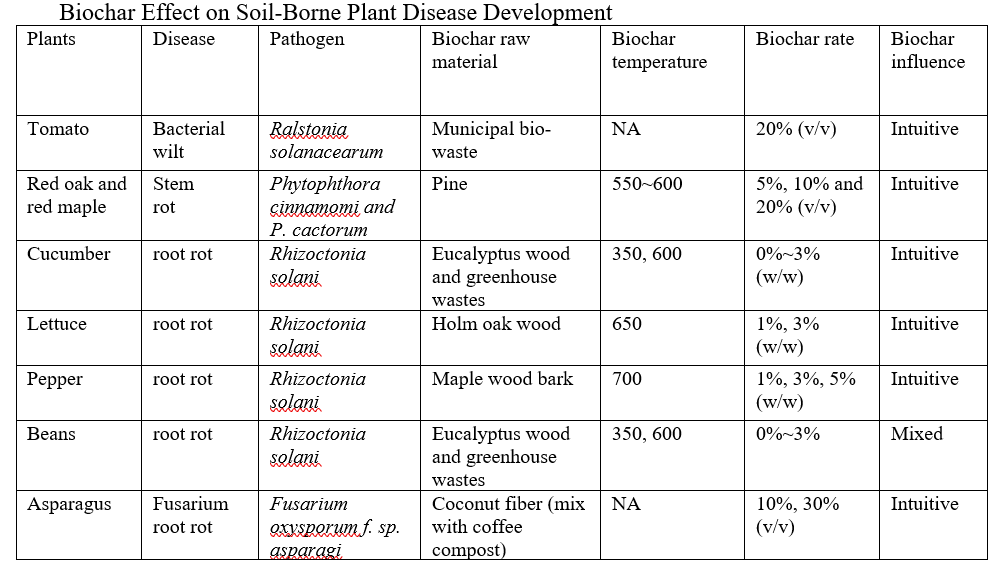
We must remember that every biochar is different. Among the studies listed in the table, most of them used low biochar rates (0-5%) and the highest rate was 30% (by vol.). Also, the field of biochar-plant disease research is small. More greenhouse research needs to be done on this topic for the following reasons: 1) the humid and warm environment could favor a lot of pathogenic organisms; 2) the mono-cultivation could make the plants more susceptible to pathogens; and 3) the pathogens are resistant to fungicides, pesticides, and bactericides.
How to Measure Biochar Influence on Disease
So how did we measure the impact of biochar on plant disease? Biochar influence on plant disease was measured according to the following parameters: 1) when the first symptom appears; 2) percentage of diseased plants, and 3) disease severity. For a biochar-disease system, biochar alone may not be capable of stopping the disease, but it may delay the symptoms’ appearance time. For instance, from our previous trial, adding mixed hardwood biochar delayed the first symptom of poinsettia root rot by five days. Also, adding biochar may reduce disease incidence (the total number of plants to get diseased). Assuming you have 100 poinsettia plants, without biochar, 40 poinsettia plants may develop poinsettia root rot disease (disease incidence 40%). With biochar, the pathogen may only infect five poinsettia plant (disease incidence 5%), which means biochar reduced the disease incidence by 35%. The same principle applies to disease severity. Imagine that a poinsettia without biochar becomes infected and develops a 5 mm-diameter rotten spot and, comparing to the ones that added biochar, which reduced the pathogen infection, the diameter of the rotten spot might be only 1 mm instead of 5 mm without biochar. This is also a sign of intuitive effect.
References:
- Bonanomi G, Ippolito F, Scala F, 2015. A”black” future for plant pathology? Biochar as a new soil amendment for controlling plant diseases. Journal of Plant Pathology, 97.
- Graber, E., et al., How may biochar influence severity of diseases caused by soilborne pathogens? Carbon Management, 2014. 5(2): p. 169-183.
- Gravel, V., M. Dorais, and C. Ménard, Organic potted plants amended with biochar: its effect on growth and Pythium colonization. Canadian Journal of Plant Science, 2013. 93(6): p. 1217-1227.
- Shurtleff, M.C., Pelczar, M, J., Kelman, A., and Pelczar, R. M. Plant disease. https://www.britannica.com/science/plant-disease, accessed on Nov. 8, 2022.
Subscribe to eNewsletter