



Paths to Growth: A Measured Approach to Growth with Karin Walters
 May 15, 2026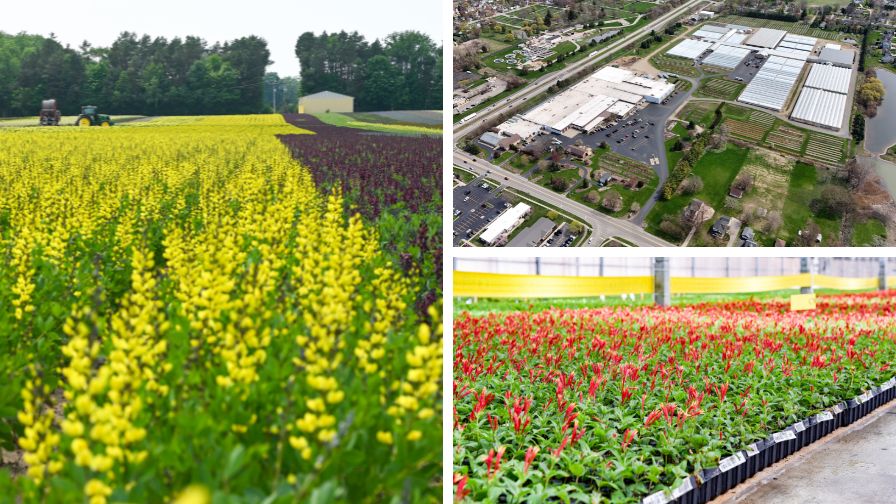
(Clockwise from left) Baptisia grows in the field at Walters Gardens, an aerial view of Walters Gardens in Zeeland, MI, and Spigelia ‘Little Redhead’ in production trays at Walters Gardens. | Walters Gardens
As floriculture businesses adapt to shifting consumer preferences, labor realities, and long-term expansion goals, leadership strategy matters more than ever. At No. 73 Walters Gardens on Greenhouse Grower’s 2026 Top 100 Growers list, Karin Walters of Walters Gardens is helping guide her family business forward.
A Measured Approach to Growth
Karin Walters is helping lead Walters Gardens through a new phase of growth with a strategy rooted in long-term flexibility, operational efficiency, and a disciplined approach to automation. Since stepping into leadership with her sister and cousin in 2022, Walters has been part of the executive team guiding the family business through its next chapter.
That next phase is supported in part by a second greenhouse facility, added about five years ago, just south of the company’s headquarters in Zeeland, MI. Walters Gardens, a major wholesale perennial producer and the primary breeder and grower for the Proven Winners Perennials brand, operates 20 acres of greenhouse space and 1,500 acres of field space. Walters says the additional greenhouse gives the company both room to grow and infrastructure designed for long-term efficiency.
“We’re ready to grow,” she says. “We have 4 acres of greenhouse on there now, but we have the capacity to have 20 acres, and we built this to be efficient.”
That emphasis on efficiency also shapes how Walters Gardens approaches automation. Rather than rushing to adopt new equipment, Walters says the company prefers what she describes as “patient adoption,” waiting until technologies have proven themselves before making major investments.
Unlike growers focused on monocrops, Walters Gardens manages an extensive range of species and plant sizes, which makes some specialized automation harder to apply across the board. Walters points to equipment such as the TTA Flex Sorter, which the company uses only in limited capacity because of the varied dimensions within its perennial catalog.
“We wrestle with the question of changing how we do things to fit automation or waiting for automation to fit how we do things here,” she says.
In the meantime, Walters says the company remains focused on being a reliable one-stop source for perennials, prioritizing a stable, high-quality labor force over technology that does not clearly improve the business.
“The bottom line is that an innovative technology must make sense for us in terms of cost, efficiency, and productivity,” Walters says. “And if it doesn’t, then we need to move on.”
Subscribe to eNewsletter