




It’s Time to Wise Up About Water Use
 July 30, 2026
Growers who recycle water need to be aware of potential contaminants or pollutants that can affect water quality. | Pacific Plug & Liner
Water management is no longer just a question of when to irrigate or how much water to apply. For greenhouse and nursery growers, water availability, water quality, fertilizer efficiency, and environmental conditions are increasingly connected.
Drought, municipal restrictions, high-alkalinity well water, runoff concerns, and recycled-water quality issues are all forcing growers to take a closer look at how water moves through their operations. At the same time, irrigation decisions can influence crop quality, finish time, fertilizer use, disease pressure, and shelf life.
That means improving water use is not simply about cutting back. It is about delivering water and nutrients more precisely, reducing waste, and protecting crop performance.
“Growers, especially in Florida and Georgia this year, have been dealing with drought conditions, which are having an impact on groundwater and increasing water restrictions depending on the municipality,” says Harrison Meekins, Grower Specialist, Southeast, at Sun Gro Horticulture.
Water sourcing can be affected by both availability and management options. Growers using city water may face municipal limits, while those relying on wells may encounter chemistry issues such as high alkalinity. In Florida, groundwater conditions can be especially complex because limestone contributes carbonates that make water more resistant to pH changes.
Water quality is another concern. Saltwater intrusion is becoming a greater issue in some Florida aquifers and can create serious problems for growers producing salt-sensitive crops. Recycled water and surface water sources may also carry contaminants from agricultural runoff or industrial effluent.
“Pesticide residues and plant growth regulators can be common issues, especially in greenhouses that are recycling their water,” Meekins says. “Environmental concerns can also arise if growers are overfertilizing and leaching nutrients into the groundwater because high levels of nitrogen and phosphorus can contribute to algal blooms.”
For growers dealing with moderate-alkalinity water, acidic fertilizers may be enough to help manage pH. When alkalinity rises above 150 ppm calcium carbonate, Meekins says growers should consider acid injection. Nitric, sulfuric, and phosphoric acids are among the most common options, and each can also contribute plant-essential nutrients.
Using Less Water
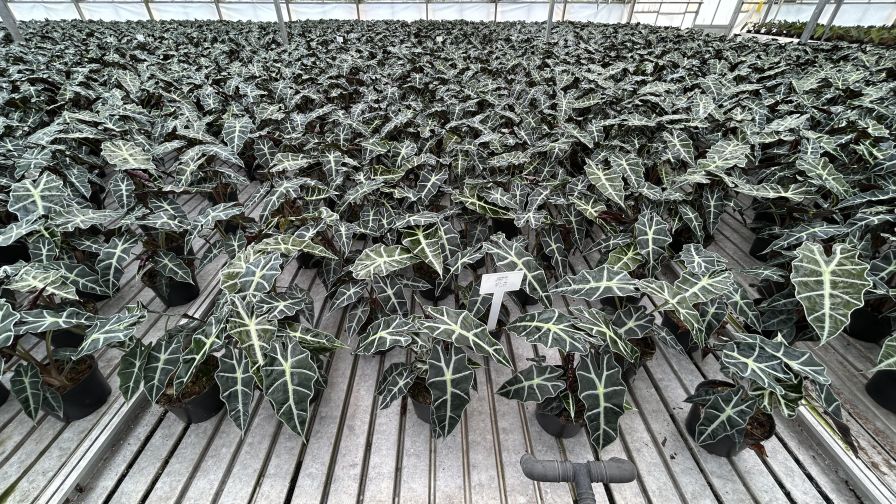
Ebb-and-flood irrigation systems can improve water use efficiency by delivering water directly to crops while reducing water loss. | Harrison Meekins, Sun Gro Horticulture
Reducing water use does not mean simply irrigating less. The bigger opportunity is improving how efficiently water is delivered.
“Growers who are overwatering or wasting water can look at irrigation system upgrades that don’t significantly impact their crops,” says Ryan Dickson, Associate Professor and Container Crop Specialist at the University of Arkansas.
Dickson says inefficient irrigation systems create more waste than systems designed to deliver and distribute water more precisely. Outdoor overhead sprinklers, for example, are generally less efficient than drip irrigation or ebb-and-flood systems used in greenhouses.
“A system designed to capture excess water, clean it, and reapply it is going to move the needle a lot in regard to improving water efficiency and use,” Dickson says.
Meekins says growers can also improve efficiency by rethinking irrigation frequency and volume. Systems that deliver water directly into the container with minimal leachate can reduce water loss, limit fertilizer waste, and improve overall water use efficiency.
“I encourage growers to do pulse irrigation,” Meekins says. “The overall volume of water applied is reduced during an irrigation event, and the water is applied more frequently.”
By applying smaller amounts of water more often, growers can keep more water in the root zone while reducing leachate. That can help retain nutrients in the substrate, improve fertilizer efficiency, and reduce the likelihood of oversaturating the root zone after heavy watering.
Differences in Substrates
Substrate selection also plays a role in how often crops need to be irrigated. Mixes with higher water-holding capacity can help growers reduce water applications, although the best choice depends on crop needs.
“Typically, the substrate water-holding capacity should not be lower than 40% to 45% by volume,” Meekins says. “There needs to be some amount of moisture in the substrate to support the plants’ water needs.”
Growers should consider both air-filled porosity and water-holding capacity when evaluating substrates. More air-filled porosity generally means more drainage and less water retention. Traditional peat-perlite mixes typically hold more water than bark-based mixes, although some crops do not tolerate excessive moisture in the root zone.
Crop Timing
Water management can also be used as a crop-control tool when applied carefully.
Some growers use deficit irrigation during the vegetative phase to maintain lower volumetric water content in containers. Meekins says this can reduce stretch and help create more compact, well-toned plants without affecting flower number or flower size during reproductive growth.
Low-level drought stress may also help prepare plants for retail conditions by engaging physiological mechanisms that improve drought-stress response after plants leave the greenhouse.
Focused on Environmental Conditions

Substrate water-holding capacity should generally not fall below 40% to 45% by volume to ensure plants have adequate moisture. | Brian Jackson, North Carolina State University
Even the best irrigation strategy has to account for what is happening above the crop. Light levels, high temperatures, and wind can all drive evaporation and water loss from plants.
Greenhouse and controlled-environment production offer some advantages. Shade cloth can be used to manage light, the structure protects plants from wind, and temperature can be controlled to some extent. All of these factors can help improve water use efficiency.
Technology is also helping some growers move away from irrigation schedules based only on the clock. Sensors that track vapor pressure deficit (VPD), light accumulation, substrate moisture, and crop canopy temperature are beginning to play a bigger role in irrigation decisions.
“Growers in Europe and some in the U.S. who have made higher capital investments in their greenhouses are increasingly using advanced climate sensors and integrating them with their climate control and irrigation systems,” Meekins says. “They are moving away from the older model of using a time clock to water at a predetermined interval.”
Infrared sensors, for example, can be used to monitor crop canopy temperature. If the canopy temperature increases, it can signal that plants are becoming water stressed because there is not enough water in the root zone to cool leaves through transpiration.
That kind of data gives growers a clearer picture of what is happening in the greenhouse environment, in the container, and in the crop canopy — and helps them make more precise decisions with their water.
For growers facing tighter water supplies or more variable water quality, the path forward is not simply to cut back. The bigger opportunity is to understand where water is going, how efficiently it is reaching the crop, and how irrigation decisions affect fertilizer use, disease pressure, crop timing, and shelf life. As water becomes a more valuable production input, precision will matter more than habit.
Subscribe to eNewsletter
