



Preventing Greenhouse Diseases in Tropical Propagation
 August 13, 2026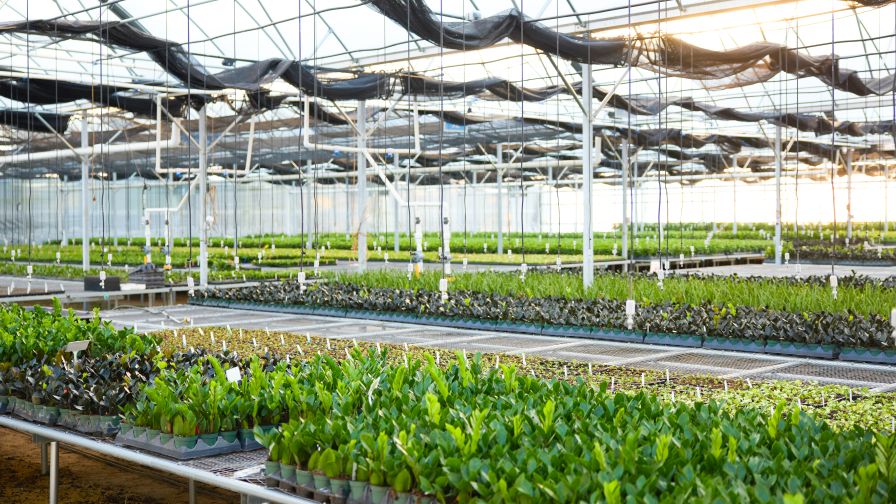
Tropical foliage crops, including Zamioculcas zamiifolia, Coffea arabica, and Serenoa repens, fill Phoenix Foliage’s Winter Garden, FL, greenhouse. | Foremost Co
For many greenhouse growers, tropical foliage represents an opportunity to diversify production, but propagation can seem unusually difficult. Most tropical foliage species experience fewer economically significant diseases than many annuals and perennials, so the challenge is not an endless list of pathogens. It’s creating conditions that keep unrooted cuttings hydrated and promote rapid rooting while minimizing stress.
Disease prevention begins long before symptoms appear. Healthy cuttings placed in warm, well-aerated media and maintained under high humidity with minimal leaf wetness are less likely to remain vulnerable to bacterial and fungal pathogens. Successful propagators spend less time asking what to spray and more time asking why a cutting is taking too long to root.
Create the Right Propagation Environment
The greatest difference between tropical foliage and bedding plant propagation is how moisture is managed. Annual crops often depend on frequent misting, while tropical cuttings perform better when humidity is maintained without continuously wetting the foliage.
Excessive mist can cool the root zone, spread bacteria, leach nutrients, and delay rooting. The objective is hydrated plants without signs of stress, not wet leaves.
Bacterial soft rots, bacterial leaf spots, Pythium, Phytophthora, Rhizoctonia, and Botrytis can all occur during propagation. Their impact often increases when rooting is delayed or when saturated media, poor sanitation, and prolonged leaf wetness create favorable conditions. Environmental management remains the foundation of disease prevention.
A disease-preventative propagation program begins with healthy plant material. Shipments should be unpacked immediately, inspected carefully, and stuck into prepared media without unnecessary delay.
Maintaining a root-zone temperature between 70°F and 74°F promotes callusing and root initiation, shortening the period when cuttings are most vulnerable. Bench-tenting systems can help maintain humidity while reducing leaf wetness, improving rooting uniformity and limiting disease pressure.
As roots begin to develop, irrigation practices should change. Rather than continuing overhead mist, propagators should transition to watering the growing media directly.
Sanitation must also become a daily discipline rather than an occasional task. Clean tools, disinfected benches, prompt removal of plant debris, and employee practices such as regular handwashing or changing gloves between production lots can help prevent pathogens from spreading through the greenhouse.
Adjust Practices With the Seasons
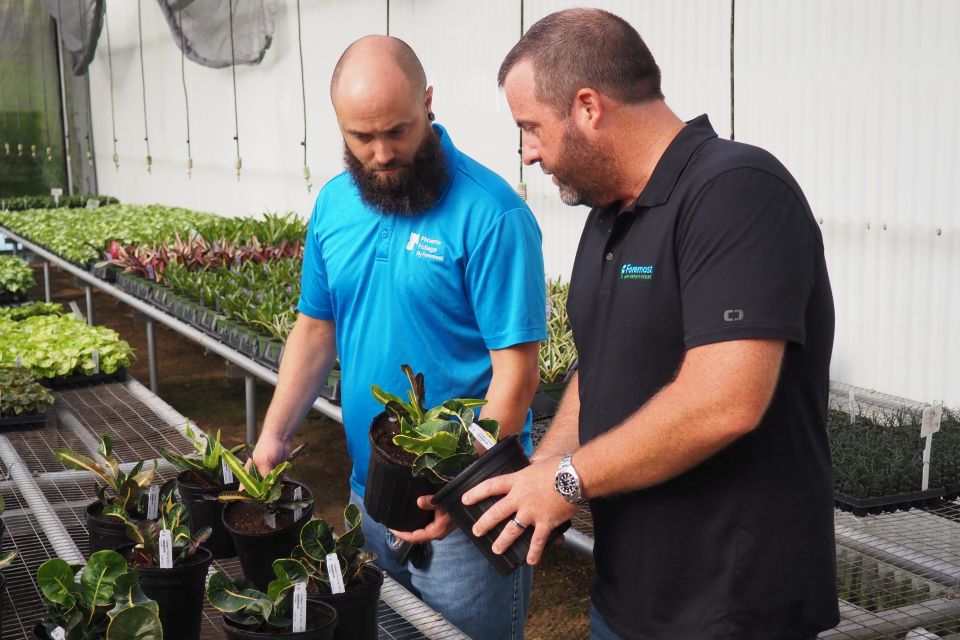
Chris Rocheleau (L) and Joseph C. Roberts IX (R) evaluate a new introduction in Foremost’s Codiaeum Thai Dye Series. | Foremost Co
Environmental management should change with the seasons. In winter, lower light and cooler media temperatures can slow rooting, making bottom heat and careful mist management especially important. Spring requires quick adjustments as light and temperatures fluctuate.
Summer favors both fast rooting and rapid bacterial development, placing greater importance on receiving practices, airflow, and humidity management. Fall is the time to recalibrate environmental controls before winter conditions return. Growers transitioning from annuals and perennials often make a few predictable mistakes: relying too heavily on mist, providing excessive light before roots develop, focusing on air temperature rather than media temperature, overwatering the substrate, or trying to solve environmental problems with additional pesticide applications.
In many cases, correcting the production environment produces better long-term results than increasing chemical inputs.
Start With Dependable Crops
For growers entering tropical foliage production, it pays to begin with dependable crops. Silver or satin pothos (Scindapsus), vining philodendrons, dracaena, scheffleras, and peperomias generally root reliably and can help production teams build confidence before expanding into more specialized crops.
Mastering a handful of crops while refining propagation systems creates a stronger foundation than attempting to grow dozens of species at once.
Use Crop Protection Strategically
Even in propagation programs with strong sanitation and environmental controls, crop protection products may have a role when equipment failures, weather, or human error create conditions favorable for disease.
Product selection should be based on the disease, crop, production site, application method, state registration, and current label. For bacterial diseases, copper — or Bacillus — based products may be options where labeled.
For Pythium and Phytophthora root rots, Subdue MAXX (mefenoxam), Segovis (oxathiapiprolin), and Adorn (fluopicolide) are commonly used options in greenhouse propagation. Cleary’s 3336 (thiophanate-methyl) and Mural (azoxystrobin + benzovindiflupyr) may be considered for Rhizoctonia, while products used for Botrytis include Decree 50 WDG (fenhexamid), Palladium (cyprodinil + fludioxonil), and Affirm WDG (polyoxin D zinc salt). Growers should confirm that each product is labeled for the crop, pathogen, and application site. Rotate FRAC groups to reduce resistance risk and test unfamiliar chemistries on a small group of plants before broad application.
Ultimately, successful tropical foliage propagation is built on consistency. Stable temperatures, humidity, sanitation, irrigation, and observation all contribute to rapid root development and healthy liners.
Healthy roots produce healthy plants, and healthy plants generally require fewer chemical interventions. When growers focus on creating an environment that promotes rapid rooting, disease prevention becomes the natural result of strong propagation practices rather than the primary objective.
Subscribe to eNewsletter