




How Greenhouse Lighting Is Evolving to Meet Grower Needs
 October 22, 2026
Lighting is fundamental to greenhouse production, and few areas of controlled environmental agriculture (CEA) have changed as quickly in recent years. That pace is likely to continue as growers weigh not only fixture performance, but also energy use, crop response, system flexibility, and long-term operating costs.
We asked lighting manufacturers what growers should be thinking about now and where greenhouse lighting may be headed over the next several years.
Planning for 2027
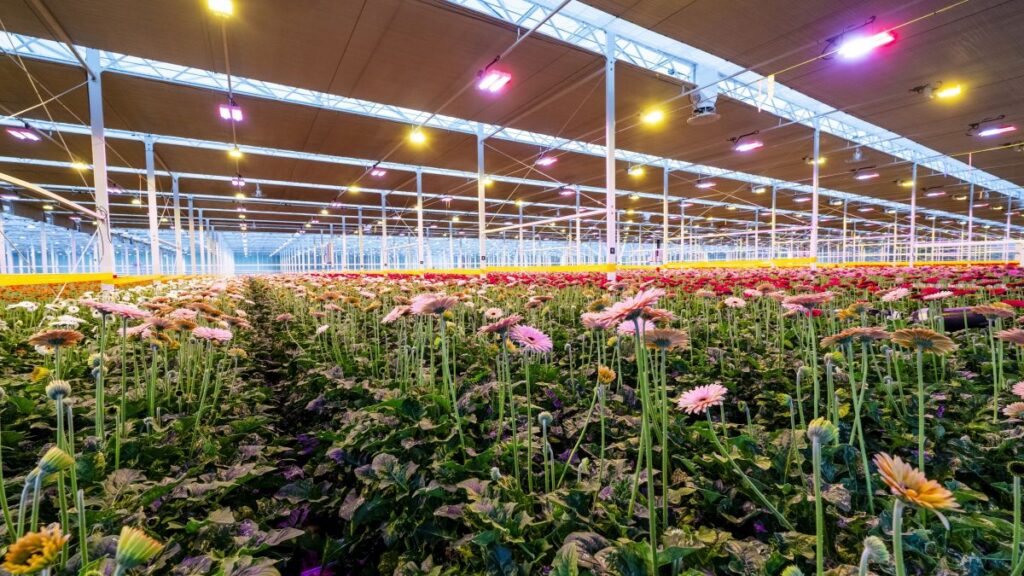
Hollandia Greenhouses in British Columbia uses two-channel LED lighting to adjust light levels in response to natural sunlight while also using spectral control to influence crop response. | Signify
Michal Hanan, Commercial Sales Leader North America at Signify, says growers should evaluate the total value of a lighting system over its lifetime rather than focusing only on purchase price.
“Lighting is a significant 10- to 15-year investment that influences crop performance, energy use, and operational flexibility,” he says. “While efficacy is important, growers should compare solutions on an apples-to-apples basis.”
Hanan says that means looking beyond basic light output to factors such as inrush current, total harmonic distortion, integration with greenhouse controls, scalability, adaptability, provider support, and long-term stability.
Jeff Mastin, Director of Lighting Science and Product at TotalGrow Lights, says growers should also avoid getting distracted by advanced features before addressing the most basic question: Are plants receiving enough light?
“If you don’t have enough light being generated and delivered to your plants, they will not meet your growth and quality goals,” Mastin says. “If you err on the side of extra total light, it will often make up for other imperfections.”
Efficiency, reliability, and other design considerations are important, but Mastin says growers should first determine how much light their crops actually need.
Before evaluating new fixtures, Kassim Tremblay, Senior Vice President of Sales and Marketing at Sollum Technologies, recommends measuring current light levels at the crop canopy. “Put a quantum sensor at canopy height and track daily light integral through a full winter, bench by bench,” Tremblay says. “Growers who do this usually find two things: Uniformity is worse than they assumed, especially at bench ends and along gutters, and on bright winter days, the lights keep running after the sun has already delivered what the crop needed.”
Tremblay says those measurements should inform how growers evaluate a lighting system. For floriculture crops, that includes considering spectrum in relation to a specific production goal.
“Blue light is one of the more reliable tools for holding back stretch, and adding far-red to photoperiodic lighting can speed flowering in many long-day crops like petunia and snapdragons,” he says. “If a supplier can’t tell you what their spectrum does for your crop list, you should know that before you sign.”
George Mekhtarian, CEO and Chief Engineer at California Lightworks, recommends soliciting bids from reputable vendors and comparing the installed cost per micromole delivered rather than evaluating systems only by fixture price or wattage.
“Operating expenditure costs are becoming critical,” Mekhtarian says. “Electricity prices are up sharply, and it’s important to ensure their lighting system is delivering the best long-term value through high efficacy and low maintenance cost.”
AI Will Play a Role in Future Lighting Systems
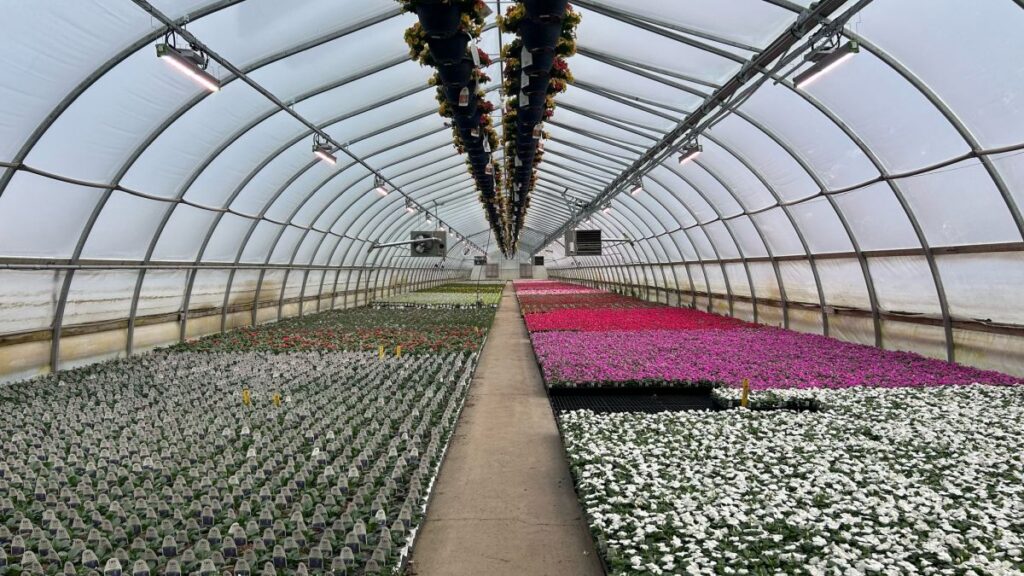
Supplemental LED lighting over young ornamental crops illustrates the range of applications growers are weighing as they balance light quantity, energy use, and crop needs. | TotalGrow Lights
The combination of AI, sensors, and adaptive lighting could eventually allow systems to respond automatically to changing greenhouse and crop conditions. The challenge is determining how quickly those systems can make reliable decisions.
Mastin says environmental sensors, chlorophyll fluorescence sensors, cameras monitoring plant size and coloration, and even internal plant electrical signals could provide information used to guide lighting decisions.
But he cautions against automating those decisions too quickly. “In reality, this is extremely complicated and would be a huge risk to automate prematurely,” Mastin says. “Most plant responses are the result of many confounding variables which could have different advisable responses for how lighting and other equipment should be adjusted.” In the nearer term, he sees more opportunity for these systems to provide growers with alerts, data, and recommendations rather than making production decisions independently, with the value of that technology varying by crop and operation.
“A produce-based monocrop operation with a higher dependence on LEDs than on sunlight is much more likely to benefit from this trajectory than an ornamental grower with dozens of varieties in a location where more than half of the light is coming from the sun and diluting LED fine-tuning impacts,” Mastin says.
Tremblay says much of the useful AI in greenhouse lighting may ultimately be found in the software deciding what fixtures should do, rather than in the fixtures themselves.
“The right amount of supplemental light at any moment depends on how much sun is coming through the glass, what the afternoon forecast looks like, what electricity costs right now, and where the crop is in its cycle,” he says. “A grower can’t recalculate that every few minutes for every zone, and a timer can’t do it at all. But software can.”
He also expects AI to influence how light recipes are developed. “As more greenhouses log light, climate, and crop results together, recipes can be tuned from thousands of production cycles,” Tremblay says. “I expect that’s where the next real gains in crop timing and quality will come from.”
Hanan also sees AI as a way to translate existing plant-light research into more responsive production tools.
“The real value of AI won’t come from algorithms alone,” he says. “It will come from the quality of the horticultural knowledge behind them and the ability to turn that knowledge into better outcomes for growers.”
AI is also being explored as a research and design tool. Mekhtarian says digital-twin experiments could allow researchers to test dynamic light recipes more quickly than with traditional plant trials.
“Doing a design of experiments on real plants can take years given the lengthy crop cycles, and AI can dramatically accelerate this process,” he says.
Moving Toward Custom Solutions

Spectral control allows growers to adjust the proportions of different wavelengths of light depending on crop goals. | TotalGrow Lights
Over the next five years, lighting suppliers expect continued movement toward systems tailored more closely to individual operations, crops, and production goals.
Mekhtarian predicts the industry will move away from standard one-size-fits-all fixtures toward more customized solutions. “AI should enable us to provide cost-effective bespoke systems that deliver uniform intensity and dynamic spectrum for each customer crop and setup,” he says.
Hanan says the conversation is also shifting away from whether LEDs belong in greenhouse production and toward how much value growers can extract from their systems. “Lighting will become more adaptive, automatically responding to crop requirements, sunlight levels, and energy market conditions,” he says.
As systems become more sophisticated, he expects growers to place greater emphasis on reliability, long-term performance, and whether a lighting platform can continue evolving after installation.
“The features will be important, but so will confidence that the company behind the technology will continue to innovate and support the investment throughout its lifecycle,” Hanan says.
Tremblay expects one of the biggest changes to be in how fixtures are operated. Hardware will continue to improve, he says, but as efficacy gains slow, more savings may come from deciding when lights should run and at what intensity.
“In five years, I’d expect HPS to be rare in new projects and retrofits,” Tremblay says. “Supplemental lighting will adjust through the day with the sun as a matter of course, rather than running on fixed schedules.”
He also expects more operations to participate in programs that reduce lighting loads when the electrical grid is stressed, something that requires fixtures capable of dimming on demand.
Ultimately, Tremblay says growers will evaluate lighting more closely on crop and production outcomes.
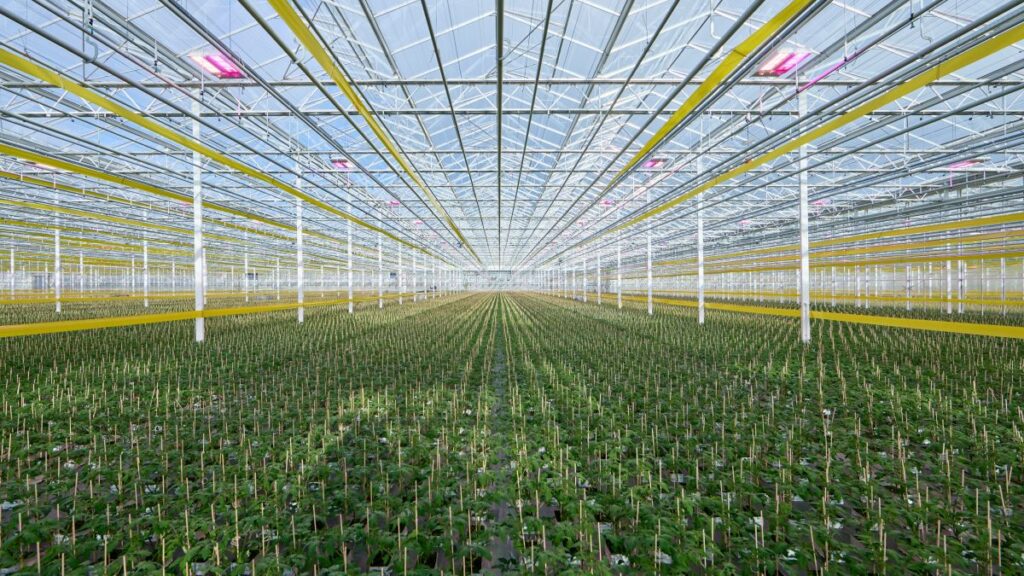
Vreugdenhil-Klugt in the Netherlands uses LED top lighting in young plant propagation for ornamentals and vegetables, with controls that allow the operation to adjust intensity and spectral output. | Signify
“Growers will judge lighting on crop results: did the poinsettias finish on time, and what did light cost per finished pot?” he says. “Suppliers who can show that data will have an easier conversation than the ones selling watts.”
Mastin offers a more measured outlook for many ornamental greenhouse operations. Where LEDs provide less than half of a crop’s total light, and supplemental lighting is needed only during part of the year, he says dramatic changes may be less likely. “Efficiencies will continue to inch higher, some nuanced features will add value, but overall I expect continuity predominantly,” he says.
Operations in northern regions, or those growing crops that depend more heavily on supplemental light, may have more incentive to adopt advanced lighting technologies because lighting has a greater influence on crop performance and operating costs. For growers, the challenge will be deciding where advanced capabilities produce enough value to justify their cost.
Mastin says that will require continued transparency from both manufacturers and growers as operations weigh simpler, lower-capital-cost systems against more advanced lighting technologies with more complex returns on investment.
“It will be important for continued growth in transparency and honesty in the industry from both manufacturers and growers to help one another choose strategically between prioritizing the lower CapEx simpler lights and the more advanced lighting where ROI calculations are complex,” he says.
Subscribe to eNewsletter