



Executive Perspective: What It Will Take to Increase Grower Adoption of Dynamic Lighting
 October 1, 2026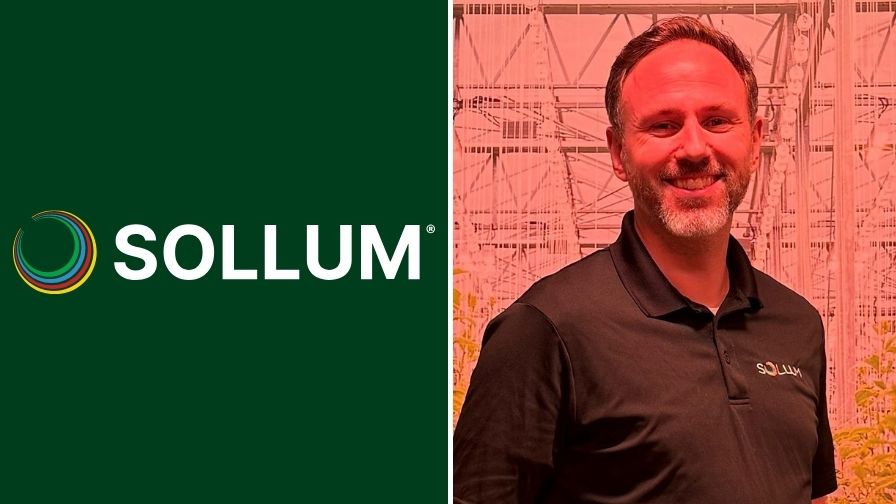
Senior Vice President of Sales & Marketing Kassim Tremblay. | Sollum Technologies
Lighting is fundamental to greenhouse production, and it’s possible that no other part of growing under cover has experienced as much change in recent years. Here, Kassim Tremblay, Senior Vice President, Sales & Marketing for Sollum Technologies, talks about the benefits these changes offer to growers, his recommendations for identifying reliable lighting suppliers, and why growers who haven’t tried LEDs should think about doing so sooner rather than later.
Greenhouse Grower (GG): How did Sollum get its start?
Kassim Tremblay (KT): Our founders had invented a light that reproduced the sun, and they were looking for a home for the technology. The early applications were in museums, where a color rendering index of 100% means you see a painting the way the artist painted it. They even built lights for the penguins at a biodome that was under renovation, because without natural light the birds were getting depressed.
The momentum really came from trials at an indoor farm growing herbs. The lights produced an 18% to 40% increase in productivity compared to a plain white LED. That was the number that sent everyone back to the science lab to understand what was actually driving the result. We took that idea and that technology into the greenhouse space. We deployed the first 4 acres of dynamic lighting in Leamington, growing the first Canadian winter peppers, and that is where it became clear that every stage of growth calls for its own lighting regime. Growers already knew that. What they lacked was a tool to deliver it.
Look at where the industry was at the time. Temperature was tightly controlled. Irrigation was tightly controlled. Nutrient timing was tightly controlled. Lighting was either entirely on or entirely off. That gap is where dynamic lighting began, and fast forward to today, it has become the standard in the industry.
GG: What are your thoughts on 2026? How has this year been for the industry?
KT: The last couple of years have been challenging for the industry as a whole, with interest rates going up, the gas crisis in Europe, and so on. 2025 was pretty slow for a lot of people, and in 2026 everyone still seems to be catching up. I think 2027 is going to be a huge year.
Some players on the lighting side have felt that same pressure. We have kept growing, though, because for so many growers this is still a new technology. Probably half of our business right now is retrofits. There is a lot of high-pressure sodium still hanging in greenhouses that needs to come out, and then there are the few new builds. Dynamic lighting is becoming the main lighting segment, and that creates a lot of growth for us.
GG: What percentage of U.S. floriculture growers would you estimate are using dynamic lighting today?
KT: Very little. Probably less than 10% right now. Knowledge is not the barrier. Growers know they need light, and they know they need different types of light. Where it does not always work for floriculture is the financials, because of tight margins and access to electricity. The operating case makes sense, but somebody still has to commit the capital expenditure. Subsidies are there. But U.S. floriculture growers have typically been less aggressive about pursuing innovation than the vegetable growers.
GG: Is there a rule of thumb for how many years are required for a U.S. floriculture grower to get the return on their investment for this expenditure?
KT: The rule of thumb in the horticulture industry is that if your ROI is not under five years, you are not in the conversation as a supplier. Getting to three years or less is when growers get really excited, and the vegetable and strawberry growers are pushing 18 months.
When we started out more than 10 years ago, a seven- or eight-year ROI was typical. We are not there anymore, especially for subsystems such as lighting.
GG: What needs to happen for this market to get from 10% adoption to 20% or to 40%?
KT: You need first movers, the innovators who are ready to test the premise of the business case. At the same time, the demand has to be there to justify it. If a grower is already meeting all the demand he has, why innovate?
That is the difference between the two segments today. Climate challenges and demand for healthy, local food have created a big tailwind for vegetable growers, and that is what is pushing them to innovate. Floriculture does not have that pull right now.
GG: If you could give growers one piece of advice relative to their lighting, what would you advise them?
KT: Find good partners. There is a lot of noise in the lighting segment. It is easy for four or five guys to go to China, find a product, put a brand on it, come back and say, “Oh yeah, we’re experts.”
Growers need to look for proof of the quality. Where is the support going to come from? Is there a basis for a long-term collaboration? Will this company help me realize the value they are selling me, or are they just going to sell me something and say, “Hey, good luck”?
A good partner also lets you build at the speed you are comfortable with. Is it a trial first? Is it one particular greenhouse? There are thousands of acres of floriculture in the U.S. If I am a grower of any real size, I can dedicate 10% of my surface to test a technology and prove it, or I can find a partner who can show me that value somewhere else first.
One more thing. There are still a lot of subsidies for LEDs, mostly based on energy efficiency, and they are not going to last. Governments and grant programs have been generous for the last five or six years, but that is going to run out. I would take the opportunity to move within this window of 12 to 36 months, and at minimum get the proof of concept and the proof of value done.
GG: How do you expect the lighting space to look different five years from now than it does today?
KT: We are already seeing a lot of change. The players who were dominant two or three years ago are not here anymore. That is what happens when a market resets. We went from a very mature technology, high-pressure sodium, with basically two companies fighting it out, to LEDs, which are far more energy efficient. Suddenly there were 300 different players and a lot of noise. Plenty of them got traction with very shallow support teams, thin financial structures, and quality issues, and they are gone.
The other dynamic is that the level of sophistication in controls is changing. New technology is helping growers close the decision-making loop, automate a portion of it, and get to a diagnosis faster with more sensors, more AI, and more control. We are in the middle of that transformation, and a lot of proof of concept still needs to happen.
The practical implication for a grower is this: if you are buying a lighting system rated for 50,000 hours, you are going to live with it for 10 to 15 years. Choose one that can evolve.
GG: You’ve talked a good bit about the controlled environment agriculture (CEA) space. What are your expectations for that portion of the industry?
KT: The question in CEA is always what else we can grow in a controlled environment. The opportunity is great, but it has not been as easy as people thought. Growing a new crop in a new way comes with a learning curve every time.
Can we grow much more than we grow today? Yes, definitely. New crops will come into the greenhouse, because for many of them it is simply a better methodology than the field. But economically, not every crop makes sense, and that is where we need proof points and progression rather than promises. That is going to take some time.
I am glad there are bold growers who want to go full steam ahead. Once the first movers have proven the business, the rest of us can work together to develop a new segment and a new growing methodology around these crops.

Executive Perspectives is an editorial series in which Greenhouse Grower visits with leaders from across the industry to learn the challenges they see facing growers from their respective part of the business and their recommendations to help growers succeed. This interview has been edited for style, length, and clarity.
Bob West is the Chief Content Officer at Meister Media Worldwide, the publisher of Greenhouse Grower. He can be reached at 440-602-9129 or [email protected].
Subscribe to eNewsletter