



Right-Sizing Light: What Works in Today’s Greenhouses
Zach Jones remembers the early days of his operation’s foray into supplemental lighting.
In 2022, the production controller at The Chef’s Garden in Huron, Ohio, turned the lights on and left them on. His crops germinated well enough, but then growth stalled. It wasn’t until the company shut the lights off, convinced the trial had failed, that the plants finally took off. The problem: Overlighting can be just as detrimental to yield as underlighting. The lighting was working, but the company needed a better strategy on how to use it.
“That was one of the first lessons we learned when we started using supplemental lighting,” Jones says.
The Chef’s Garden has since overhauled its entire approach, replacing nearly all of its older high-pressure sodium (HPS) fixtures with variable-spectrum LEDs in 2.2 acres and installing its own power generation system: solar on 4 acres, wind with 12 small, low-impact tulip turbines, battery, and high-efficiency diesel generation while still connected to the grid. Today, Jones runs supplemental lighting during the day when less expensive solar power makes it more cost-effective.
The lighting decisions at the operation are tightly integrated with energy strategy, crop scheduling, and a sophisticated software platform that adjusts intensity every 15 minutes to account for passing clouds.
As a result, The Chef’s Garden is able to maximize yield all year long versus just in summer. “We can now accomplish the same 10- to 14-day cycles year-round as opposed to the 30 to 40 days required during the winter season before adding lighting.”
The lighting landscape has never been more complex or more capable. LEDs have replaced HPS as the commercial standard, smart control platforms can orchestrate entire greenhouse zones from a tablet, and spectrum science has evolved from red and blue to nuanced, four-channel dynamic systems tuned to cultivar-level responses. Yet suppliers and experienced growers say the industry keeps making the same fundamental mistakes.
When More Light Isn’t the Answer
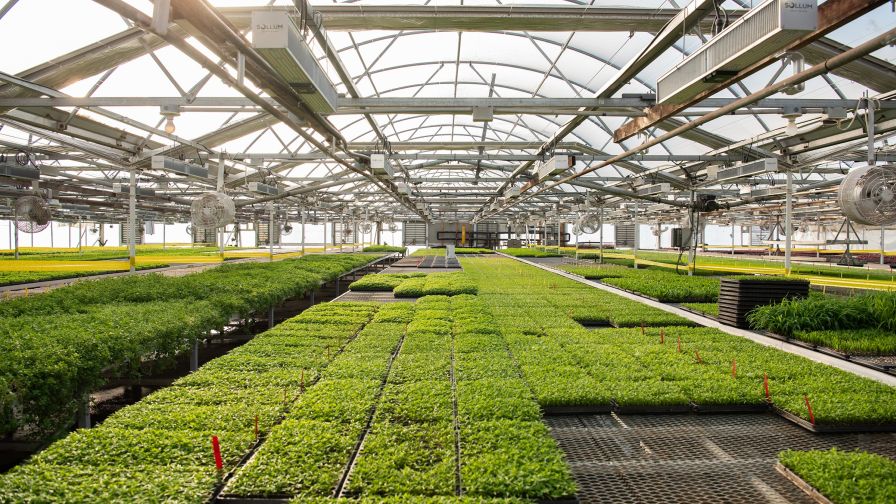
Over time, The Chef’s Garden has replaced nearly all of its older high-pressure sodium (HPS) fixtures with variable-spectrum LEDs. | The Chef’s Garden
The assumption that more light always means more yield is a myth and only holds true when the plants experience a deficit to reach the optimum daily light integral (DLI), says Abhay Thosar, Chief Horticulture Specialist at Sollum Technologies. Excess light doesn’t convert to growth, and plants have a saturation point.
“If more light meant more production, all greenhouses would be producing the maximum in summertime when they get the most natural light,” he says. “But the plant can only utilize a certain amount of light. After that, a lot of it gets either reflected by the plant or increases the plant temperature.” That can force the plant to spend metabolic energy on thermal regulation and, in some cases, actively suppress performance.
Underlighting is equally costly and is often driven by a calculation error that Thosar sees repeatedly. Growers assume their glass greenhouse delivers 80 to 90% natural light transmission year-round. While that figure is accurate at noon in summer when the sun is directly overhead, in winter, when the sun angle is low, transmission at the plant canopy can drop to 50 or 60%. The resulting deficit in supplemental light design can leave crops 2 to 3 moles short of their daily target, a gap that compounds over the winter months.
Matching light to crop type is another area where mistakes accumulate. Different crops and even different cultivars of the same species respond to spectrum and intensity in distinct ways. “If you just have one light treatment for all five cultivars within tomatoes, you might see that two are performing well, one is medium, and two are suffering,” Thosar explains. “If you change the light recipe for the two that are suffering — in terms of the ratio of red, blue, green, and far red — you will see them start performing better.”
Ultimately, growers should never evaluate lighting in isolation, says Pieter Slaman, former Chief Growing and R&D Officer at Little Leaf Farms and now a consultant with GaaS Solutions. Increasing lighting without adjusting temperature, CO2, and water inputs means the plant is receiving energy it cannot metabolize. Growers who understand this and pair lighting decisions with full growing system adjustments, Slaman says, are the ones capturing real returns.
HSP to LED Retrofits
The HSP-to-LED retrofit process is easier than many expect in some ways and harder in others.
“Growers don’t need to change any of the electrical infrastructure in the greenhouse to switch to LED; they just need to change the fixtures,” Thosar says.
The surprise that catches most growers off guard is heat — or, rather, its absence. HPS fixtures generate radiant heat that reaches the leaf canopy directly. LED systems, especially water-cooled units, produce far less radiant heat. Growers who don’t compensate for this in their heating infrastructure see leaf temperatures drop and can notice a negative crop response.
Slaman learned this firsthand at Little Leaf Farms. After installing LEDs with the wrong spectrum, he observed that plants were underperforming. His team’s response was to install HPS fixtures between the LED lights to supplement radiant heat and adjust the spectrum mix.
“Within three days, we saw a change in color. Within two weeks, we saw an increase in yield,” he says, adding that the operation eventually returned to full LED once the spectrum was reworked. But the lesson stuck. “You have to make sure you have enough power in your heating system to compensate for radiation heat.”
Jones echoes this experience. “Winter heating costs are definitely a consideration when making the transition from HPS to LED since HPS lights are significantly less light/power-efficient than LEDs,” he says. “When we switched, we had to ensure we had enough heating capacity to compensate for the heat loss. It took us a little bit of time to get our heating capacity smoothed out.”
Design missteps also occur when growers specify lighting too late in the project’s development, such as after installing HVAC infrastructure, facility layout, or energy curtain systems, which can act as heat retention barriers.
Luis Gabriel Forero, a plant specialist with Signify, the parent company behind Philips Horticulture LED, shares an example from his former grower days. He couldn’t make a full HPS-to-LED transition because the greenhouse lacked an additional energy curtain. “The right decision wasn’t to delay LEDs indefinitely,” Forero says. “It was first to add the curtain, then plan the full LED conversion.”
Smart Lighting
Zach Jones, production controller at The Chef’s Garden. | The Chef’s Garden
Variable-spectrum LEDs and intelligent control platforms offer capabilities that would have been unimaginable to greenhouse operators a decade ago. These include automated DLI targeting, spectral compensation, real-time energy tariff response, and remote monitoring from a phone or tablet.
At The Chef’s Garden, Jones says the software does most of the heavy lifting. Intensity adjustments happen automatically on 15-minute intervals based on the operation’s own radiation sensors, while energy pricing logic now governs when supplemental light runs at all, Jones explains. This strategy is possible because the control system can track real-time generation cost against grid pricing.
Thosar says that while many growers are actively using smart features, the adoption curve is often uneven because they aren’t fully aware of what their systems can do.
ROI Math
When growers go to determine ROI on LEDs, it’s important not to focus too narrowly on fixture price. “They need to take a look at the complete picture,” says Thosar.
“The ROI growers should be looking for — up to a five-year payback — needs to include electrical savings, improvement in crop yield, and quality tied to revenue,” he says. “It also needs to factor in the ease of working with the software and lighting system, which saves the growers time.”
LED lighting, he adds, is going to stay in the greenhouse for 10 to 15 years. Thosar explains that LEDs are typically rated to last 50,000 hours. At 2,000 to 3,000 hours of use per year, that translates to roughly 15 years of fixture life.
Unfortunately, drivers (which supply power to the fixture) have a shorter lifespan of five to seven years and will likely need to be replaced at least once within that window. “That’s a cost growers need to factor in,” he says.
There are also energy savings to consider. When a grower replaces a 1,000-watt HPS fixture with a 700-watt LED, producing the same lighting output, the 30% energy reduction across an entire greenhouse acreage can generate significant utility rebates, often funded per fixture by the local hydro company. Alternatively, keeping wattage constant in the LED swap can yield 30 to 35% more light to the crop with commensurate yield gains.
Says Thosar, “If the grower was getting 70 to 80 kilos of tomatoes per square meter under HPS, with the LED, he or she is going to get more than 100 kilos per square meter because of the added light and the flexibility to change the wavelength.”
Amos Bassi, another plant specialist with Signify, says timing is an often overlooked ROI factor that can catch growers off guard. “Some growers think they can decide quickly and have lighting installed right away, but these systems aren’t off‑the‑shelf products. They need to be designed for the crop and facility, then manufactured, shipped, and installed,” Bassi says.
He often compares lighting projects to crop planning. “You don’t decide six weeks before harvest that you’ll grow a crop,” Bassi says. “You plan ahead, so everything is in place when timing matters.”
Editor’s note: This article was originally published in CEAg World’s 2026 Industry Report: Greenhouse Produce.
Subscribe to eNewsletter