


How Greenhouse Coverings Are Taking on New Roles
 September 11, 2026
 The material covering a greenhouse is no longer simply a clear barrier that keeps rain out and heat in. Modern greenhouse films, glass, plastics, coatings, and screen systems can help growers adjust light levels, change spectra, increase performance, and even generate electricity.
Advances in these materials are giving growers more options for improving efficiency, reducing costs, and supporting crop performance.
Glass That Generates Electricity
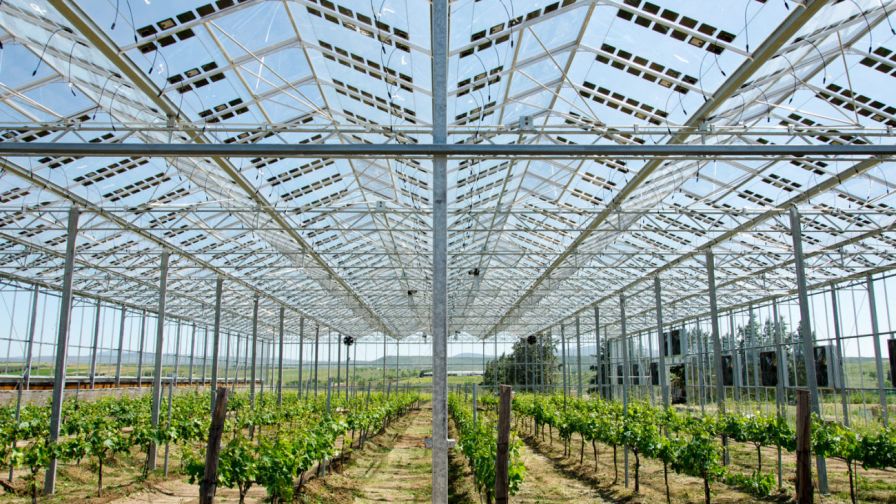
Semi-transparent solar glass is integrated into the greenhouse roof at an installation in Agios Pavlos, Greece. | Brite Solar
At certain times of the year, solar radiation reaching a greenhouse during the day far exceeds what crops need for optimal growth. Active solar glass can harness some of those rays through small embedded solar cells, generating electricity that can be stored in batteries to power lights in the morning and evening or operate HVAC systems.
“A greenhouse typically is considered an energy user, but if the greenhouse has active solar glass on the roof creating electricity, that energy is free, and the grower can reduce their electric bill,” says Nick Kanopoulos, Ph.D., CEO at Brite Solar. “In some cases, the greenhouse can be energy autonomous or even sell excess electricity back to the grid.”
The amount of power generated by each panel depends on its transparency.
“More transparency equals less power generation and vice versa,” says Kanopoulos. “The level of transparency depends on the crop and also the location of installation.”
Regions with higher daily solar inputs can use a different transparency than regions with lower daily light levels.
“We would design two different panel transparencies for a grower in Arizona versus a grower in Nebraska,” says Kanopoulos. “Semi-transparent solar panels make perfect sense for growers that need less light. When there’s too much light from the sun, they can produce energy and at the same time get the shading required.”
Kanopoulos believes the industry has likely gone about as far as possible in improving the light transparency of greenhouse glass. He expects future improvements to involve passive and active coatings, technology that is already being deployed.
“We are at the beginning of this market, at the start of scaling,” he says. I believe that the combination of glass with energy production will be the norm in the next five to 10 years.”
Spectral-Shifting Coatings
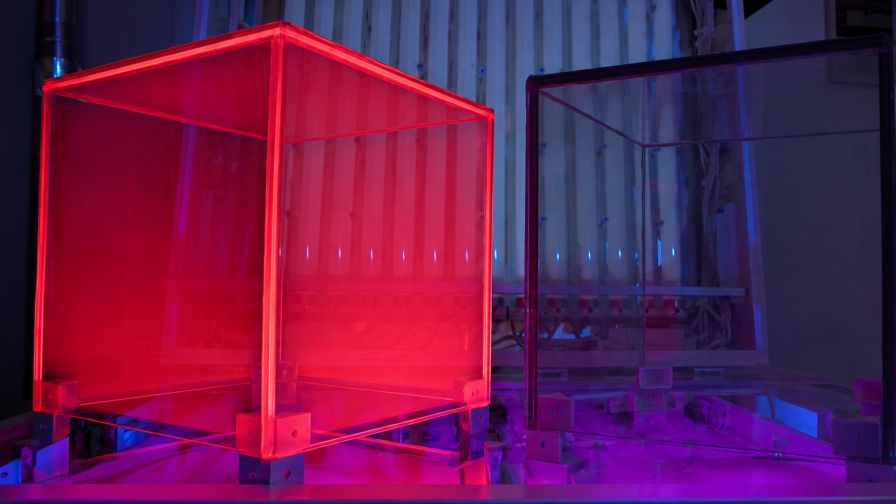
A demonstration shows glass with a spectral-shifting coating that converts UV light into red light. | Brite Solar
Dynamic LEDs are becoming more common, allowing growers to adjust the spectrum of light they emit according to crop needs. New glass coatings offer another way to alter the light entering the greenhouse.
Kanopoulos says spectral-shifting coatings take UV light and convert it into red, blue, or green wavelengths within photosynthetically active radiation (PAR).
“We have developed three different coatings that shift plant-unusable UV light to red, blue, and green,” he says. “Shifting to red has the largest influence because photosynthetic energy in the red region of the spectrum has the highest impact on plant growth.”
According to Kanopoulos, vegetable growers are seeing higher yields, while floriculture operations could benefit from faster growth and shorter production cycles.
Multilayer Greenhouse Films
Polyethylene remains the most prevalent and economical greenhouse plastic, but today’s products differ considerably from those available a decade ago.
“I think there are three areas of innovation in polyethylene film formulations, and it comes down to the raw material itself: the additives in the film, physical modifications to the film, and how the film itself interacts with the structure,” says Loran Stanley, Polyethylene Market Development Lead for Agricultural Film at ExxonMobil Signature Polymers.
New formulations and manufacturing processes have produced greenhouse films with greater strength, flexibility, and mechanical resistance.
“In terms of polyethylene, what we’ve seen over the last 20 years is much stronger, tougher film with increased mechanical resistance,” Stanley says. ”The film can have higher resistance to snow and puncturing from hail, and won’t wrinkle or move in the wind.”
Films have also become softer and more flexible while maintaining their mechanical properties, which can make installation easier.
Multilayer manufacturing now allows producers to combine several functions in one film.
“What those multilayers do is allow you to add a variety of functions into a single film,” says Stanley. “We’re seeing up to 13-layer technology in the market today.”
Depending on the formulation, new films can provide insulation, light management, and increased durability while reducing moisture and heat buildup within the film.
Combining Multiple Screens
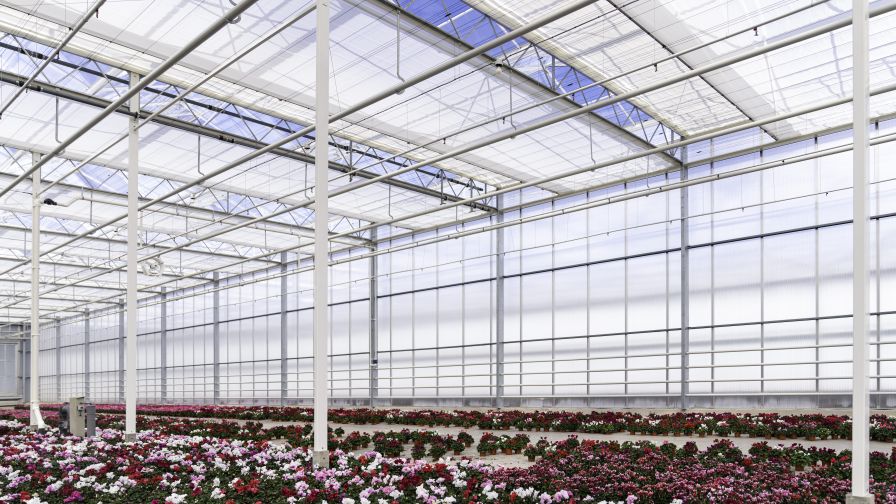
A greenhouse screen system helps manage light over flowering crops at Bergcamp. | Svensson
Shade screens inside the greenhouse are not new, but using multiple screens with different functions gives growers more flexibility.
“Shifting to double screens compared with single screens is really the biggest technology jump,” says Paul Arena, Greenhouse Climate Consultant at Ludvig Svensson.
Arena says growers are seeing greater flexibility in production and operating costs while providing crops with a more uniform, controlled environment.
“These dual screens are designed to control the exact amount of light in the greenhouse and act like a dimmer for the sun,” he says.
Svensson’s PARperfect system uses a high-shade or blackout screen above a secondary low-shade, high-diffusion screen to provide even light distribution.
When the screens are connected to a climate-control system, growers can maintain a more consistent level of solar flux from the morning through the middle of the afternoon rather than experiencing the usual peaks and valleys.
“It evens out to a completely smooth curve, or if you’re looking at the PAR sum, it’s just a straight line up,” says Arena. “When it hits the light level you want to achieve for the crop, you can close the blackout screen, achieving optimal DLI.”
The screens can serve different functions throughout the year. During summer, they can control the amount of light entering the greenhouse and provide shade. The upper screen can also be porous, providing shade while allowing greater airflow. During winter, the lower energy screen can help retain heat inside the greenhouse.
The type of greenhouse covering can also influence the screen strategy.
“If you’re a grower in a climate where it’s frequently cloudy or constantly overcast, you might consider a clear greenhouse covering and then use a diffuse shade material underneath to provide light diffusion as needed during periods of high radiation,” says Arena. “When it’s overcast and you just need light in general, you can rely on that clear roof to maximize light in the greenhouse.”
Evaluating New Covering Technology
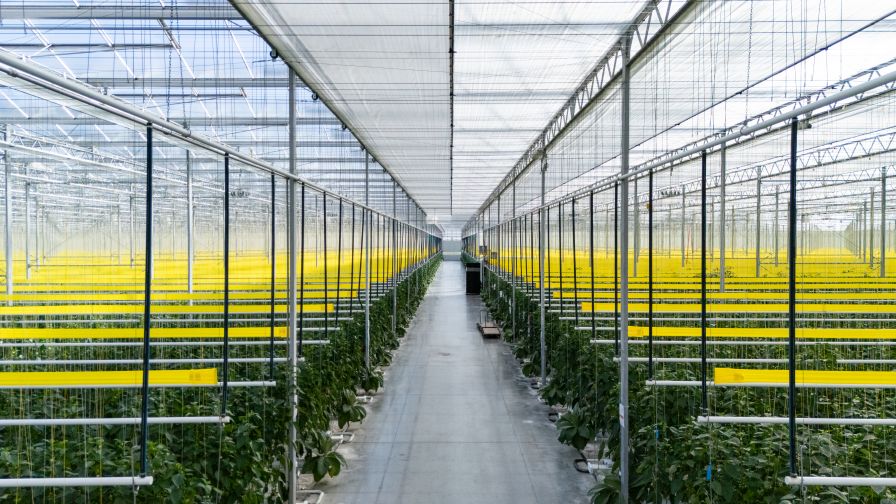
Greenhouse screens extend across the production area at Twin Creeks to help regulate light conditions. | Svensson
The latest technology is not necessarily the right fit for every operation. My grandfather called it “new paint disease” — the tendency for farmers to go out and buy something new and shiny even if they didn’t need it.
Kanopoulos urges growers to remember their focus should remain on the plants.
“The best thing to do is to work with an agronomist who understands the photobiology for your crop,” he says. “Make decisions that way instead of arbitrarily or based on the marketing of greenhouse manufacturing companies.”
Stanley encourages growers to ask questions and examine specific properties when comparing films.
“I really want to encourage growers to become interested in the technology around the film and the raw material itself,” she says. “Don’t assume that it’s the same thing it always was just because it’s generically labeled as polyethylene or PE.”
Growers should ask suppliers about the grade of polyethylene and examine properties such as mechanical strength, tear resistance, haze, transmittance, and durability.
“Polyethylene can be designed to last much longer than four years,” says Stanley. “There’s not going to be a one-size-fits-all solution for all growers. That’s why becoming well informed about the different offerings is important.”
Subscribe to eNewsletter