



Executive Perspective: Breeding to Drive Industry’s Future
 August 13, 2026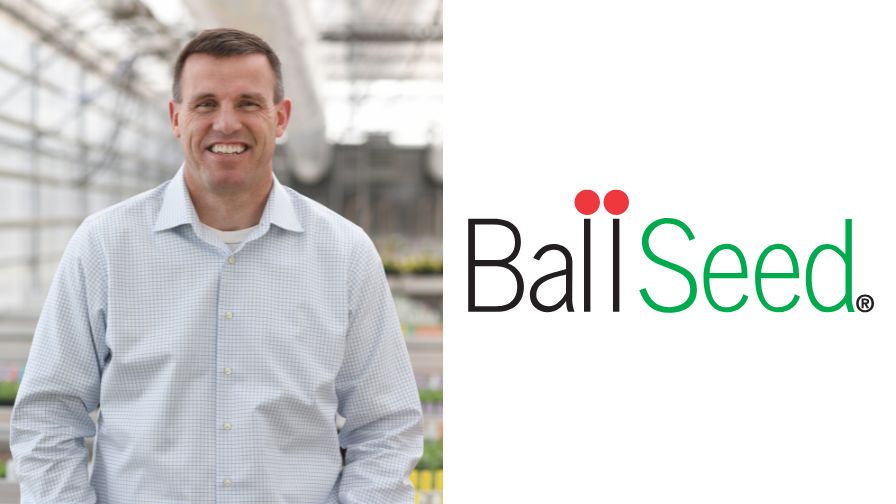
Jim Kennedy, soon-to-be President of Ball Seed. | Ball Seed
There may not be a company in the greenhouse industry doing business with more growing operations every day than Ball Seed. The distribution arm of Ball Horticultural Co. offers a range of plant material from seed, plugs, and unrooted cuttings to bare root, prefinished, or bulbs. Jim Kennedy is a 22-year veteran of the company, and he has been named its new president, effective Oct. 1, 2026. We caught up at the always-busy Ball Seed booth on the Cultivate’26 trade show floor to talk about this year, what growers can expect from future breeding innovations, and what differentiates growers who buy their plant material most effectively.
Greenhouse Grower (GG): So, how would you characterize 2026 for growers?
Jim Kennedy (JK): 2026 was a year of adaptation that turned out to be a pretty solid year for the industry. Many parts of the country had a strong June, and we needed a strong June. Having the consumer buying into the month of June was important for our customers. The year started out strong in the South, started out strong in the West, then in the Mid-Atlantic, Northeast, and East, some rough weather hurt sales in May, so we all needed that June.
From a supply chain standpoint, there were no massive disruptions. There were some snowstorms, there were some frozen cuttings, there were a few frozen shipments, but I feel like we weathered it well. And we worked through the tariffs and the surge in fuel prices in the late part of the cycle.
GG: You mentioned the importance of having a good June, but your year (at Ball Seed) is essentially booked by then, right? So, is the summer really about rooting for your customers to have a good year because that will lead into fall bookings and 2027 conversations?
JK: We take a long-term view of success within the company. If our customers aren’t doing well, we’re not doing well. Our whole mindset depends on our customers’ success. So, while we are booked up by June, the health of the industry depends on the consumer buying, and that’s why it’s our focus.
GG: Talk to me about your thoughts on consolidation. There’s obviously been plenty on the live goods side, and now there is news of the merger of Syngenta Flowers and Dümmen Orange. Is consolidation over in the industry?
JK: I don’t think consolidation is over. The big growers will continue to get bigger. I think that the scale of operations, from efficiencies in labor, efficiencies in systems, and being able to scale automation, pushes consolidation, along with the access to capital.
And while I do see that trend, there’s also a counter trend: there’s a lot of new customers coming into our category, new cut flower customers, smaller [growing] operations that are doing niche things.
GG: How about consolidation within seed and variety companies?
JK: You mentioned earlier about the current merger: That’s almost a mega consolidation because Dümmen Orange had already acquired several companies and Syngenta Flowers was the combination of a couple of companies over time. Now those two becoming one is a big event. It’s hard to predict where the next one might occur. What’s important in our model is to have a diversified supply base because we like to bring unique products to our customers.
When I think about our supplier community at Ball Seed, we actually have more suppliers today than we did 10 years ago because of the interest in finding product that has a regional fit. Maybe it is unique to the Mountain West or unique to the Northeast, or a product that does well in the Southwest. Maintaining that diversity is important for us to be able to bring the best to our customers from a depth and a breadth of assortment.
So, even as some of the other suppliers might be getting bigger, we’ve added smaller suppliers that bring something novel or diverse to the table.
GG: If you could give growers one piece of advice for 2027, what would you tell them to focus on?
JK: I would tell them to focus on your team. Focus on your people. Everybody wants to talk about AI and implementing technology, but enabling any kind of technology takes a human mind. It takes human ingenuity to get new ideas. So, invest in your team. You’ll get the return out of that investment because that’s where your good ideas come from, and they’re the ones who will load the right prompt into the language model. They’re the ones who will suggest, “Let’s automate this other process,” or “Let’s add this new product because we see an opportunity.”
GG: Okay, look out five years for me. What changes between now and 2031 in the floriculture space in particular?
JK: As technology continues to evolve, the opportunity to improve replenishment and improve systems through language models that can program and code and make things faster, augmenting that technology to make team members more efficient or do more by leveraging technology, that will probably increase.
What’s going to change in genetics will be driven by advancements to find products that are tolerant of greater stresses, like plants that are more drought-tolerant or can survive a wet summer or provide more disease resistance. Those kinds of features are going to drive value to the consumer through greater longevity and performance in the garden while still working in the supply chain in terms of efficiencies and scalability.
But it’s also important to talk about what won’t change … and that is the positive impact of plants on people’s lives. There is a timeless connection between plants and human hearts, and the intrinsic value of what plants bring to the world. I think that’s going to continue to be a constant. It’s still going to matter. And that’s really important.
GG: How much room is there for meaningful improvement in genetics? And I ask that with respect for the tremendous plants that have already been developed. If I’m a grower walking around this [Cultivate] trade show floor, I don’t see a lot of gaps. I can get a quality version of just about every plant I want.
JK: Well, it’s the thing that they’re not asking for today that’s going to bring the innovation. You could make the analogy to the iPhone or to Henry Ford’s car — people were still looking for faster horses when the first car arrived. If you’re looking for a better red Begonia, you’re not likely to find one. But if you want something that will perform in your garden, that has unbelievable heat tolerance or unbelievable disease tolerance.
If you take just a short look back into the history of varieties that have been transformative to the category, like in the last 20 years, you had something like SunPatiens. You go back 25 years, you have Wave Petunias. More recently, look at the growth in a category like Mandevilla. Maybe even seven years ago, a lot of our garden centers or retailers didn’t know they needed a Mandevilla. Now they do.
There’s likely that next thing around the corner that’s going to bring superlative performance, whose name we don’t know, species we can’t pronounce, that’s going to bring innovation to the category.
GG: Do those new plants grow the pie for the industry, or do they just shift dollars?
JK: I think they grow the industry in terms of dollars. They may not grow total units. As the industry has evolved from mass plantings and homeowners planting flats of Impatiens in the shade in the backyard, today, maybe they’re planting a few less plants.
But think about today’s landscaper who’s purchasing and planting and invoicing 400 SunPatiens for a job that 15, 20 years ago might have been 400 Impatiens walleriana. They’re generating more dollars. And today’s consumer who’s buying a huge patio pot with a Hibiscus and several other components that are going to sit on their porch and look beautiful all the way to frost, they’re dropping more on that than they did for a $10 hanging basket.
So, I think the innovation grows the dollars. It helps drive growth and overall revenue to the industry.
GG: Ball Seed has a unique perspective, given your scale. When you think of the growers who buy live goods most effectively, what do they do that differentiates them from the growers who don’t buy their plant material as effectively?
JK: One of the first things that comes to mind is how much they pay attention to their customers. From a wholesale grower to a grower-retailer, making purchases with a read on data and also with intuition.
When they focus on how consumers are acting in their space and then couple that with data and what’s selling, what colors they’re selling, what sizes they’re selling — any kind of seasonality or any kind of trends — then they have the right customer perspective.
I think the other thing they do is engage with their supply community. What is coming down the line? Trialing new products. I think that the ones who do it effectively maybe don’t trial everything, but they trial some things to say, OK, I’m going to do a test market on this. I’m going to trial this plant to make sure I understand the crop time.

Executive Perspectives is an editorial series in which Greenhouse Grower visits with leaders from across the industry to learn the challenges they see facing growers from their respective part of the business and their recommendations to help growers succeed. This interview has been edited for style, length, and clarity.
Bob West is the Chief Content Officer at Meister Media Worldwide, the publisher of Greenhouse Grower. He can be reached at 440-602-9129 or [email protected].
Subscribe to eNewsletter