



New Research Explores Emerging Tools for Plant Health
 August 25, 2026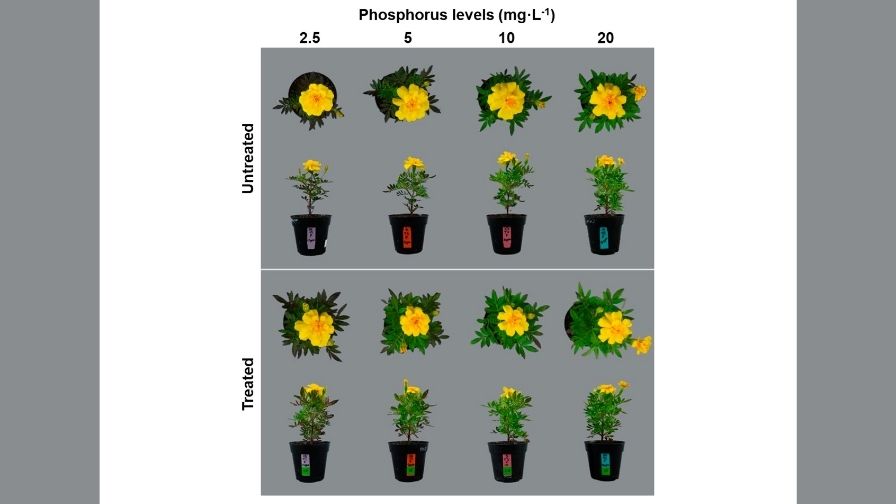
French marigold (Tagetes patula ‘Durango Yellow’) plants received four phosphorus rates, with or without Lalrise Vita applied at transplanting. Plants were photographed four weeks after transplanting. Photos were taken four weeks after transplanting. | The Ohio State University
Greenhouse growers spend much of their time focused on immediate production needs, while horticulture researchers continue to explore new ways to improve plant health. Here’s a look at two research projects that could offer growers new approaches to plant nutrition.
Exploring Insect By-Products as Nutrient Sources
With funding from American Floral Endowment and other groups, Pamela Andrade, a master’s student in horticulture at the University of California, Davis, is exploring nutrient management approaches related to fertilizer supplies and sustainability.
Mealworms raised for animal feed and alternative proteins generate by-products that may also have horticultural value. Two of the most abundant are frass, or insect manure, and exuviae, the exoskeletons shed during growth.
In commercial mealworm systems, frass can accumulate at up to 40 times the insects’ biomass and typically contains 3% to 5% nitrogen and about 70% organic matter.
Exuviae contain chitin, a naturally occurring polymer associated with microbial activity, gradual nutrient release, and plant-growth responses. Research has also linked chitin-based materials with increased plant biomass and nutrient uptake.
In greenhouse trials comparing chitin, chitosan, and mealworm exuviae, Andrade and her team found that exuviae consistently produced stronger plant growth, particularly in biomass measurements.
Learn more at Endowment.org/all-news.
Can Biostimulants Improve Phosphorus Efficiency?
Researchers at The Ohio State University examined whether Lalrise Vita, a commercial biostimulant containing the beneficial bacterium Bacillus velezensis, could improve French marigold growth while reducing phosphorus fertilizer inputs.
Marigolds received four phosphorus levels: 2.5, 5, 10, and 20 mg/L. Half received Lalrise Vita at transplanting, while the others served as untreated controls. Researchers measured plant growth, leaf color, chlorophyll-related traits, and nutrient concentrations over four weeks.
Treated plants at 2.5 and 5 mg/L produced significantly more biomass than untreated plants at the same rates, and treated plants at 5 mg/L grew similarly to untreated plants receiving 20 mg/L.
Treated plants also had greener foliage and higher leaf phosphorus concentrations, suggesting improved uptake or use of available phosphorus.
Researchers found lower nitrogen concentrations in the faster-growing treated plants, which they attributed to greater biomass. The authors suggested that additional nitrogen may be needed to maintain balanced nutrition as growth increases.
Overall, the study suggests the biostimulant could improve phosphorus-use efficiency in greenhouse-grown French marigolds while maintaining plant quality.
Learn more at https://journals.ashs.org/view/journals/horttech/36/2/article-p256.xml.
Subscribe to eNewsletter