




7 Reasons to Upgrade to an Open-Roof Greenhouse
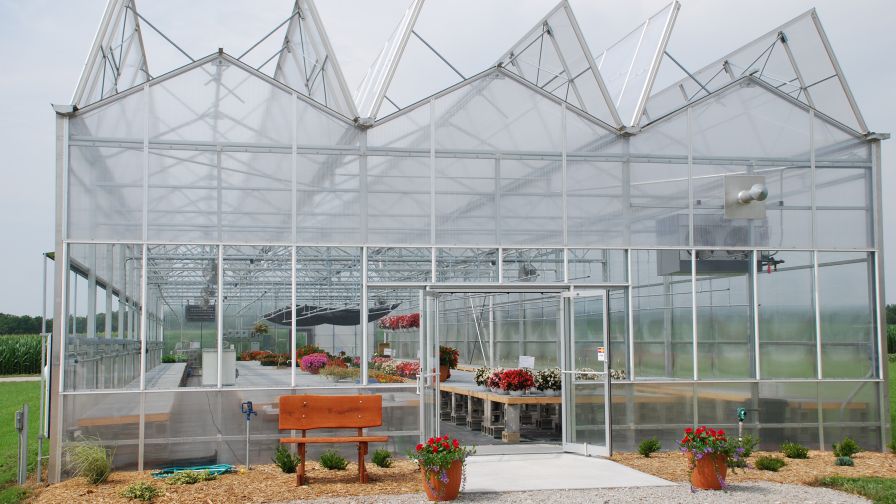
A retractable/open-roof greenhouse design. | Prospiant
Open-roof greenhouses, also known as open-roof greenhouses, help eliminate the common risks tied to all-greenhouse or all-outdoor crop production by providing greater control and flexibility over one’s growing environment.
Growers can safely expose crops to outdoor environments for steering and conditioning without moving them and without compromising their protection.
So, why choose an open-roof greenhouse design? Here are seven reasons why making the switch can benefit a grower’s crops, crew, and customers.
1. Put the Natural Elements to Work
Annuals and other bedding plants must eventually leave the comforts of the greenhouse. But first, they need gradual conditioning or toughening up to prepare them for harsher outdoor conditions.
Plants sitting on outside benches are at the mercy of sudden weather changes — cold snaps, heavy rain, or high winds — that could damage them or set their growth back.
An open-roof greenhouse allows growers to acclimate their plants to the outdoors with complete control and without extra handling.
Simply open the roof when conditions are favorable and close it when inclement weather threatens.
2. Save on Labor
Traipsing back and forth to move plant containers out of the greenhouse to harden them off requires a significant amount of time and labor, which can be put to better use.
Instead of moving plants, growers can open the roof for conditioning and keep outdoor growing space free for other uses.
Instead of half the team spending hours swapping out seasonal coverings, growers can eliminate this labor-intensive step.
For crops like florist azaleas, using an open-roof greenhouse can mean two to five fewer handling steps, according to Sven. E. Svenson, a retired professor from Southeast Missouri State University and Oregon State University. Svenson says growers can eliminate as much as 50% of handling labor costs by growing under an open-roof greenhouse, depending on the crop and current handling system.
3. Maximize DIF and DIP to Reduce PGR Use
Growers can use an open-roof greenhouse to manipulate DIF (the temperature difference between day and night) and DIP (the morning temperature drop). This has a similar effect to plant growth regulators (PGRs) on plant growth.
A positive DIF promotes stem elongation, while a negative DIF inhibits it. For more compact plants, growers can open the greenhouse roof just before sunrise to let the greenhouse temperature drop, then close it a few hours later to warm the greenhouse back up.
This dip in temperature creates the negative DIF needed to suppress stem elongation. Growers also gain some energy efficiency since they’re not heating the greenhouse overnight.
4. Protect Crops from Unwanted Moisture
Growers can shield their crops from excess moisture without sacrificing airflow because the peak gutters in open-roof greenhouses catch the rain while the roof stays slightly open for ventilation.
And because open-roof systems open by degrees, growers can crack it open slightly, from 10% to 15%, in the morning to clear out moisture and humidity without shocking the crop. Continue to open it wider incrementally for the next few hours and then begin closing it in the afternoon to lock in heat for the night.
The best part? It’s all automated. No manual adjustments are needed.
For three additional reasons to consider an open-roof greenhouse, please read the original article found on the Prospiant website.
Subscribe to eNewsletter