



Taking Action on Profitability
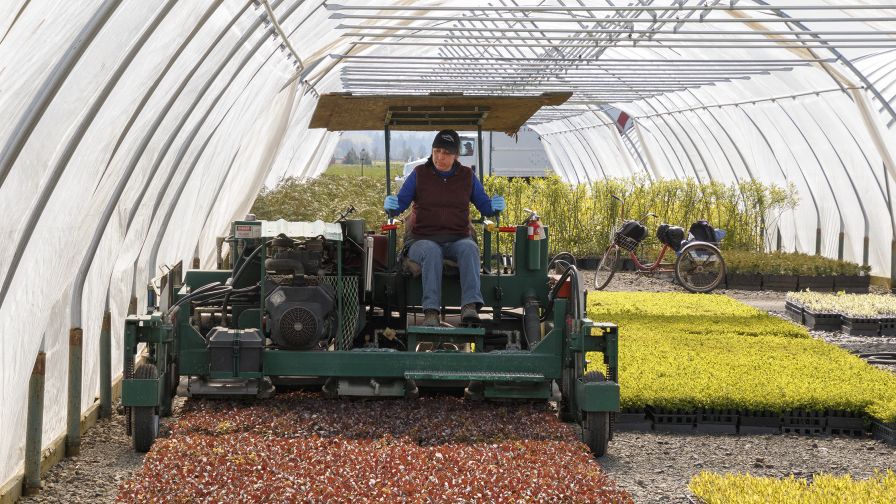
Mechanized pruning can help growers save labor and improve consistency across the crop. | Doreen Wynja
Improving profitability in 2025 did not come down to one standout move. In Greenhouse Grower’s 2026 Top 100 survey, respondents pointed repeatedly to the same kinds of actions — tightening labor, improving workflow, investing in practical automation, planning production more carefully, and taking a harder look at pricing and product mix. The details varied from business to business, but the responses point in a clear direction. The actions that made the biggest difference were usually the ones that gave growers more control over labor, production, and margins.
Operational efficiency came through as one of the strongest themes in responses. For some growers, that meant reducing labor hours, limiting overtime, or finding ways to improve productivity across the team. For others, it meant tightening inventory control, improving product flow, or organizing production schedules more effectively.
Several respondents pointed to more accurate production planning as one of the most effective steps they took in 2025, especially when it came to aligning output more closely with demand. That matters because it shows profitability was often improved by reducing the kinds of losses that quietly chip away at margins, whether from excess product, inefficient labor use, or preventable waste.
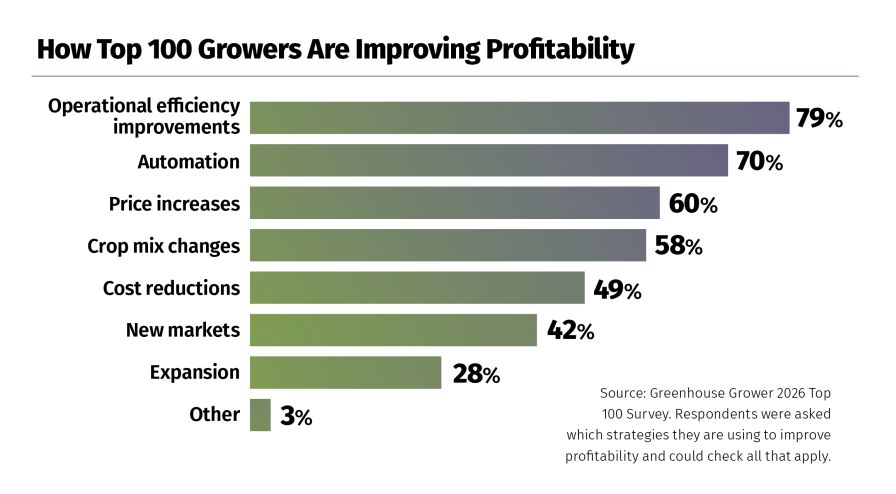
From the Greenhouse Grower Top 100 Survey: Respondents were asked which strategies they are using to improve profitability and could check all that apply.
When asked which strategies they are using to improve profitability, respondents most often selected operational efficiency improvements at 79%, making it the top-ranked answer. Automation followed at 70%, with price increases at 60%, crop mix changes at 58%, and cost reductions at 49%, also ranking high. Rather than pointing to a single profitability formula, those results suggest growers are improving performance by tightening multiple parts of the business at once.
Automation also showed up often in responses, but usually in a practical way. Growers were not talking about technology as a future-facing concept. They were talking about investments that solved specific operational problems. Some pointed to packaging-line automation, stick machines, ERP upgrades, and greenhouse or sales software as effective actions that improved profitability. Others referenced robotics, analytics, labor tracking, and data-driven tools that gave them better visibility into workflow and performance. What those responses suggest is that automation is proving most valuable when it supports consistency, reduces labor pressure, and helps managers make better decisions faster.
Profitability was not just about labor and automation, though. Many respondents also pointed to pricing discipline, cost control, and product decisions as some of the most effective actions they took in 2025. Some said they raised prices based on a better understanding of actual production costs. Others mentioned fuel surcharges, broad expense reductions, or efforts to cut input costs. Several growers described simplifying their product offerings, eliminating poor-selling or low-margin items, or making shifts in container size and crop mix to improve turns and reduce inefficiencies. In other words, profitability was not just about producing more. It was also about being more selective about what to grow, what to keep, and what no longer made financial sense.
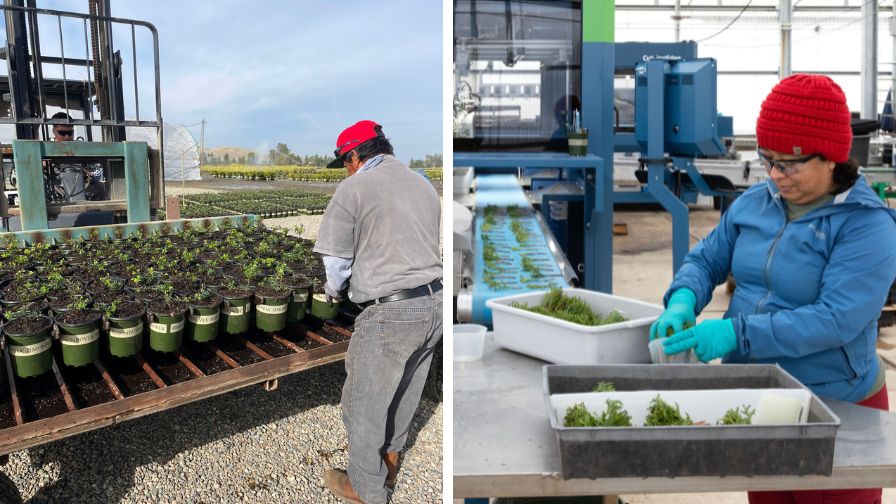
Tighter workflow and more efficient product handling can make a meaningful difference in profitability (L), and for many growers, the most effective automation investments are the ones that solve everyday operational problems (R). | Monrovia and Doreen Wynja
What stands out in the responses is how grounded these decisions were. The strongest profitability moves were often not about expansion or sweeping transformation. They were about sharper execution. Growers talked about knowing their numbers better, planning more carefully, simplifying where needed, and investing where the return was clearest. In some cases, the most effective move was not adding something new, but removing something that was no longer working, whether that was a weak product line, an inefficient workflow, or an expense that no longer made sense.
That may be the clearest message from this year’s Top 100 survey. The most effective actions were often the ones that gave growers more control over labor, production, pricing, and product mix.
Subscribe to eNewsletter