


Why Business Valuation Matters for Horticulture Owners
 November 15, 2025
Aerial view of the greenhouses of a large farm. | Stefano Tammaro via Adobe Stock
Every horticulture business owner faces the same reality: one day, you’ll exit your business. Whether you sell, shut down, or transition to family or employees, planning starts with knowing what your business is worth.
We often start educational sessions by asking, “Does everyone know the value of their home?” Most people raise their hands. It’s easy to check on Zillow or ask a realtor.
We follow up with another question, “Does everyone know the value of their 401(k) or investment portfolio?” Again, most people raise their hands. Online retirement plan portals or a financial planner are quick resources to determine value.
Finally, we ask, “Do you know the market value of your company?” Very few hands go up. For most owners, the business is their largest asset and biggest wealth builder for them and their family. Yet, many don’t know what the business is worth.
Unlike your home or investments, which depend on external factors outside of your control like the stock market and economy, you have control over your company’s value. A business valuation is the first step in succession and exit planning — and in shaping your retirement and financial future.
The Survey Said…
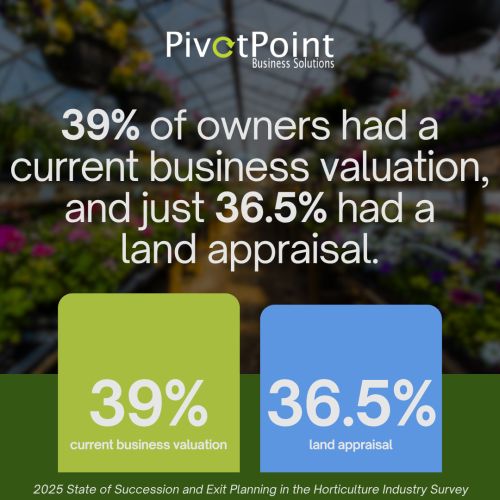
In our 2nd Annual “State of Succession and Exit Planning in the Horticulture Industry” survey, we asked respondents if they had done a business valuation or land appraisal in the past two years. Only 39% had a current business valuation, and just 36.5% had a land appraisal. Nearly half, 47%, had neither. It is safe to assume many owners do not know what their business is worth today, making it nearly impossible to evaluate an unexpected offer, determine how close they are to a financially secure retirement, or even have a baseline value to work from when preparing the business for transition to family or a third-party sale.
When asked if they had calculated a minimum purchase price to fund their post-exit lifestyle, 55% of respondents said they’ve determined their minimum price, yet 61% still lacked a firm estimate of their current business value. That disconnect is concerning. How can you define your financial finish line without knowing where you’re starting? This also raises the question: Are owners considering creative strategies, like retaining and leasing land back to family successors or a new owner to generate passive income in retirement? Tactics like this can significantly help close the financial gap — but only if the numbers are known.
Identify Value
So, where do you start? According to the Exit Planning Institute, there are five stages of value maturity:
- Identify value (valuation)
- Protect value (risk mitigation)
- Build value (business improvements designed to maximize value at the time of succession or sale)
- Harvest value (reap the rewards via succession or sale)
- Manage value (manage your business value and your personal financial value after exiting the business)
There is a reason it all starts with identifying value. Your business could represent 80–90% of your net worth, yet less than half of owners know its true value. A baseline valuation identifies key factors to increase value and highlights risks that could decrease value to a potential buyer.
Types of Valuations
In our work with growers and horticultural business owners, we begin with what we call the Discover stage — understanding your business beyond numbers, including goals and readiness. Any advisor can tell you what to do, but without grasping the inner workings and key tangible and intangible factors of your business, they risk missing the big picture.
In our industry, we generally see the following types of valuations:
Asset Sale Valuation
Used in most business transactions within the industry. It identifies the value of both tangible and intangible assets (see below) and is often the simplest approach for businesses with significant physical assets, such as greenhouses, equipment, and inventory.
Multiple of EBITDA
Earnings Before Interest, Taxes, Depreciation, and Amortization is a common measure of pre-tax profit. The multiple is based on factors such as industry standards, market conditions, comparable operations for similar businesses, as well as intangibles, and whether the business is a “best-in-class” operation.
Multiple of Sellers’ Discretionary Earnings (SDE)
Primarily looks at cash flow to the owner. It is typically used for businesses under $1.5 million in value, or when someone is looking to “buy a job”. It helps buyers estimate how much they can expect to make as an owner/operator running the business full-time.
Enterprise Value (Stock Sale)
Considers the whole business — lock, stock, and barrel — including all assets and short- and long-term liabilities, which are typically excluded from an asset sale. Commonly used when a buyer acquires the ownership interest of a partner (internal sale), family succession, or when a buyer purchases the entire business from the owner.
Liquidation Value
Immediate sale of assets and covering all debts. Often, the land is simply worth more than the business could ever generate. Unfortunately, this happens in our industry more than we would like.
A baseline business valuation will look at the land as a separate transaction, considering its value in relation to the business. It could be sold, leased to provide an alternative income stream, or used in a lease-to-own scenario in the future with a potential buyer or a family successor.
Tangibles vs. The Intangibles
In the past, wealth was created from physical assets (land, equipment, and human/machine labor). Technology has changed all of that. Traditional accounting measures only the tangibles, which represent, on average, 25–30% of the business value. Intangible assets are the primary drivers of business attractiveness and represent 70–75% of a company’s value, significantly influencing the multiple that a potential buyer will consider. Today, intangibles are the most important in the green industry and are equal to a company’s intellectual capital divided into the 4 C’s, which should be measured and represented in value calculations:
1. Human Capital
The measure of talent on your team, your key management, training and development, and bench strength.
2. Customer Capital
Customer concentration to sales, sales relationship ownership, and future growth targets and planning.

3. Structural Capital
“The Secret Sauce,” including your processes, standard operating procedures (SOPs), key performance indicators (KPIs), technology/automation, and what differentiates you from your peers.
4. Social Capital
Your culture, brand, online, customer, and industry reputation, team collaboration, and whether there is a growth and opportunity mindset.
Where to Start
Connect with a Certified Exit Planning Advisor (CEPA). Your CEPA can coordinate with your accountant, attorney, and financial advisor to align your personal, financial, and business goals and conduct or arrange a business valuation as a vital first step. You may know your numbers, but do you know how much you and your business are worth? Our best advice – start today! A valuation isn’t just a number; it’s the foundation for your future.
Get the Survey
View and download a complimentary digital copy of the 2025 State of Succession and Exit Planning in the Horticulture Industry Report and ask us about the new, complimentary PeerReview, a customized report comparing your responses to the full 2025 survey data. It shows where you’re ahead, where there’s room to grow, and what steps others are taking to prepare for transition.
Subscribe to eNewsletter