



Watch for Unusual Leaf Deformations in Poinsettias from Zinc Deficiency
 November 12, 2026
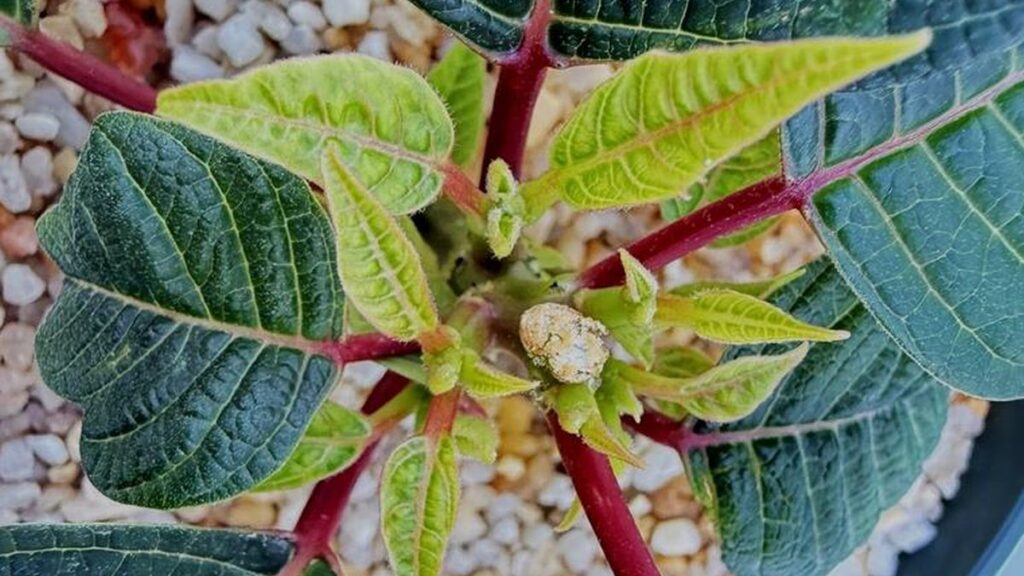
Ranch Red’ poinsettia with thick arrow-shaped leaves. This is the typical symptom of zinc deficiency in recently pinched poinsettias. | Luke Finn, North Carolina State University
A recent e-Gro Alert from Brian Whipker and Luke Finn of North Carolina State University looks at the uncommon plant nutrition issue of zinc deficiency in poinsettias. Taken from a research study at NC State relating to rooted cuttings grown hydroponically, the pair investigate the symptoms to determine the root cause and share their findings so growers can be more conscious of potential crop health problems.
Zinc Deficiency in Poinsettias
The Ecke Poinsettia Manual describes zinc deficiency in poinsettias as the “yellowing or interveinal chlorosis of the young leaves.” However, Whipker and Finn note that there are much more severe symptoms that growers should be made aware of. In the study of hydroponically grown poinsettias, new growth from zinc-deficient plants was observed as “thick, arrow-shaped leaves,” with the compact growth continuing to linger after corrective measures were taken. Past hydroponic research studies documented this unusual disorder when zinc was supplied at a fertilization rate of 10 mM. It was solved when the rate was doubled to 20 mM.
Whipker and Finn hypothesize that plants grown in hydroponic systems are more susceptible to this condition due to the lack of zinc being provided to the plants from a substrate.
Corrective Measures for Zinc Deficiency
Whipker and Finn recommend that growers “ensure that their fertilizer has enough Zn available” and that the “substrate pH is within range (5.8–6.2),” so that the zinc is “soluble and available to the plant,” as it becomes less available when the substrate pH rises above 6.5. Additionally, the pair warn against overwatering, which can inhibit zinc uptake and/or siphon nutrients, and excess phosphorus fertilizer concentrations, which “can have an antagonistic effect on Zn uptake.”

For additional information on zinc deficiencies in poinsettias, including why the findings of this study are applicable beyond hydroponics, please read the full e-Gro (Electronic Grower Resources Online) alert “Poinsettias: Unique Distortion of a Zinc Deficiency.”
Additional and current e-Gro alert pieces from Volume 15 (2026) can be found online.
Subscribe to eNewsletter