





Bract Edge Burn and Leaf Edge Necrosis. Might be Calcium Deficiency.

Along with magnesium and sulfur, calcium is one of the three secondary macronutrients. Although these macronutrients are not required at the same levels as the primary macronutrients (nitrogen, phosphorus, and potassium), these elements are essential for healthy plant growth.
Symptoms
In Poinsettias, calcium deficiency will typically show up as leaf edge necrosis or bract edge burn. As it develops, a leaf tends to stop developing properly and it forms brown spots and distorted leaf growth.

Leaf edge necrosis in poinsettias
For fruits and vegetables, fruits will not develop properly when affected by calcium deficiency. Common calcium deficiency causes blossom end rot where the fruit looks good on top, and the bottom has a brown spot on it.
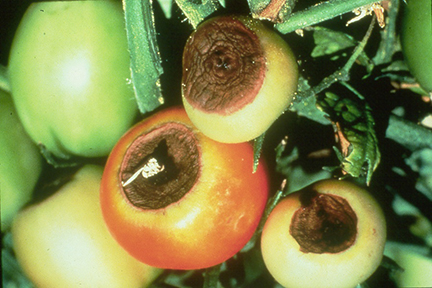
Blossom end rot in tomato
Causes
Typically, the causes of calcium deficiency, besides the lack of calcium in a fertilizer program, can be anything that disrupts the water flow through the plant. As the plant requires the water to bring the calcium up into its new growth, anything that reduces the evaporation or the movement of water out through the plant can cause a deficiency.
For example, if the humidity in a greenhouse is high or conditions are very cold, it will inhibit the uptake of water which in turn inhibits the uptake of calcium. Even if the calcium levels are normal in the growing media, it can induce a deficiency. Another possibility is competition. For example, at high levels, magnesium can be in direct competition with calcium, preventing the plant from taking up calcium as efficiently and inducing its deficiency.
A lot of people think that calcium is tied in with pH. It is true that pH does influence its availability to some degree, but pH is really not a factor when it comes to deficiency symptoms. Normal rates of calcium in your fertilizer solution or in your growing media should be at a minimum of 40 parts per million (ppm). Some crops such as poinsettias and geraniums prefer 80 parts per million minimum.
Toxicity
Some crops can tolerate much higher levels of calcium, and toxicity is a rather unusual symptom to find. However, if you do see high levels of calcium, what typically happens is that calcium can interfere with the uptake of other elements instead of causing toxicity. For example, a high calcium level will interfere with the uptake of magnesium and/or potassium and indirectly cause their deficiency symptoms to appear.
If you have a high level of calcium in your growing media, check your fertilizer type and application rate, but specifically check your irrigation water. Some water sources can have calcium levels as high as 200, 300 parts per million, which is very unusual. In this particular case, you may want to consider looking at other water sources or re-evaluate your fertilizer type and application rates for something that is better adapted for your irrigation water.
Sources of calcium
There is certainly a lot of good choices of water-soluble fertilizers available that contain calcium and magnesium. For instance, of 13-2-13, 15-5-15, 17-5-17, which are called Cal-Mag fertilizers, provide both calcium and magnesium, but generally not a large amount of calcium. So, they’re good if you need to increase these elements a little bit and if your irrigation water contains a low level of calcium. If your irrigation water has very little calcium in it (<20 ppm Ca), a 15-0-15 water soluble fertilizer provides a significant amount of calcium, and you can rotate its application with other fertilizers in your fertigation program. Make sure to adjust the fertilization to the appropriate stage of growth of your poinsettias.
If you are using reverse osmosis, pond water or other types of purified precipitation runoff irrigation water, these are typically low or void of calcium, so you likely will need to supplement calcium.
Another option is to supplement by incorporating gypsum into the growing media. Gypsum will give you a one to two months’ supply of calcium. If you’re growing organic, you can add bone meal products or other calcium supplements, but keep in mind that these products take a long time to break down. Your goal is to achieve >40 parts per million calcium in your water and fertilizer source with every watering. This will help to avoid calcium deficiency symptoms in your crops.