




Is hydroponics profitable?
Many farmers wonder what the productive difference is between hydroponics or soil cultivation, beyond the need to avoid edaphological limitations.
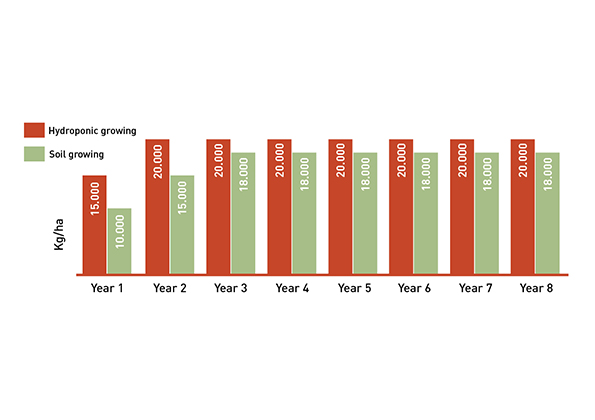
Per Álvaro Villalba, Projar’s expert in hydroponic cultivation, “Soilless crops offer harvests up to 50% higher in the first year. In this way, although hydroponic productions require, of course, a higher investment, it quickly pays off ”.
As a demonstration case of this profitability in the short term, we are going to analyze the specific case of a company in Peru, a project developed entirely by Projar, which started a hydroponic blueberry production from scratch. It was decided that part of the production would be in soil and part in hydroponics, to test and decide which method to use in larger plantations. *
With the results obtained, the observed costs were the following:
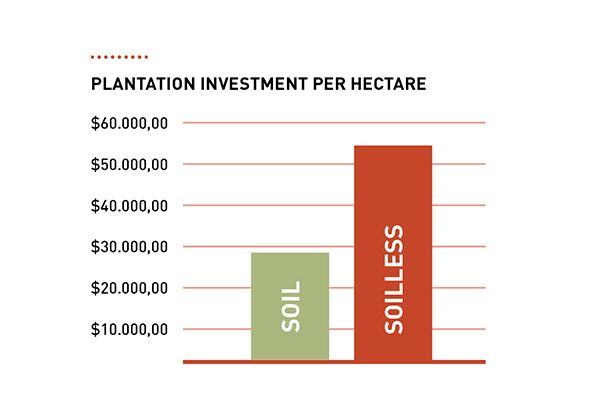
These costs include everything from soil preparation to plant acquisition to labor. It is important to note that in soil the planting density was 3,000 plants per hectare and in hydroponics 5,000 plants per hectare, so the cost of the plants themselves is almost double.
Once both cultivation methods were implemented, the production phase began. When it was time to harvest, the income per hectare in the first 3 years was as follows:
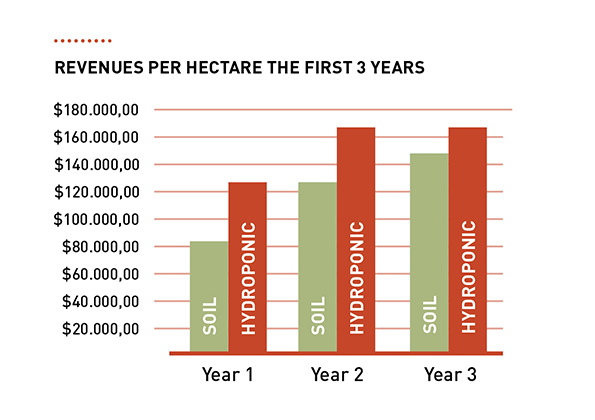
The income calculation has been carried out knowing the production obtained and taking overseas seasonal prices as a reference. In this production, the income of the hydroponic plantation in the first year was 50% higher than that of the soil plantation.
* We are talking about a production with suitable soil in which the farmer, who knew the advantages of hydroponics, wanted to verify these results.
Why are there such good returns in those first few years?
The substrate is a “more comfortable” growing medium than the soil. To begin with, the moment of planting occurs without stress, because the substrate offers an environment very similar to the one that housed the plant in the nursery. This causes the plant to start up very optimally. In addition, in a container, the roots will develop very strong and quickly.
This early development of the roots will cause the harvest to be advanced and it will be much higher in those first years. As the years go by, of course, the harvests are equalized because in the soil they end up developing well, despite the fact that the first year, more slowly.
 More technical production
In addition to the productive advantages, hydroponics allows the cultivation to be made more technologically advanced, achieving greater control in production. This is where the efficiency of hydroponics resides, since it allows the farmer to provide the plant with the exact dose of water and nutrients at the right time, preventing the plant from investing much more energy in its growth and production.
Projar, with more than 15 years of experience in the market, created an advisory manual on the basics of growing with coconut fiber, which are the crops that are best adapted to hydroponic cultivation and the rapid return on investment of this system cultivation.
You can download the manual for free from this link: https://bit.ly/2HXPjh3