



Why the Future of Grower Software Looks Promising
 November 19, 2026
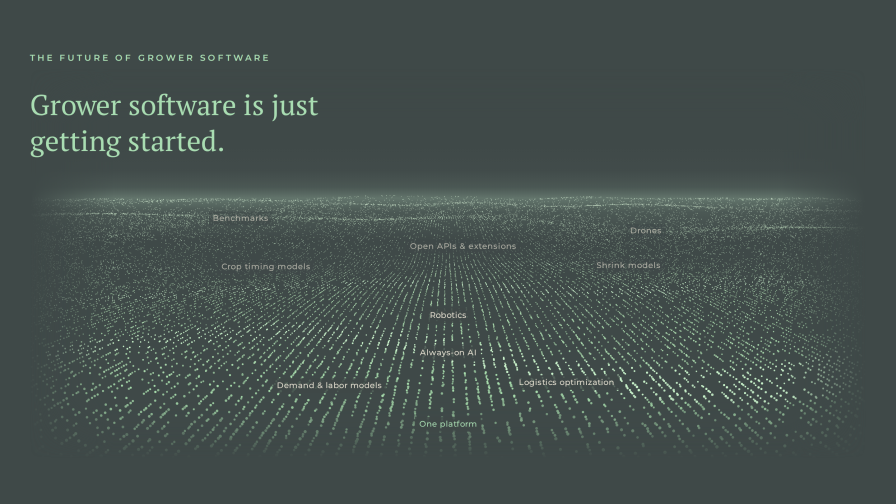
Image credit: Silver Fern
The greenhouse industry has reached a turning point in how software is built and used. The good news, however, is that AI is not only dramatically reducing the cost and time required to create and maintain software. It may also make it economically feasible to create modern horticultural ERP systems that manage the entire business on a single grower-focused data model.
That’s according to a new “Future of Greenhouse Software” report from the executive team at Silver Fern. The report begins by noting that most growers are still managing their businesses through a patchwork of production systems, accounting platforms, spreadsheets, custom databases, and specialized applications because no single solution has historically handled the complexities of live crops.
Software fragmentation is one of the industry’s biggest hidden costs, according to the report. Growers often maintain separate systems for production, inventory, sales, forecasting, accounting, and customer management. As a result, staff spend significant time re-entering data, reconciling reports, and determining which system contains the most accurate information. This not only creates inefficiencies but also increases the risk of errors that can affect inventory accuracy, order fulfillment, and customer service.
One key reason for this fragmentation is that greenhouse operations manage a living inventory, which behaves very differently from products sitting on a warehouse shelf. Growers must track planting dates, finish dates, expected shrink, pre-booked orders, allocations, pay-by-scan inventory, and multiple unit conversions as plants move from liners to finished containers. Generic ERP platforms such as Microsoft Business Central, Sage, or Salesforce were not originally designed around these biological and production realities. Consequently, growers often rely on extensive customizations, spreadsheets, or add-on applications to fill the gaps.
The report also highlights a broader industry problem: too much software spending goes toward rebuilding the same basic functionality. Whether software is developed by ERP resellers, niche horticultural software companies, custom development firms, or internal IT teams, many organizations repeatedly invest in similar capabilities such as inventory management, order entry, availability calculations, pricing, EDI connections, and pay-by-scan tracking. Because resources are spread across many vendors and platforms, fewer investments are available for innovation and new features that could truly improve business performance.
Looking ahead, however, artificial intelligence is changing the economics of software development. As development becomes less expensive, it becomes more practical to build comprehensive, purpose-built grower platforms rather than relying on a collection of disconnected tools.
The practical implication is clear: when evaluating future technology investments, growers should prioritize solutions that reduce data silos, eliminate duplicate data entry, connect production and sales information, and provide a unified view of crop inventory from propagation through shipment. The report contends that the industry’s future lies not in adding more point solutions, but in moving toward integrated platforms designed specifically for horticulture. Growers that focus on system consolidation and data integration will likely be better positioned to improve efficiency, visibility, and decision-making as AI-enabled software continues to evolve.
Click here to check out the entire report.
Subscribe to eNewsletter