



Better Economy Or Bust
 April 28, 2009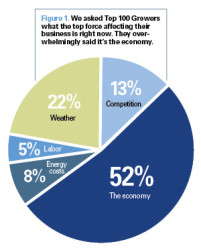
In our Industry Pulse report last issue, we asked growers of all sizes about the factor they deemed most important for their success this spring. Overwhelmingly, 70 percent of respondents to the Industry Pulse survey responded that good weather was the most important factor. Only 18 percent called a “vastly improved economy” the most important factor for success.
Right around the same time, we posed the same question to Top 100 Growers in another survey. Our anticipation was that good weather would once again trump the economy. But surprisingly, slightly more than half of Top 100 respondents called the economy the most important factor, more than doubling those who said the weather was the key (22 percent).
So why might the economy be a bigger factor than the weather for the bigger grower?
“That’s a tough call,” says Scott Lueder, president and CEO of Floral Plant Growers (No. 25) “It could probably go either way. The weather is definitely a driver, but assuming the weather is decent, I still think there are economic challenges facing the consumer on where they spend their dollars. So far, I hear from other growers that demand is strong and people are out.”
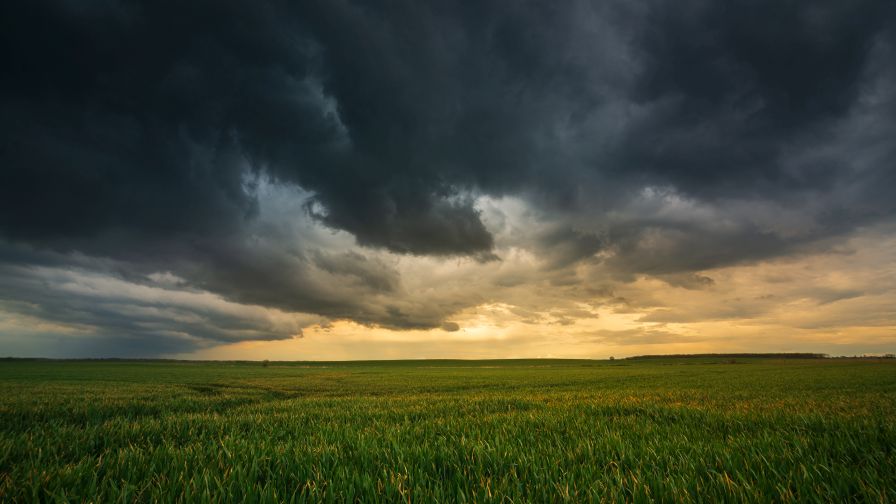



Plus, the weather can’t get much worse for growers in 2009 than it was in 2008.
“We had such poor weather to contend with in 2008,” says Charles Masloski, vice president of Hiebert Greenhouses (No. 66). “This year should be much better.”
Economical With Energy
Because the economy poses so many big questions, growers are now turning to energy-saving products and systems more than ever. Of the Top 100 Growers who responded to our survey, 96 percent are using bench and/or floor heating, 75 percent have energy curtains and 64 percent rely on double-layer glazings.
A handful of Top 100 Growers (11 percent) are also now using alternative energy, and wood is the resource most are burning. Petitti Garden Center/Casa Verde Growers (No. 77) is among the few operations burning wood, and General Manager Wayne Cousins says it’s the best idea the operation has implemented to tackle rising energy costs.
Other growers (92 percent) still rely heavily on natural gas as a primary or secondary fuel source, although more Top 100 Growers are burning oil and biofuels today compared to five years ago.
In addition, most Top 100 Growers report spending more per therm of natural gas in 2008 than 2007. In some cases, the increase per therm was only a few cents–and no growers reported any major spikes between 2007 and 2008. The same cannot, however, be said of propane, which was 42 percent more expensive last year than in 2007, according to Top 100 Growers who use it.
Other solutions to tackling rising energy costs:
–Rocket Farms (No. 5) is exploring the potential of solar panels and even more energy curtains.
–Twixwood Nursery (No. 83t) is paying better attention to production cycles and changing them so less heat is required.
–Green Valley Growers (No. 60) is taking advantage of portable heaters for nights, when it doesn’t need to heat its entire greenhouse range.
–Stacy’s Greenhouse (No. 93) has contracted long-term crops to be grown offsite.
Labor Issues
With the national unemployment rate nearing 9 percent, growers shouldn’t be experiencing labor shortages. Twenty-four percent of Top 100 survey respondents are, though, and another 7 percent expect to be affected by a labor shortage soon.
Bob’s Market and Greenhouses (No. 87) in West Virginia is one Top 100 operation currently coping with labor issues. A local aluminum plant there recently closed, putting about 650 people out of jobs. Forty- and 50-year-old men make up much of that group, but the operation needs quick, nimble employees to complete tasks.
Bob’s has not used Hispanic labor in the past, but it might have to considering it has few alternatives.
“Generally, we hire almost anyone that applies, as long as they pass their interview,” says Bobby Barnitz, CEO and president of Bob’s. “After peak season is over, we lay off the ones who weren’t so good and try to keep some of the best for the slow seasons and the future.”
For growers like Bob’s that have been affected by labor shortages, more automation (53 percent) has been the most common response. Some growers (27 percent) are increasing wages, while others (20 percent) have turned to labor placement services.
Subscribe to eNewsletter