


The Risk vs. Reward of Preventative Dipping
 June 15, 2026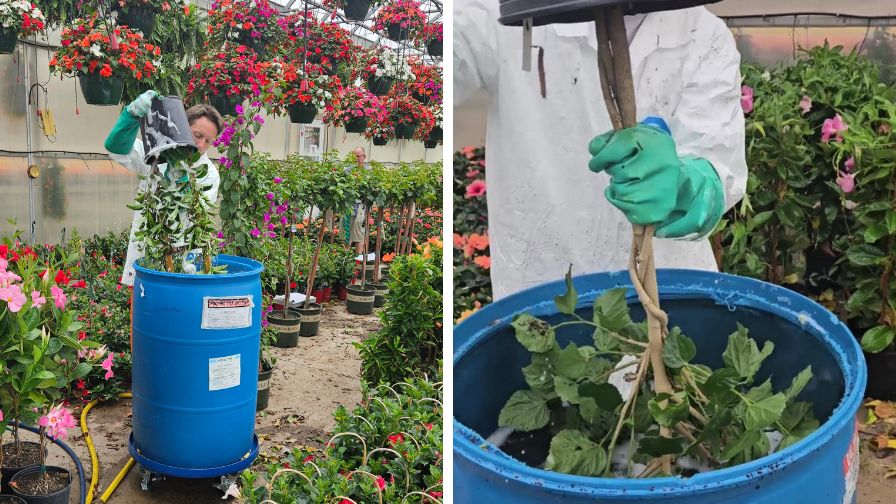
A mature plant infested with spider mites is dipped in EpiShield-O, a 25(b) bioinsecticide, to improve leaf-surface coverage and control where spray applications may not fully penetrate the canopy. | Julie Graesch, BioWorks Inc., taken at Eberts Greenhouse, WI.
For some growers, dipping unrooted cuttings and rooted liners is a standard preventative step. For others, the practice raises valid concerns, especially around the potential spread of disease. Even so, growers who rely on dipping say it can be an effective tool when handled carefully and built into a broader IPM program. We spoke with several experts about the risks, the benefits, and the best practices that can help reduce the chances of problems.
What Is the Risk?
The biggest concern with dipping is the possibility of spreading disease to cuttings or liners that were otherwise clean. Margery Daughtrey, Senior Extension Associate in the Plant Pathology and Plant-Microbe Biology Section of Cornell CALS’ School of Integrative Plant Science, says even a small amount of contamination on incoming material can be spread through water. “Even if there is only a very small percentage of contamination in the plants as they arrive, it can be shared even more effectively by dipping than by overhead irrigation, which we all accept is a way that bacterial diseases spread.”
While growers may dip to reduce pest pressure, it is the potential spread of waterborne pathogens that gives many of them pause.
“I think the biggest disease-spreading concerns would be bacteria, including various Xanthomonas, Pseudomonas, Pectobacterium, and Dickeya species, and perhaps Berkeleyomyces and Fusarium,” says Daughtrey. “All have small propagules — cells or small spores — that can be easily distributed in water, so dips into a solution that does not control them can facilitate disease spread.”
Michael Brownbridge, Ph.D., Senior Technical Services Manager for BioWorks, points to research at the Vineland Research and Innovation Centre in Ontario that examined disease transmission during dipping.

Rooted cuttings are dipped in RootShield PLUS WP to treat roots with Trichoderma and help prevent soilborne disease. | Michael Brownbridge, BioWorks Inc.
“We focused on Pectobacterium carotovorum because it transmits very easily in poinsettias and could potentially be spread through a dipping process,” he says.
Even under artificially high concentrations of the bacteria, Brownbridge says the risk of transmission remained extremely low, with pests posing the bigger concern.
Matt Foertmeyer, Head Grower and Owner at Foertmeyer & Sons Greenhouse Co. in Ohio, has been dipping young plants for nearly nine years. His team dips everything as it comes in, whether it is a cutting, plug, or rooted liner, and he says the benefits still outweigh the concerns.
“There’s some increased potential to spread disease,” he acknowledges. “But the benefits of making sure your product comes in clean outweigh that risk. As far as disease spread goes, I have not had any major outbreaks in the nine years we’ve been doing it.”
What Is the Benefit of Dipping?
Dipping is meant to protect healthy plants, not rescue infected ones.
“If you have a plant that’s infected with a pathogen, you’re not going to be able to cure it,” says Dr. Angela Madeiras, Extension Plant Pathologist at the University of Massachusetts Amherst. “But the plants that are not infected will get some protection against becoming infected. That’s really the game plan.”
For Foertmeyer, dipping works best when it supports a clean start for incoming material.
“We want to make sure everything coming in is as clean as possible,” he says. “We know from our experience with biocontrol that if you don’t start clean, and you begin with an established pest population, your beneficial insects are going to do a poor job of controlling it. If you start with a pest population that’s nearly zero, your beneficial insects are going to do an excellent job of keeping it from becoming a larger problem.”
Dipping Is Part of the IPM Program

Poinsettia cuttings rooted in Oasis strips can also be dipped. This allows time for whitefly eggs on the unrooted cuttings to hatch so the treatment can target young whitefly nymphs more effectively. | Julie Graesch, BioWorks Inc., taken at Eberts Greenhouse, WI.
Madeiras emphasizes that dipping should be viewed as one tool within a broader integrated pest management (IPM) strategy, not as a standalone fix.
“Dipping is not a magic bullet. No pesticide, organic or conventional, is a standalone treatment. It’s not a one-and-done kind of thing,” she says. “Dipping is best done as part of an IPM program. If it’s not part of an IPM program, it won’t have the desired effect.”
She adds that proper cultural controls also need to be in place. And for dipping to work well, it must be built into the workflow as soon as plant material arrives at the facility, before it moves on to transplanting or sticking.
“We have staff prepared to do that as soon as the material comes in,” says Foertmeyer. “It doesn’t get moved to our transplant lines until that dipping process has happened. If you’re a grower utilizing biocontrols, do whatever you can to make sure your plants are starting clean. If you’re not doing that, your chances of failing with beneficial insects increase significantly. Dipping is a foundational aspect of our success with biocontrol.”
Best Practices Matter

Foertmeyer & Sons Greenhouse employee Gaby Day dips rooted liners in a 5-gallon solution of BotaniGard and RootShield. | Foertmeyer & Sons Greenhouse Co.
Success with dipping depends on consistency. Growers who use the practice effectively say it works only when best practices are followed closely, from inspecting incoming material to maintaining clean equipment and fresh solutions. Several best practices came up repeatedly:
Inspect Incoming Material and Discard Anything Questionable
“It is really important to inspect plug trays or cuttings carefully when they arrive,” says Madeiras. “Really look at them, pop some plugs out of the tray, look at the roots. See how the plants are doing.” If plants arrive looking distinctly unhealthy, talk to your supplier. If in doubt, quarantining suspect material is a good idea. Do not dip plants that are stressed, wilted, or already appear sick.
Keep the Solution Well Mixed
“Agitation of the solution keeps the product dissolved. If left to sit, some of the active ingredient is going to precipitate out and end up at the bottom, and then when you dip your tray, you may not be getting a full dose onto your plants,” says Madeiras.
Follow the Label
Use a product labeled for dipping and follow the recommended rates, which may be much less than those used for spraying. “Anything can cause phytotoxicity under the right circumstances,” says Maderias. “Phytotoxicity is not expected with biologicals, but some plants may be sensitive. Dip a few plants first and then put them aside as a test. Watch them for a week and see what happens.”
Change Solutions Frequently
“The biggest thing we do is change our solution,” says Foertmeyer. “If we’re dipping geranium cuttings and we have 1,000 each of 10 different colors, we’ll make a new dip for each color. We’re not going to cross-contaminate those colors. If that material came in with a disease, we want to make sure it isn’t spread to the other colors. We dump our dip solution between varieties.”
Don’t Save Solution for Later
“Mix it, use it, and dump it,” says Foertmeyer. “We don’t ever keep a dip solution in the tub for more than 24 hours — really, no more than eight hours. It’s mixed in the morning and dumped at the end of the day.”
Keep Equipment Clean
“Sanitation is important,” says Brownbridge. “Make sure all equipment is properly cleaned. Don’t risk the buildup of anything on those surfaces. Everything you use for dipping — the tank, the mixing paddle, the trays — should be cleaned before you use it and again when you’ve finished.”
Pay Attention To Water Quality
“The forgotten culprit in a lot of situations is water. Make sure the water is clean because that’s your primary vehicle for application,” Brownbridge says. Sanitizing your irrigation water, but filling the dip tank with untreated pond water would defeat the purpose.
Do Not Crowd Cuttings or Liners
“There’s a temptation to put as many cuttings in that tray as you can fit, press them down in, pack them tightly. That’s not good,” Brownbridge says. “You want that dip to cover all the leaf surfaces, so you need a little bit of looseness there to allow that to happen. If the leaves are really pushed on top of each other, they come out, and some portions are actually dry.”
Subscribe to eNewsletter