



Benefiting Plants and the Planet with Nutrient Management Best Practices
In the field of floriculture, nutrients are a vital part of what helps plants thrive. Primary macronutrients, including nitrogen, phosphate, and potassium, are the essential ingredients in fertilizer that assist in the growth of everything from flowering plants to crops that are produced for food, clothing, and other items.
But, as the old idiom suggests, “Too Much of a Good Thing” can sometimes lead to more harm than good. While that relates to many things in life, it is especially true in floriculture.
Growers must be cautious in the use of these macronutrients, often called the Big 3 or N-P-K. While they are critical for good plant production, excessive use could not only be detrimental to plant health but also harm the environment in the process. It becomes a crucial balance of ensuring that plants are getting what they need without excess, potentially harming Earth’s natural resources.
Finding Middle Ground
Floral industry growers can find help striking that balance through a Nutrient Management guide produced by Sustainabloom. The continuously evolving initiative aims to steer businesses through the often complex and expansive area of sustainability, providing research-based, categorized guides for wholesalers, growers, and retailers, as well as up-to-date and relevant industry resources, real-world experiences, and more.
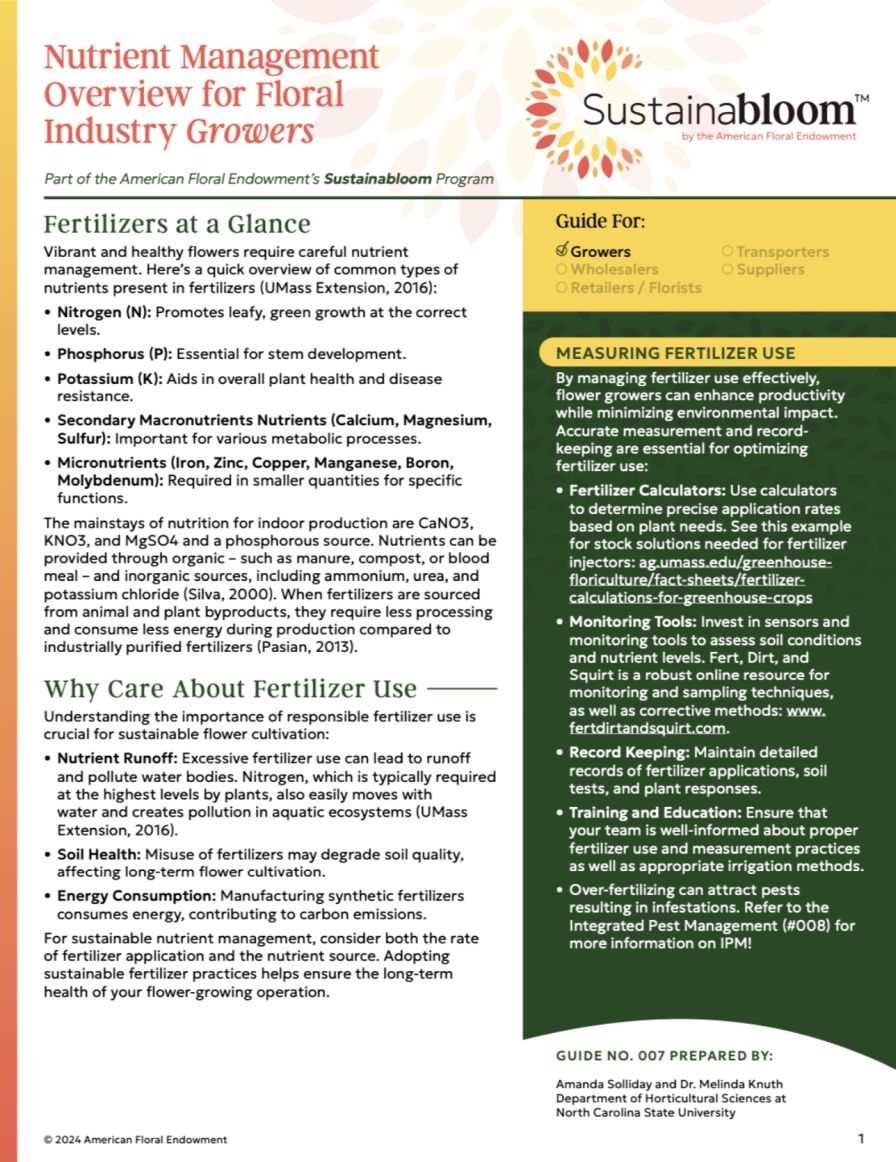
The first page of the Nutrient Management guide. | Sustainabloom
Researchers who put together Sustainabloom’s guide for Nutrient Management walk growers through the good and the bad of fertilizer use, detailing the nutrients found in it and how those nutrients contribute to plant growth and health. With the support of research-based extension publications, the researchers cover responsible fertilizer use, presenting information regarding how excessive use can pollute water, degrade soil, lead to pest infestations, and contribute to more carbon emissions through production.
Armed with that information as a starting point, growers can also access a how-to on measuring their fertilizer use within the guide. This practice can maximize results in both boosting production and lessening environmental harm. The researchers recommend approaching responsible fertilizer use with accurate measurements through the use of specialized calculators and monitoring tools. Growers should also keep detailed records of their findings and ensure their teams are well-educated and trained in those practices.
Developing a Plan
Once growers determine their fertilizer usage and identify areas where changes could increase sustainable efforts, the next step is to move forward with a nutrient management plan. The plan should be specific to the needs of the plants. The researchers have also outlined a strategy for growers to implement responsible fertilizer use within their business operations. Expert research in the field suggests several ways to proceed with a nutrient management plan, including:
- Conducting regular soil testing to help growers determine how much fertilizer is being used and adjust as needed.
- Drawing from published guides in finding the right amount of fertilizer to use with certain plants and applying it at the right time.
- Learning the benefits of organic fertilizers and how to use them effectively.
- Rotating crops properly.
Additionally, growers can reference the guide to ensure the fertilizers they are using are certified, further advancing their sustainability efforts.
Sustainabloom’s guide for Nutrient Management can help growers find a perfect balance, leading to the best of both worlds – healthier and enhanced production while being better stewards of the environment.
Click here to read and download the Nutrient Management guide.
Subscribe to eNewsletter