



Executive Perspective: Know Your Environment Before Deciding on a Structure
 September 24, 2026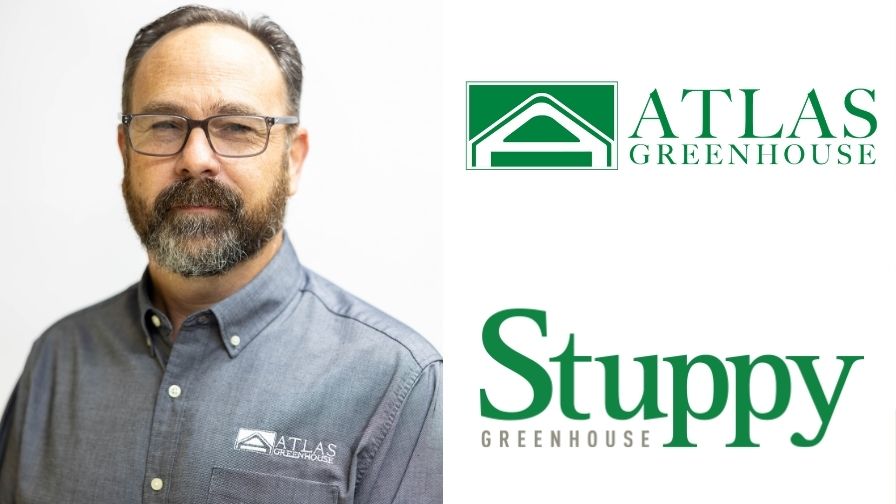
CEO John Edwards of Atlas/Stuppy. | Atlas Greenhouse, Stuppy Greenhouse
The greenhouse industry’s maturation has most companies looking for new growth ideas. For Atlas Greenhouse, that meant partnering with private equity in 2022, hiring a new CEO from outside the industry in 2024, and acquiring industry stalwart Stuppy Greenhouse in 2026. We talked to the aforementioned CEO, John Edwards, at Cultivate’26 about what he’s learned about the floriculture business thus far, what living in an “Amazon world” means for structure manufacturers, and the keys to managing your greenhouses.
Greenhouse Grower (GG): What are your thoughts on how this year was for the industry?
John Edwards (JE): We started to see a little softening at the end of Q4 2025, which gave us a bit of a hole to dig out of in Q1 2026. But Q2 was amazing, and Q3 and Q4 look very promising for us.
There are a lot of factors in this world that affect us, but we’d be remiss to think that the war did not hit us at a bad time. Right when everybody was starting to make buying decisions, everything got put on pause. And this was on the heels of last year — we do a lot of work with the USDA, so when the government shutdowns happen, everything instantly comes to a halt. That can change how the business is going to go because those are not small projects.
So, what we’ve had to learn to do is really keep our ear out there. As an industry, we need to do better at predicting the next year, three years, and five years. And how can we build a better predictive plan? Because right-sizing the business for that environment has become our number one goal, making sure that we can deliver when we need to. I think we do a better job planning than we ever have. We really inherited a lot of that process from the Stuppy side of the business and its excellent project managers, which has really made us better.
Now, on the Atlas side, we have always been good at delivering quickly because we have a lot of room to keep inventory. We’re able to pre-build a lot. That allows our sales team to deliver some of our lower-end projects in as little as three days.
GG: The way you described Stuppy and Atlas really fits the personalities of Matt Stuppy and Mark Davis.
JE: They’re both great business leaders who know a lot and care a lot about this industry. They’re both no-nonsense guys, but they approach the business in very different ways that complement each other very well.
GG: What are your expectations for growth over the next couple of years, especially because the sector you’re in is dependent on growers’ expansion?
JE: It’s very important for us to keep innovating. There are a lot of projects that we’re working on in the background. There are different ways to build a greenhouse, but there are also different ways to incorporate technology into them. And we’re working on what makes the most sense there.
We’re also working to update the business to reflect the generational change taking place. The younger generation wants to order greenhouse supplies on their iPhone. So, we’ve updated our web store to use a Shopify platform, and it’s amazing to me how many people will be sitting there at 3:00 a.m. on a Saturday morning and order thousands of dollars of cooling pads. But that means we have to have the product in stock because we live in an Amazon world. Now we’ve got to get this industry in that same mindset. Everybody expects what they want the next day, and I think we’ve got to learn to deliver on that.
But more importantly, one of the things we’re really focusing on with our customers is what environment is it exactly you need? It’s not about the structure and all that until we establish what environment and end use you’re going for, and then we back into the project. Sometimes the growers come in with preconceived notions, and it’s important that we delve down into exactly what they need so that we don’t sell them the wrong thing that won’t deliver how they need it to after six months.
GG: When you think of the growers who manage the structures portion of their business most effectively, what do they do better or differently than other growers?
JE: Successful growers prioritize maintenance and regularly inspect critical systems for proper operation prior to needing them. A great example is testing heaters before cold weather hits or cleaning evaporative cooling pads before the heat sets in. The same is true for control systems, fans, curtain systems, and the like. Lighting must not be forgotten either. In order to have optimum performance, there is a maintenance aspect that cannot be overemphasized.
GG: If you could give growers any one piece of advice for 2027, what would you tell them to do?
JE: Think outside the box. Much like we’re approaching things in our business, just because we’ve always done something one way doesn’t mean that that’s the only way. Growers need to take that same approach of identifying their desired end result and then saying, “If I could start with a clean slate, what’s the best way to accomplish our goal?”
You might ultimately go down the same road you always go down, but it’s important to take a step back and determine if there are alternatives to consider that you missed in the past.
GG: There’s obviously been a good bit of consolidation in your sector of the industry over the last couple of years. Is the consolidation over within the structures side of the business?
JE: I don’t think so. When you look at the synergies of buying power and efficiencies like that, more companies will pursue consolidation. This is a very seasoned industry. And as more people near retirement, they will be looking for an opportunity to keep their name out there in their company and do it the right way.

Executive Perspectives is an editorial series in which Greenhouse Grower visits with leaders from across the industry to learn the challenges they see facing growers from their respective part of the business and their recommendations to help growers succeed. This interview has been edited for style, length, and clarity.
Bob West is the Chief Content Officer at Meister Media Worldwide, the publisher of Greenhouse Grower. He can be reached at 440-602-9129 or [email protected].
Subscribe to eNewsletter