



What to Evaluate Before Switching to Sustainable Pots and Trays
 November 19, 2026
As growers weigh recycled content alongside crop losses, handling, freight, and disposal costs, pot and tray suppliers are broadening their sustainability efforts.
“Everybody’s wanting to know what’s in our materials,” says Bill Riffey, Vice President of Sales and Marketing at Landmark Plastic. “What’s changed is everybody wants to know what the post-consumer recycled material content is in that product.”
The answer depends on the source of the recycled plastic. Post-industrial material is recovered during manufacturing; post-consumer material is collected after use. Riffey says Landmark’s black plastic products have used recycled material at levels as high as 99% for years. Annual third-party audits through GreenCircle document post-consumer and postindustrial percentages by product line.
Documentation is also becoming more important as regulations and retailer requirements change, says Tom Marting, Director of Sustainable Solutions at Growscape. Growscape is increasing its use of certified post-consumer material and providing audit records to customers. T.O. Plastics reuses reclaimed post-industrial material and reground production scrap in new products.
Protect the Crop and the Production Line
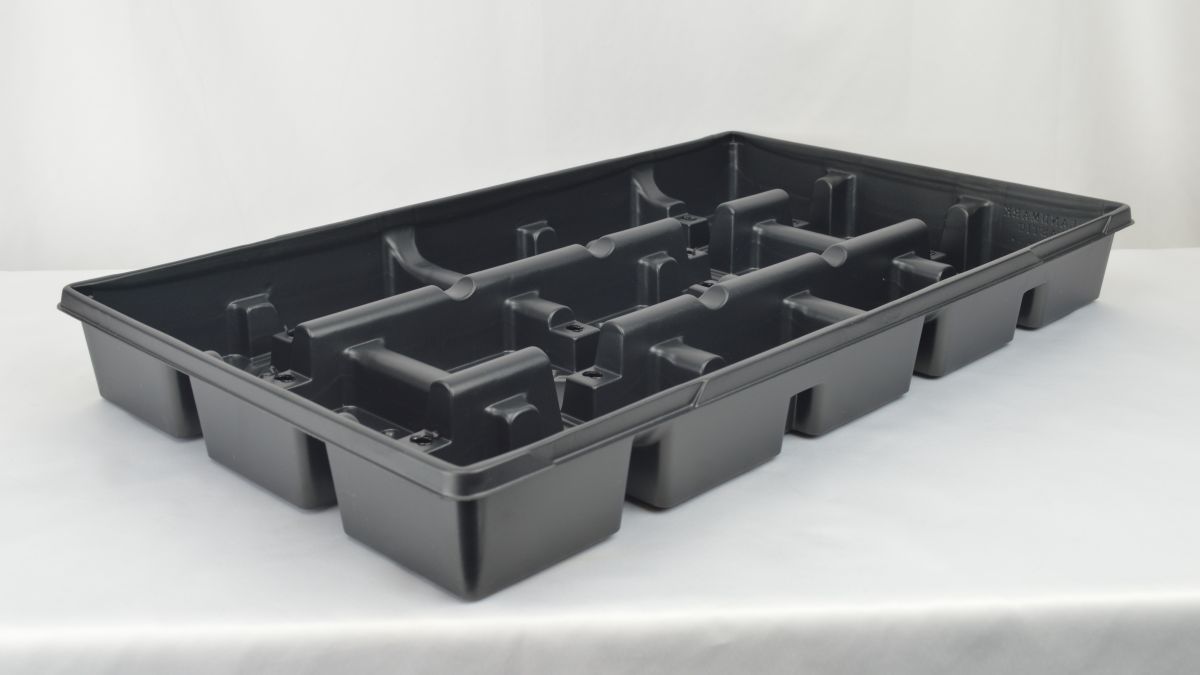
Landmark’s Water-Matic trays collect irrigation water beneath dense plant canopies, making it available for uptake by the plants. | Landmark Plastic
A recycled-content percentage does not tell growers how a container will hold up in production. Using less plastic can make a pot less rigid. If it crinkles or has weak rims, it can be harder to handle, Riffey says. Tag slots and other design details can create problems, too. A thinner pack may work for annuals, while a larger pot may need more strength and flexibility.
Container design also affects irrigation. Riffey says Landmark’s Water-Matic trays are designed to address uneven watering beneath large plant canopies. Water channels in the company’s pack trays are intended to help distribute irrigation. Riffey says the focus is reducing losses from plants drying out; he does not claim these designs reduce total water or fertilizer use.
Growers should also consider how many times a container can be used. Riffey says injection-molded trays and some thermoformed trays can be washed and reused. A thicker container may cost more up front but could be used for more crop cycles. “Can they buy a thicker material sometimes and get more uses out of it?” Riffey says. “While it’s a higher cost, they’re getting multiple uses out of that.”
Check the Savings Against Your Operation
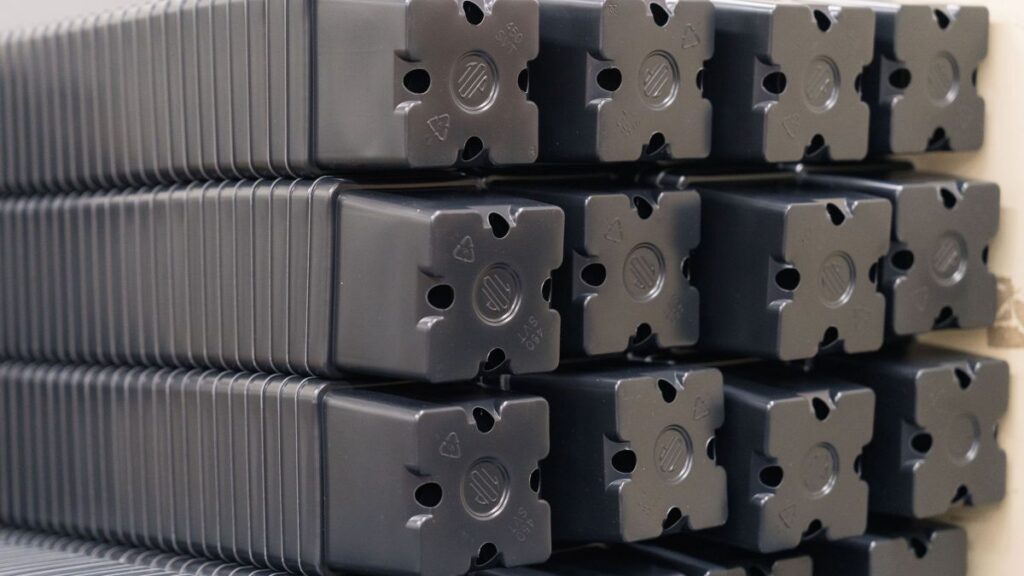
T.O. Plastics’ Press-Fill System allows workers to load compatible pots into trays together rather than individually. The company reports labor savings of up to 75% for that task. | T.O. Plastics
Some container systems are designed to reduce labor or shipping costs, but the reported savings depend on how well they fit a grower’s T.O. Plastics’ Press-Fill System allows workers to load compatible pots into trays together rather than individually. The company reports labor savings of up to 75% for that task. Photo: T.O. Plastics operation. T.O. Plastics’ Press-Fill System allows workers to place compatible pots and trays in one motion. Jared Rusch, Vice President of Sales and Marketing for Horticulture at T.O. Plastics, reports labor savings of up to 75% for that task compared with loading pots individually. Growers would need to confirm that the pots and trays are compatible and assess how the system fits their workflow.
Growscape says its Keystone Pot and Tray System can help growers ship up to 20% more plants per shipment by changing how plants fit on shipping racks and retail shelving. The company uses a calculation tool to compare the system with a grower’s current setup. The potential savings will depend on the operation.
Plan for the Container After Use
Recycling requires space, sorting, and transportation. Through Growscape’s ReSource Recycling Program, growers prepare materials for collection through a network of recycling partners. Marting says full truckloads are needed to make collection economical; smaller growers may be able to pool material with nearby operations.
Recovered material can return to Growscape’s manufacturing facilities or go to regional recyclers, depending on hauling and processing costs. The program can also accommodate materials such as pallets, metal, and corrugated packaging. Marting says the goal is to balance freight and processing costs against recovered material value to provide a no-cost solution for growers.
New materials also need clear end-of-use instructions. Growscape’s ReTerra plantable bioplastic pot, developed with Kaimarra Advanced Materials, is in development, with a planned 2027 launch. The pot is intended to be planted with the crop or composted, though breakdown will depend on conditions. Growscape’s EcoGrow fiber products, Marting says, are intended for industrial composting, not backyard composting or planting. Traditional plastic containers also need a local collection program that accepts them.
When comparing options, growers can look beyond the purchase price to how many crop cycles a container lasts, what it takes to handle it, and whether there is a practical recovery or disposal route. A supplier’s stated savings or sustainability claim is a starting point; the operation’s own costs and conditions determine whether the change works.
Subscribe to eNewsletter