


Juan Ponce of Metrolina Greenhouses on Building a Strong Growing Team From the Bottom Up
 November 14, 2026
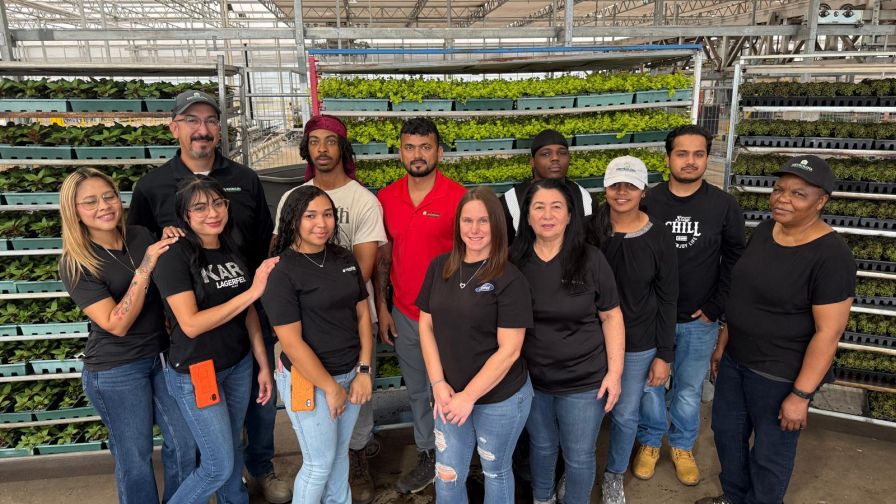
Juan Ponce with the Metrolina Greenhouses production team; photo: Metrolina Greenhouses
Juan Ponce of Metrolina Greenhouses was recognized as the 2026 Head Grower of the Year by Greenhouse Grower during our Evening of Excellence event at Cultivate’26. Juan was featured in the cover story of our November 2026 issue, but those of you who know Juan know there’s so much more to his story. This article is the second of a four-part series where we highlight everything from Juan’s early career, to how to has built a strong and dedicated team at Metrolina, to his approach to IPM and technology. You can find Part 1 here.
Greenhouse Grower: Can you talk about how you work with your team to help them develop as growers?
Juan Ponce: I interact closely with my team to help them develop the independence, integrity, accountability, and responsibility they need to become successful growers and consistently produce high-quality crops. My goal is not to do their work for them or tell them exactly what to do, but to teach them how to think, make decisions, and take ownership of their areas.
One of the main ways I do this is through weekly crop walks. Instead of immediately telling a grower what I think should be done, I normally start by asking, “What is your plan?” I want them to evaluate the crop, explain their reasoning, and think about the potential outcome of their decision. Then I can use my knowledge and experience to ask additional questions, point out potential risks, and help them determine the best approach. It is not about being right; it is about doing what is right for the crop at the right time.
Whenever possible, I also like to walk crops with more than one grower. Having multiple growers involved brings different perspectives and possible solutions to the same problem. It also strengthens teamwork and allows us to make decisions based on facts, experience, and group discussion rather than simply one executive decision.
When I see that a grower is considering a high-risk decision, I become more involved. Rather than immediately stopping them, I explain the possible outcomes and ask whether the potential benefit justifies the risk. This helps them think beyond the immediate problem and consider the impact of their decisions on the crop and other departments involved.
I also believe strongly in leading by example. If a grower is unsure how to handle a situation, I may take the lead and demonstrate how I would evaluate the problem, communicate with the people involved, and work toward a solution. The next time a similar situation occurs, I expect them to apply what they learned and take more ownership themselves.
These situations also provide valuable coaching opportunities, especially when growers need to navigate difficult conversations with other managers or leaders. I help them understand how to approach those conversations with honesty and respect, communicate concerns professionally, and focus on finding solutions rather than creating conflict.
Training is another important part of my approach. I enjoy developing training materials, participating in training sessions, and giving managers responsibility for meetings and projects so they can develop their own leadership skills. With assistant growers, I often ask them to teach back what they have learned. I ask not only whether they know how to perform a task, but whether they understand why they are doing it and what impact has on the crop and the company. This also helps me evaluate whether our growers are effectively training and following up with their teams.
Finally, I encourage new ideas. New generations of growers bring different perspectives from school, conferences, other facilities, articles, and new technologies. I want them to bring those ideas forward. When appropriate, we test them on a small scale, evaluate the results, and learn together. Developing growers is not about creating people who make decisions exactly the way I do; it is about giving them the knowledge, confidence, and judgment to make good decisions independently.
I work with team members from many different countries, cultures and backgrounds, including a large Spanish-speaking workforce. Being bilingual allows me to bridge communication gaps, ensure expectations are clearly understood, and explain the reasoning behind growing decisions. Open, honest, and respectful communication is essential for building trust and maintaining alignment across the team.
I believe leadership starts with setting the right example, so I hold myself accountable to the same expectations as the rest of the team, without exceptions. When a task requires specialized knowledge or additional training, I become directly involved to provide guidance, coaching, and support. I carefully select team members for specific responsibilities based on their qualifications and development goals, recognizing that not every role or task is the right fit for everyone.
Greenhouse Grower: How do you work with the management and ownership team at Metrolina to decide which projects and innovations make the most sense to pursue?
Juan Ponce: At Metrolina, innovation starts with my team and idea, then we identify opportunities for process improvement and present a proposal. We first evaluate whether the idea aligns with our operational needs, company purpose, and overall goals, focusing primarily on whether there is a real need rather than simply want.
If the proposal has potential, we establish a controlled trial to evaluate how well it fits into our operations, how impact our team, what results it produces, and how long it will take to recover return of investment. This allows us to make decisions based on actual results, and measurable data impact rather than assumptions.
Once the trial demonstrates that the proposal is viable, it goes to the next level by involving our financial team for review and presenting it to ownership. They evaluate the financial impact, budget availability, expected return on investment, and overall level of risk before making a final decision.
This process allows innovation to move forward in a structured way, balancing operational improvement, measurable results, financial responsibility, and the long-term interests of the company.
Greenhouse Grower: What do you like best about your job? And on the flip side, what is the biggest challenge you face on a day-to-day basis?
Juan Ponce: It may not be surprising that what I like most about my job is also one of my biggest day-to-day challenges. This is working and interacting with people at many different levels, both inside and outside the organization. Everyone has different personalities, skills, experiences, and ways of responding to challenges and stress situations.
Plants can be more predictable than people. Over the years, I have worked hard to become a better listener, understand different personalities, and develop empathy.
I don’t always have the answer to every challenge my team and I face, but my greatest satisfaction comes from seeing us work through difficult situations with success. Sometimes I provide the solution, sometimes I support the process, and sometimes my role is simply to listen and observe. I always encourage my team to look forward, learn from mistakes and find ways to improve. We should use the past as a learning tool, not as a source of frustration.
One of my priorities as a leader is to recognize and build on the strengths of the people on my team and, when possible, put the right person in the right situation where they can feel confident, contribute, and succeed. Seeing people grow and discovering what they are capable of is probably the most rewarding part of my job.
A grower may grow plants, but a head grower grows a culture of collaboration, accountability, and continuous improvement, and requires the combined efforts from development, planning, growers, production, task, shipping, and many other departments working toward a common goal. Watching both plants and people grow is what makes this profession so meaningful and exciting to me.
Subscribe to eNewsletter