



The Value of Comparing Historical Performance in Your Greenhouse
 June 26, 2022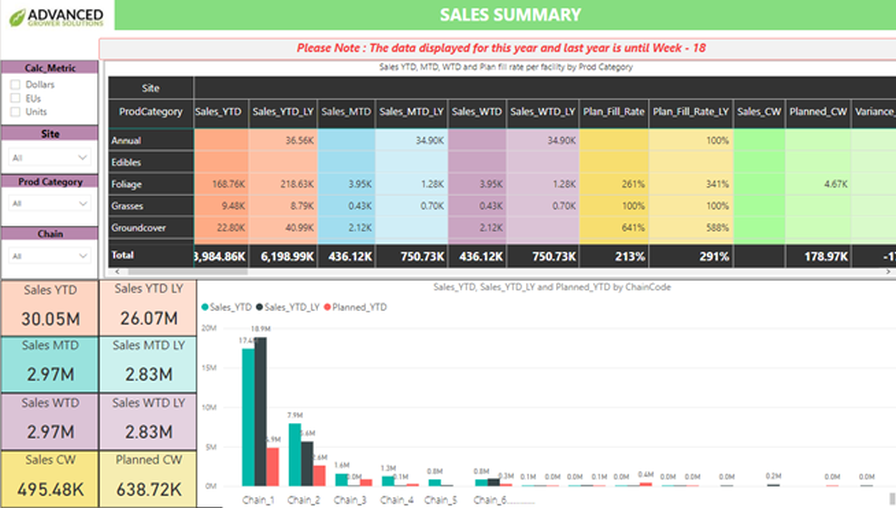
Example of a dashboard showing some tabular period comparisons. Photo: Advanced Grower Solutions
Comparing any metric over different time periods helps in evaluating a company’s performance by comparing this year’s data with the previous year. It can help you in understanding if the actual vs planned production and sales has reasonable fluctuations this year as compared to the same period last year.
Year-over-year comparison of data also highlights if there are certain patterns that can help you in making better-educated decisions.
Types of Calendar Years Used in Time Period Comparison
As simple as it sounds, the same period last year comparison can be challenging, as for weekly comparisons a particular date can fall in different date brackets for two different years. In other words, the same day this year is not always the same calendar date due to calendar differences and due to different types of calendars.
A few generally practiced accounting calendar periods are:
- Calendar Year: 12-month year starting from Jan. 1 and ending Dec. 31
- Fiscal Year: 12-month year where start and end dates are dependent on business
- 4-4-5 Year: 12-month calendar that is divided in quarters each quarter with 13 weeks each; two 4 weeks and one 5 week
The 4-4-5 year calendar is mostly used by retail businesses. Here the data visualization tool proves to be really helpful in aligning different dates as you have the ability to use the desired calendar structure for a fair comparison of data.
Typical Comparison Periods
The right software can help you avoid data problems leading to simplified comparison across a broad variety of KPIs for this year and past years like:
- Year to date (YTD) – Time period from the first day of the current calendar year to the current date
- Month to date (MTD) – Time period from the first day of the current calendar month to the current date
- Quarter to date (QTD) – Time period from the first day of the quarter to the current date
- Week to date (WTD) – Time period from first day of the current week to the current date
This analysis has proven to improve decision making, leading to benefits in terms of optimizing operation’s time, raw material handling, labor allocation, defining seasonality and trends, scrap management, etc.
Learn more in this blog post from Advanced Grower Solutions.
Subscribe to eNewsletter