



Diagnosing the Cause of Interveinal Chlorosis in Dusty Miller Plants
 September 10, 2024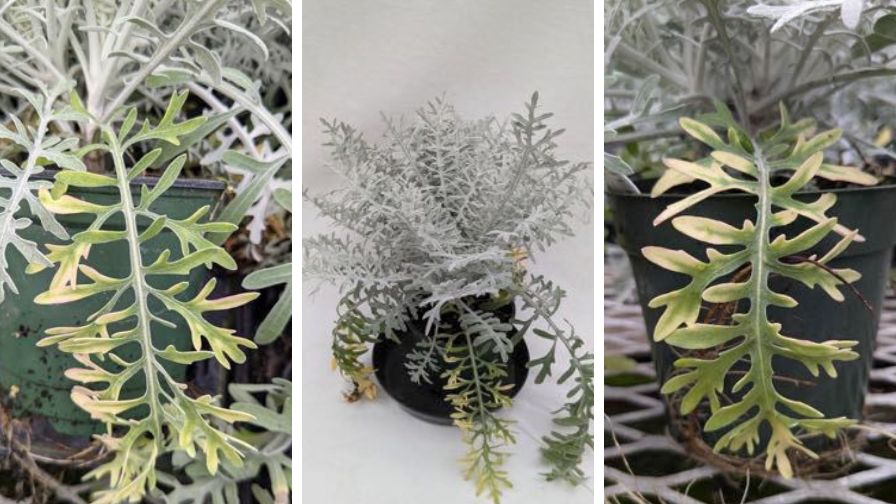
Lower leaf interveinal chlorosis in dusty miller plants | Brian Whipker, e-Gro Alerts
Brian E. Whipker and Patrick Veazie of North Carolina State University recently examined a batch of dusty miller (Centaurea cineraria) ‘Colchester White’ perennial plants in an e-Gro Alert. While the overall health of the crop looked good, it did sport a development of interveinal chlorosis and yellowing on its older and lower leaves. While the initial diagnosis assumption raised for the issue was magnesium (Mg) deficiency, further testing produced a different culprit.
Dusty Miller Plants – Tissue Analysis of Interveinal Chlorosis
Testing at the North Carolina Department of Agriculture and Consumer Services (NCDA & CS) lab showed that Mg levels were above the normal range, according to the standards laid out by the Plant Analysis Handbook.
Nitrogen (N) levels were low and calcium levels (Ca) were high, but the most likely culprit for the onset of interveinal chlorosis was the low potassium (K) levels. Despite most fertilization programs providing plants with a high dosage of K, low levels may be present due to several factors, including:
- Excess heat
- Less fertilization during later season periods
- Unbalanced nutrient concentrations (Ex. High calcium concentration)
Management and Solutions for Centaurea cineraria Potassium Deficiency
A heavy fertilization procedure of potassium (as well as nitrogen) can offset the low levels of K and N in dusty miller plants and help prevent the further worsening of interveinal chlorosis and yellowing in the leaves. However, older and lower leaves that have already been affected will not reverse their symptoms and will have to be removed.
For more information regarding the cause and solutions to nutrient disorders in garden plants, please read the full e-Gro (Electronic Grower Resources Online) alert “Lower Leaf Interveinal Chlorosis of Centaurea cineraria.” Additional and current e-Gro alert pieces from Volume 13 (2024) can be found online.
Subscribe to eNewsletter