



How Digital Technologies Are Transforming Plant Evaluation
How do you measure the quality of a plant? Its height, shape, color, vigor, and overall appearance can tell us a great deal about its health and performance. But obtaining these measurements is not always straightforward.
Traditional plant evaluations often rely on manual measurements, visual assessments, and, in some cases, destructive sampling. These methods can be labor-intensive, subjective, and limited in the information they provide.
By combining advanced imaging technologies, spectroscopy, and artificial intelligence (AI), research at the Vineland Research and Innovation Centre is developing new methods to capture detailed, objective information about plants. These emerging digital phenotyping tools allow for the measurement of characteristics that were previously difficult or impractical to quantify, while creating opportunities for entirely new types of analysis.
A New Dimension in Plant Evaluation: 3D Scanning
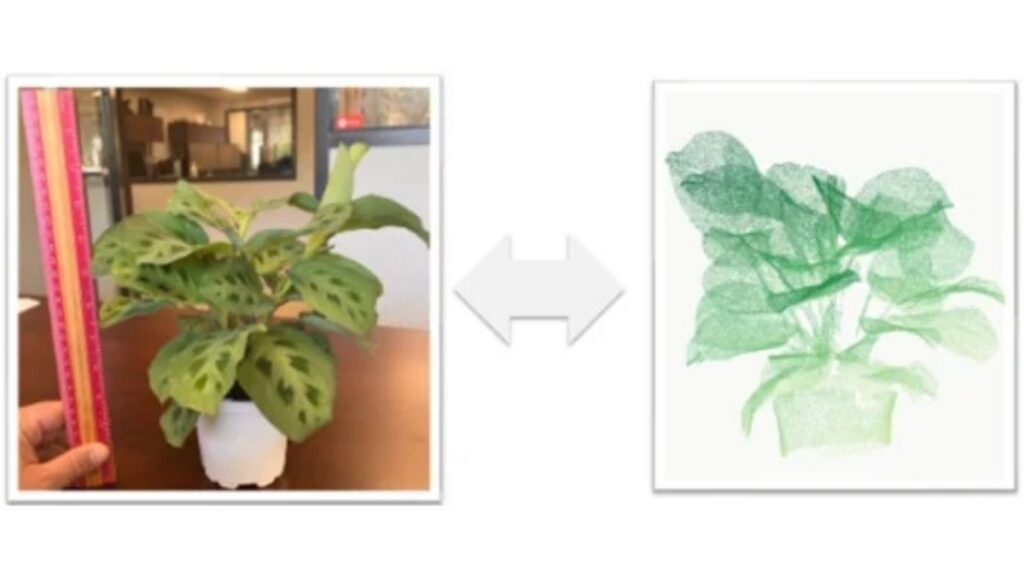
Comparing conventional measuring methods (left) with point cloud data (right) – the same plant is represented as a single value (a reading off a ruler) or thousands of detailed datapoints. | Vineland Research & Innovation Centre
Imagine being able to capture the complete three-dimensional structure of a plant in less than two minutes, without damaging it, and then use that digital reconstruction to measure its size, shape, and growth.
Using advanced 3D scanning technology, Vineland can generate detailed digital representations of plants, known as point clouds. These contain millions of spatial measurements describing the plant’s visible surfaces and structure, allowing for the extraction of a wealth of quantitative information, including plant height, width, volume, surface area, and the spatial distribution of plant material.
A More Predictive Future for Crop Protection
Unlike conventional measurements that might capture only a plant’s height or maximum width, 3D scanning provides a much richer picture of its architecture.
Additionally, because scanning is non-destructive, researchers can return to the same plant repeatedly to observe how its structure changes throughout its development.
This is particularly valuable for variety evaluations, crop research, and studies involving growth, environmental stress, or treatment responses.
Teaching AI to Recognize Plant Structures
Vineland is also developing AI-based approaches that can interpret these models and identify individual plant structures.
In a recent proof-of-concept study involving calla lilies, Vineland researchers trained a machine-learning model to recognize and distinguish individual spathes — the colorful, leaf-like structure — within complex 3D plant scans.
The model uses geometric information alone, recognizing plant structures from their shapes and spatial relationships, without needing color information. Once identified, these individual structures can be counted and evaluated for characteristics such as their size, position, height, and surface geometry.
Although the technology is still being refined, the implications are exciting. Similar approaches could eventually allow for the automatic identification of leaves, stems, flowers, and fruit, enabling much more detailed assessments of plant growth and development.
Beyond What the Eye Can See: Spectrometry for Color and Plant Health
Plant color provides important clues about quality, development, and physiological condition. Yet color evaluations are often surprisingly subjective, such as two observers describing the same plant differently, as well as subtle changes that can be difficult to detect consistently under varying lighting conditions.
Spectrometry offers a more objective alternative.
A spectrometer measures how plants reflect light across different wavelengths, producing a detailed spectral signature. Rather than simply recording what color a plant appears to be, this technique captures information about how its tissues interact with light.

For additional information on new digital technologies being tested and implemented at Vineland, including a deeper dive into how colors and pigments are understood, measured, and recorded through spectroscopy, read the original article from Dan Bath on the Vineland website.
Subscribe to eNewsletter