


Putting New Greenhouse Technology Through the Paces
 August 20, 2024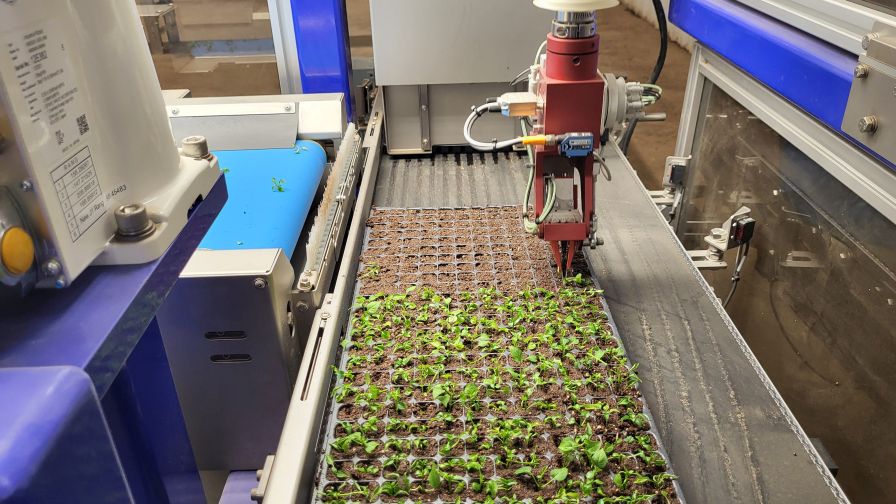
Bailey Nurseries is trialing a machine to stick cuttings. Jeff Stoven, West Coast Propagation Production Manager, says it can plant up to 2,500 cuttings per hour and has the ability to accommodate different pot sizes and planting patterns. Photo: Bailey Nurseries
Growers trial new equipment all the time, whether it’s labor-saving devices, environmental controls, lights, or even water testing systems. A test run helps ensure the new item works for your crop, greenhouse, and climate. Setting up a clear plan and identifying what success looks like will help streamline the process.
Trialing new equipment begins with knowing it exists. This often comes down to hearing about it through trade publications, articles, newsletters, and exhibits at industry conferences.
Marco de Leonardis is the R&D Operations Manager at Freeman Herbs in Ontario. He’s always looking for new technology and has several trials going on at once.
“I get the newsletters and look at the articles that come out. When I see something new, I start to look into it. I contact the company and that’s how we start,” he says. Companies are often willing to provide the technology for a trial run, possibly for low or no cost upfront.
Okay, so what’s the good stuff? What’s being trialed and tested right now? Here’s a look at a few tests going on at Freeman Herbs and Bailey Nurseries.
Cold Plasma Machine
Treating seeds with cold plasma to enhance germination and plant health sounds like science fiction, but Freeman Herbs is trialing this tech now, not in the far future. Seeds are treated with cold plasma prior to sowing, improving the germination rate and uniformity.
“I am still trying to see if it works,” explains de Leonardis. “This machine disinfects and primes the seed. So, allegedly it improves germination, both the speed of germination as well as average germination. The seeds germinate all at the same time and faster. It allegedly improves the health of the plant. I’ve been testing this, and, so far, only have marginal results.”
Petrifilm for Water Testing
Sometimes, the tech isn’t new, but using it in your greenhouse might be a new process. “We are starting to do our testing in-house for the microbiological quality of the water,” says de Leonardis. Currently, they send weekly water samples to a lab to make sure the irrigation and washing water is safe from E. coli and Coliform.
“It’s a new thing we’ve been testing — a preformed petri dish. But, instead of being a dish, it’s a film, so it’s much cheaper, much less quantity, and it’s instant, so it’s very good as an indicator. All you need to do is hydrate it and then incubate it.” The film contains a thin layer of medium that supports the growth of microorganisms, just like the agar in an old-school petri dish. Bacterial colonies on the film can be counted on a standard colony counter or light source.
Soil Mixing and Production Systems
Greenhouse operators are always interested in labor-saving devices. Jeff Stoven, West Coast Propagation Production Manager at Bailey Nurseries, told us about a new system they’re trialing now.
“A new soil-mixing/production system was installed. This new system allows greater workflow from our container and propagation departments. The ability to change soil recipes, manage materials, move responsibility internally, and streamline operations are where we are seeing the benefits.”
Dynamic LED Lighting with AI
Dynamic lighting isn’t new, but a new, even higher efficiency dynamic LED light will be tested soon at Freeman Herbs. “It’s a quite large trial lasting for two years. It’s a big investment,” de Leonardis says. These lights use artificial intelligence (AI), and they have double the diodes of legacy LED light systems. With the higher number of diodes per panel, the light doesn’t need to be run at 100%.
Running LEDs at lower power is more efficient from a light-per-watt perspective — the efficiency of the diodes is much higher. Additionally, the light is dynamic, so the spectrum can change based on plant needs, favoring red or blue. Instead of turning off some blue diodes to increase the percentage of red light or vice versa and losing overall intensity, these lights can shuttle more power to the red or blue since they’re not running at full power. One isn’t sacrificed to provide more of
the other.
“By underpowering it, the efficacy is much higher. We’re going from an efficacy of 2.9 to an efficacy of 4.5, and allegedly with their proprietary technology, which incorporates AI, up to 12,” explains de Leonardis. “The technology and the idea behind it is brilliant. It could change the light industry.”
Cutting Planter Machines
Stoven mentioned a new machine for sticking cuttings. “We’re working with a company on a planting machine. This robot continues to be evaluated throughout the greenhouse production process. After every visit from the supplier, I’m amazed at what else we should be using the machine for.”
The machine provides both uniformity and speed, with planting speeds of up to 2,500 cuttings per hour and the ability to accommodate different pot sizes and planting patterns.
Data Collection and Trial Success
“Most of the time, technology is initially implemented to assist or reduce labor dependency. If we can see a clear reduction in time and labor, we can conceptualize the payback,” says Stoven.
“Metrics are kept throughout the production process, and several are used to determine how and where technology is implemented. For project justification, these metrics range from labor savings, production timing, crop yield, safety, quality, and opportunity cost,” Stoven explains.
Growers collect data on plant weight, cycle time, or the number of cuttings per hour a new system can stick, but other parameters matter, too, maybe more than just the numbers.
“Honestly, I define success for new technology through coworker adoption. When the team and culture support the initiative, I know we will be successful. Yes, there are mathematical metrics that support the endeavor, but having support from my coworkers is paramount,” explains Stoven. “Beyond performance and coworker adoption, I look for long-term support, ability to upgrade, and safety features when considering tech trials.”
Subscribe to eNewsletter