


Your Most Valuable Asset Isn’t on the Balance Sheet: It’s You
 January 20, 2026
Wonderful beach scenery, palms and sun beds with sea view. | icemanphotos via Adobe Stock
Half of all business exits are involuntary, according to the Exit Planning Institute, triggered by one of the five Ds:
- Death
- Disability
- Divorce
- Disagreement
- Distress
There is also a sixth “D” we call “Dumb Stuff,” which includes any number of unpredictable issues that could affect a business, and one of those is failing to look after your own health and well-being.
Consider your roles and responsibilities in your own operation. Have the pace or demands of business ownership ever pushed you to the point of mental exhaustion or even physical illness? Our 2nd Annual State of Succession and Exit Planning in the Horticulture Industry survey revealed that although reallocation of roles and delegation is happening, many owners remain stuck in day-to-day operations. This leaves less time for long-term planning and growth, which helps explain why 17% of owners report they are “not prepared at all to exit.” Owner dependency, or the business’s reliance on the owner, remains a critical barrier to successful transitions.
Your business can only thrive as much as you do. Prioritizing your well-being isn’t selfish. It’s one of the most strategic investments you can make in your business’s future and your eventual transition.
The State of Personal Well-Being in 2026
According to Todd Downing at BEST Human Capital & Advisory Group, “With the rise in anxiety and depression rates since the pandemic, employee health and wellness is no longer a perk but a strategic requirement. The World Health Organization has identified that mental health is costing businesses around the world $1 trillion a year in lost productivity.”
But what about your own productivity as an owner or operational leader?
- Survey data shows owners still spend the largest share of their time on operations (28%) and sales (20%).
- Owners spent 17% of their time on financial management and only 11% on HR and people development, two areas crucial for a successful exit.
- Notably, nearly a fifth of owners have never stepped away from their business.
What about your team? A recent SHRM report found that every dollar invested in health and wellness results in close to six dollars in cost savings. A study by the Harvard Business Review found that companies with high employee engagement are 22% more profitable. According to Downing, “Flexible work schedules, mental health days, stress-reducing activities, the positive effects of plants at work (perfect for our industry), and financial counseling and coaching are all programs to consider for your people and yourself. After all, lower stress = lower burnout = better business decisions = a more attractive company to buyers.”
The Vacation Question: A Litmus Test for Readiness
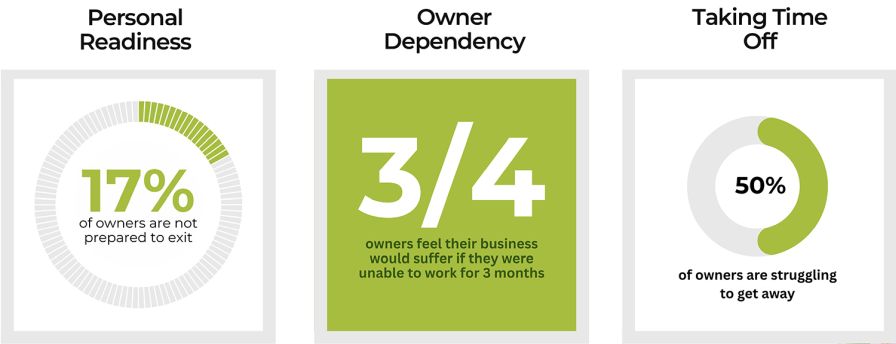
Graphic on Personal Readiness, Owner Dependency, and Taking Time Off statistics. | PivotPoint Business Solutions
“Vacations are essential. They’re not optional.” – Dr. Susan Albers, The Cleveland Clinic
When was the last time you took a vacation from your business that lasted two weeks or more? This simple question reveals a great deal about how independently a business can run without its owner. In fact, it is one of the first questions we ask when working with owners. Vacations aren’t luxuries; they are signs of a healthy business.
There is some promising news from our survey:
- 28% of owners took a two-week vacation in the last six months (up from 15% in 2024).
- 42% said they had taken a two-week vacation in the last year (up from 28% in 2024).
- Those who’ve never taken a vacation dropped by 9%.
- Those who hadn’t taken a vacation in two years decreased by 5%.
These improvements indicate growing trust in team leadership and a healthier owner mindset. However, 50% still struggle to take time off, and 34% have never taken a two-week vacation. This suggests over-involvement in the business and a lack of confidence in the team’s ability to manage independently.
For owners, time away increases creativity, decisiveness, and focus, fueling the energy to build an exit plan. A health crisis or major life change can arrive unexpectedly. Readiness isn’t a project for “someday”; it’s an operational priority for today.
The Owner Dependency Trap
We asked owners how their business would perform if they were out of action for three months. The results were sobering:
- 3.5% believe their business wouldn’t survive.
- 19.7% say it would “hardly suffer. “
- 45.3% say it would “suffer a little.”
- 31.6% said it would “suffer a lot.”
More than three-quarters of owners expect their business to suffer if they are unexpectedly away for three months. This highlights the persistent issue of owner dependency, or owner-centricity, when the organizational chart resembles a hub-and-spoke wheel with the owner at the center.
The more your business relies on you to operate, the less appealing it is to potential buyers or successors. Owners caught up in daily tasks have no time for strategic planning, and survey respondents identified “building a team that can function without me” as their top business concern (58%). Owner dependency is a value killer in the horticulture industry.
Reducing reliance on yourself is the most important step you can take to protect and increase the value of your business.
The Business Case: It Starts with You
A reported 63% of survey respondents said the top trigger for unexpected exit was “personal or health issues.” These triggers are largely outside your control, but preparation is not. When the unexpected happens, you want to be ready to act with clarity and confidence.
Make time to work on the business. Take the vacation. Step away. Prepare for your next stage of life by moving toward something like time with family, travel, charitable giving, or even pickleball, rather than being pushed out.
Delegate. Plan for the unexpected. The most successful transitions happen when you are pulled toward a purposeful next step, not when you’re forced there. After all, we all work to live, not live to work.
Your ability to take time off reflects your business’s health, maturity, and transferability.
Start Now. Stay Ready. Because “by chance” might come sooner than you think.
Get the Survey

2025 State of Succession and Exit Planning in the Horticulture Industry Report QR Code
View and download your complimentary digital copy of the 2025 State of Succession and Exit Planning in the Horticulture Industry report by clicking HERE or scanning the QR code above.
Also, ask us about the new complimentary PeerReview, a customized report that compares your responses to the full 2025 survey data. It shows where you’re ahead, where there’s room to grow, and what steps others are taking to prepare for transition.
Subscribe to eNewsletter
