



Mums That Move the Market
Garden mums still own fall, but the category is not standing still. Breeders say growers, retailers, and consumers are asking for more than a reliable burst of autumn color. They want earlier and later selling opportunities, stronger shelf life, better series uniformity, dependable timing, and plants that hold up outdoors. Across the board, the focus is on mums that work harder from production to retail to the front porch.
Stretching the Sales Window
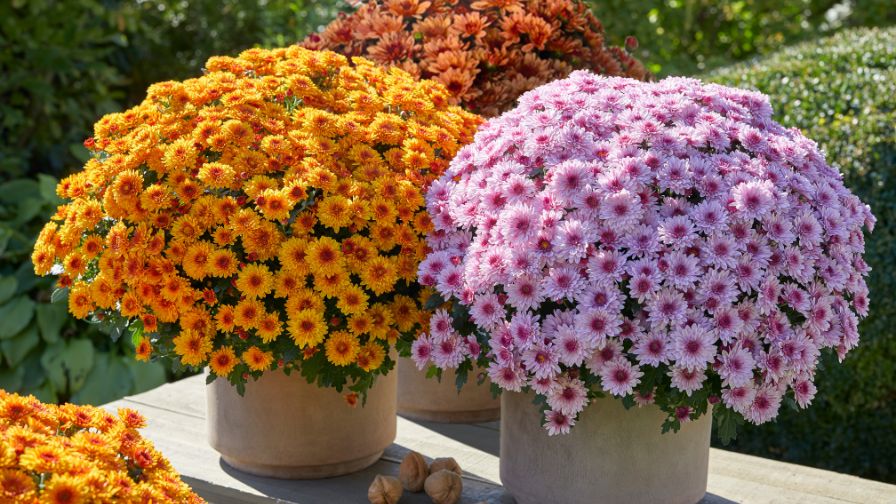
The Chrysanthemum Lively Series features Pink Bicolor, Bronze Bicolor, and Peach Bicolor. | Dümmen Orange
One clear theme this season is that breeders are thinking beyond a single fall moment. QiuXia Chen, Regional Product Manager at Dümmen Orange, says growers are looking for earlier- and later-flowering varieties that can widen the selling window.
At Dümmen Orange, the Lively Series helps anchor the early side of that strategy. The series already included Pink Bicolor and Bronze Bicolor, and now adds Peach Bicolor, giving growers another eye-catching option for early sales around Weeks 35 to 36. Chen highlights its dependable branching, strong color retention, and dark-centered bloom for added retail appeal. Its medium to medium-compact habit makes it a good fit for 1- to 3-quart pots and hanging baskets.
For the later market, Chen points to Sunniva Yellow, a variety that ships around Weeks 40 to 41. Its bright yellow flowers and dark foliage create a strong contrast at retail, while its round habit and uniformity make it practical in production. Chen also notes that it works in blackout production and aligns well with other late-season varieties.
Jessie McMillin, Chrysanthemum Product Manager at Ball Seed, says growers and retailers are asking for mums that deliver “earlier color, consistent across families, perform predictably in production, and maintain their beauty well beyond the garden center.”
Built to Work Together
Breeders are building coordinated series that simplify production, support combo programs, and help retailers create stronger displays.
Chen says Dümmen Orange continues to expand its series for better consistency and easier lineup building. They also improve uniformity in tri-color and bicolor mixed pots, which matters as combinations take on a bigger role at retail. Mark Esoldo, Product Manager at Syngenta Flowers, sees the same priority. “For growers, timing and consistency across a color range is a requirement,” he says. “The ability to schedule multiple colors within the same production window simplifies logistics, reduces risk, and maximizes bench efficiency, which is why creating families is a primary breeding target.”
That thinking is reflected in Syngenta’s Pamela Series. Esoldo says it performs well in both natural-season and blackcloth programs, and the newest addition, Dark Orange, adds a richer orange tone for more contrast in tricolor combinations. Flowering in Weeks 39 to 41, depending on the region, the series combines uniform timing and vigor with a strong, well-branched habit suited to medium and large pots, hanging baskets, and combinations.
Color That Pops
Classic fall shades still do most of the heavy lifting. Chen says Yellow, Orange, and Bronze continue to drive much of the market, while McMillin notes that Orange, Red, and Yellow remain central. But breeders are also seeing more interest in colors and patterns that stand out at retail.
Chen says purples and whites have gained attention in recent years, along with continued demand for “bold and eye-catching unique varieties” that help spark consumer interest. She points to Berry Blast Bicolor and Lively Peach Bicolor as examples of varieties that support premium branded mum programs with a more distinctive look.
Ball Seed’s Cyclone Series fits that shift well. McMillin describes it as a five-color series with bold bicolor blooms and strong retail impact. The series reaches 30% to 50% bloom around Week 39, with cracking color around Week 38, and offers a mounded, well-branched habit that performs across pot sizes and programs. It is positioned for mix pots, hanging baskets, combination programs, and patio sales, making it a strong answer to demand for mums that read as fresh, premium, and high-impact.
A Mum Look for Spring and Summer
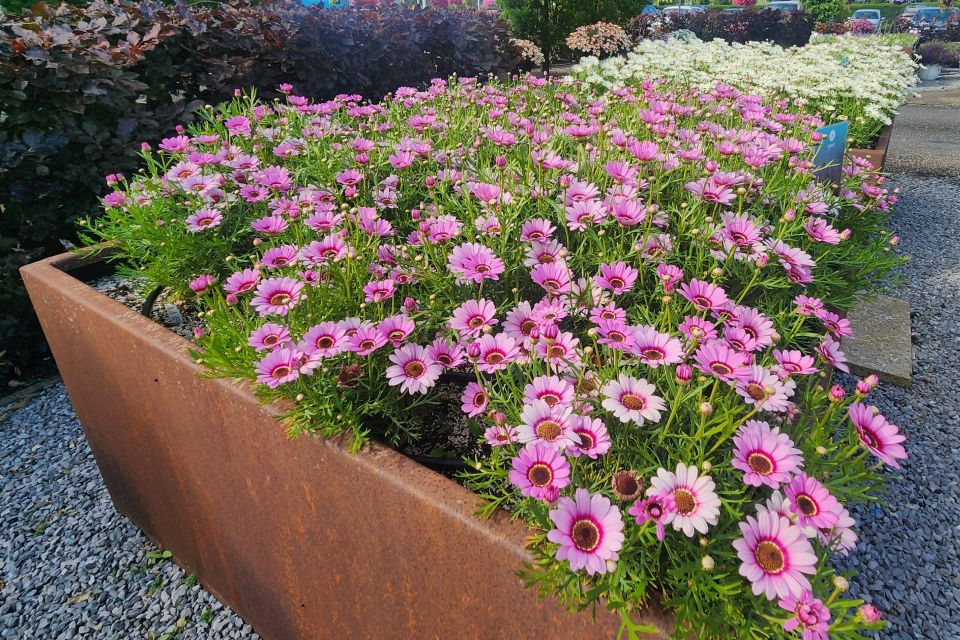
Grandaisy Pink Halo offers a mum-like look for spring and summer sales. | Suntory Flowers
Suntory Flowers is bringing some of the familiar appeal of mums into a different season with Grandaisy, an intergeneric hybrid of Argyranthemum and Ismelia. According to Delilah Onofrey, Marketing Director for Suntory Flowers, the series offers larger plants, bigger blooms, and interesting colors and rings. Grandaisy Pink Halo is a favorite, while Dark Pink is also a top seller.
For 2027, the series includes improved White and Yellow selections. Yellow now times with the rest of the five-color series and features a brighter tone and larger bloom, while White has been improved for cold sensitivity, plant size, timing, and bloom size.
Grandaisy is recommended for gallon pots or larger and is considered too vigorous for 4-inch production. Onofrey notes that three plants in a large patio pot make a strong grab-and-go option for patio sales. The series is best positioned for Easter and Mother’s Day, especially in cooler climates where cooler nights support flowering.
Performance After Purchase
Breeders are also paying closer attention to what happens after the plant leaves the garden center. Shelf life, post-purchase performance, and outdoor durability have become major priorities.
Esoldo says, “Over the past couple of years, shelf life has been climbing to the top of breeders’ list of priorities.” He adds, “A beautiful plant that fades quickly leaves a bad impression. A plant that lasts and continues to perform will drive repeat purchases and strengthen the entire category.”
Chen echoes that point, noting that consumers are using mums primarily as decorative plants for porches, patios, and outdoor living spaces, so strong post-purchase performance and longer-lasting color matter. McMillin says much the same, emphasizing durability, shelf life, and outdoor performance so the product continues to deliver value throughout the season.
That helps explain why breeders are increasingly talking about toughness and predictability alongside color and habit.
Easier for Growers, Better for Retail
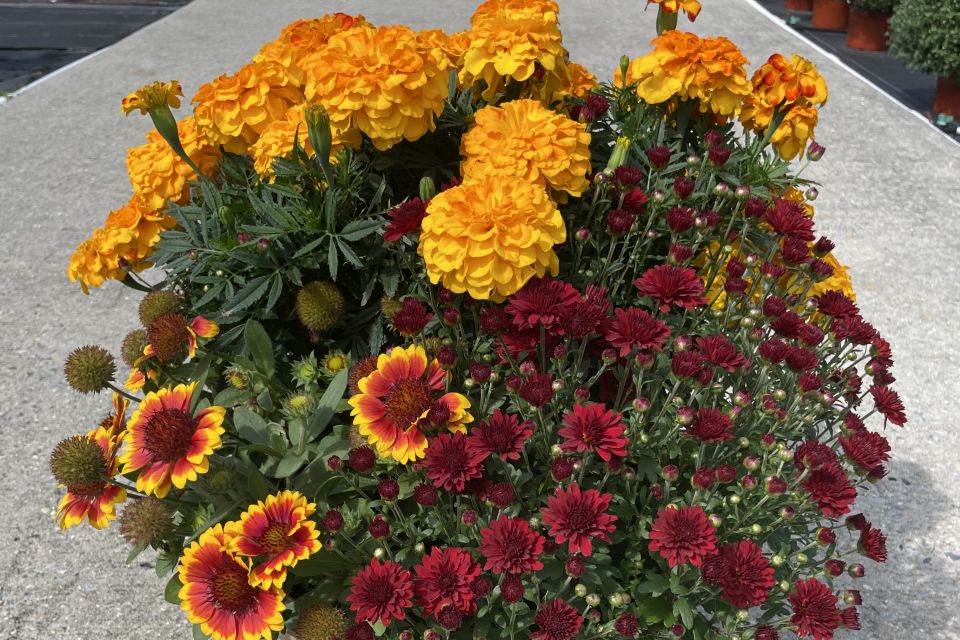
Cross-crop combinations, like this Patio Playbook planting from Syngenta Flowers, help expand the garden mum story at retail. | Syngenta Flowers
Breeders also point to labor, timing, uniformity, logistics, and disease resistance as key forces shaping development.
At Dümmen Orange, disease tolerance remains a major focus. Chen says more than 75% of the company’s garden mum program carries White Rust Resistance through its Intrinsa® line, with additional resistant varieties and future traits still in development.
Ball Seed is similarly focused on varieties that branch well naturally, grow uniformly, need fewer corrective inputs, and flower reliably within production schedules. McMillin says Ball trials its varieties every year to confirm performance.
That emphasis comes through in Ball’s Axios Series, a seven-color series McMillin describes as consistent and reliable, with a uniform habit and strong bloom coverage. Reaching 30% to 50% bloom around Weeks 39 to 40 and cracking color around Week 38, Axios combines a European-style beachball shape, strong branching, and medium vigor suited to multiple container sizes, landscape use, and mum trios.
Retailers, meanwhile, are still looking for instant fall color and more creative merchandising opportunities. Coordinated series, mix pots, and cross-crop combinations all point to a broader appetite for fall programs that feel bigger than a single mum bench.
Esoldo says, “Using families and creating combos is always something retail is asking for.” He points to Syngenta Flowers’ Patio Playbook, which pairs garden mums with zinnia, marigolds, and ornamental kale to create seasonal displays with more dimension and stronger consumer appeal.
Where Mums Are Headed
What stands out most in this year’s breeder feedback is how much the category is being shaped by performance. Color still matters, but so do timing, shelf life, uniformity, and flexibility at retail.
Subscribe to eNewsletter