



Bloom Without Burnout: A Practical Guide to the H-2A Visa Program
Labor continues to be one of the greatest challenges greenhouse operations face, especially during peak planting and shipping seasons. To help growers navigate one of the industry’s most complex hiring tools, American Floral Endowment (AFE) hosted a recent webinar, Bloom Without Burnout: A Practical Guide to the H-2A Visa Program.
The session featured Meagan Kirchner, immigration attorney and founder of Kirchner Law, PLLC, who shared a step-by-step look at how the H-2A visa program works, what employers need to prepare for, and how to avoid common mistakes.
Why Planning Ahead Matters
“The H-2A process is very time-sensitive,” says Kirchner. Growers should begin conversations with an attorney or agent 120 to 150 days before their labor needs. Filing a job order with the State Workforce Agency (ETA 790) must happen 60 to 75 days ahead of the start date, or the entire process can fall behind.
She cautioned that last-minute calls for help — such as “I need workers next month” — simply can’t be met through H-2A. Housing inspections, insurance, and recruitment requirements all take time, and missing even one step can push back worker arrival, potentially jeopardizing a season.
Understanding the H-2A Process
H-2A involves multiple government agencies, each with its own role:
- Job Order (State Workforce Agency) – File an ETA 790, which begins the process.
- Temporary Labor Certification (U.S. DOL) – Confirm housing compliance, recruitment efforts, and other requirements.
- Petition (USCIS) – Employers can petition for unnamed workers or transfer named workers already in H-2A status.
- Consular Processing (U.S. State Department) – Workers complete consular interviews in their home country, typically a two- to three-week timeline in Mexico.
Where Growers Must Be Vigilant
Kirchner emphasized that compliance doesn’t stop once workers arrive. Employers must:
- Provide accurate job orders and contracts that match actual duties.
- Arrange housing inspections and ensure facilities meet strict standards.
- Maintain weekly payroll and timekeeping with detailed pay stubs, using a modern payroll system if necessary.
- Pay wages at or above the Adverse Effect Wage Rate (AEWR). U.S. workers performing similar jobs must be paid the same.
- Retain records for at least three years, as audits and site visits from DOL, USCIS, or ICE are increasingly common.
Housing and Transportation Requirements
Employers must provide:
- Employer-paid housing that is inspected and compliant.
- Either meals or cooking facilities and access to groceries.
- Daily transportation to and from worksites in inspected, insured vehicles.
- Inbound and outbound travel reimbursement so workers can reach the site and return home at the contract’s end.
Wages and Worker Protections
Key rules include:
- Wages must meet or exceed the AEWR, which varies by state.
- The three-quarter guarantee requires employers to provide at least 75% of promised work hours across the season.
- Hours must be tracked as “offered” vs. “worked” to document compliance.
- Employers cannot deduct for visa, recruiter, or placement fees; all costs are the employer’s responsibility.
Common Pitfalls
According to Kirchner, the most common missteps include:
- Filing too late and missing deadlines.
- Inadequate housing capacity or failed inspections.
- Paying U.S. workers less than the AEWR.
- Poor recordkeeping, especially time and payroll documentation.
- Lack of coordination in joint filings with farm labor contractors or other growers.
The Business Case for H-2A
Despite the costs and paperwork, H-2A can be transformative. Employers gain:
- A reliable seasonal workforce, reducing turnover and training expenses.
- Predictability and stability, often rehiring the same workers year after year.
- Confidence to expand production and meet demand without labor shortages.
- Legal compliance, reducing risk from labor audits and immigration enforcement.
“This is a proactive process, not something you can set up when your crops are already in the field,” says Kirchner.
Costs to Consider
Kirchner cautioned growers to budget for both tangible and intangible costs, including:
- Filing fees: Around $1,000 for large employers, or about $760 for small employers.
- Consular fees: Approximately $205 per worker.
- Visa Integrity Fee: Expected to take effect soon, though details are still pending.
- Housing, meals, transportation, and payroll systems to meet program requirements.
- Administrative time for compliance, audits, and worker recruitment.
All costs must be covered by the employer; workers cannot be charged for participation in the program.
Resources to Help
Kirchner recommended that growers partner with reputable attorneys, agents, or recruiters who understand the nuances of the program. She also pointed to Sustainabloom’s H-2A and H-2B industry guide, which offer up-to-date H-2A guides, FAQs, and compliance resources.
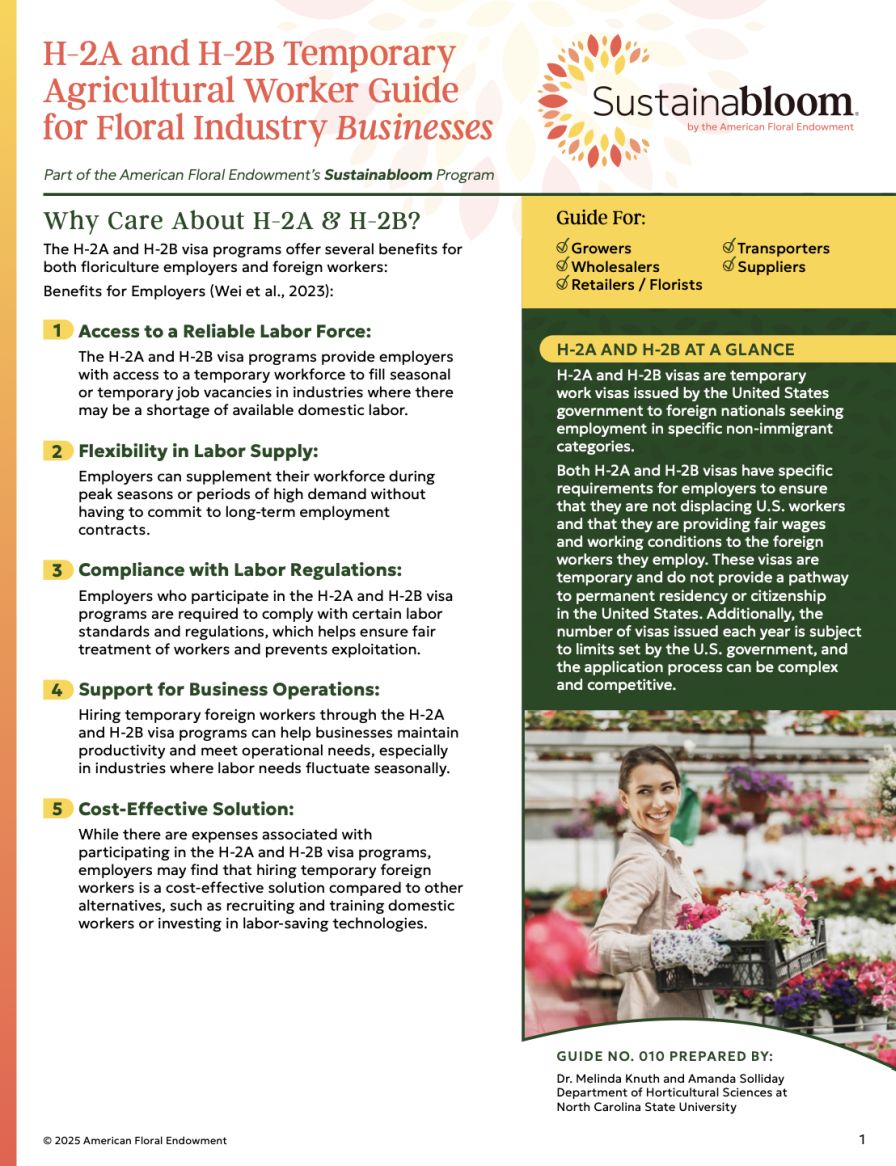
H-2A and H-2B Temporary Agricultural Worker Guide. | Sustainabloom, American Floral Endowment
Key Takeaways for Growers
- Begin the H-2A process four to five months before your labor needs.
- Secure housing and compliance items before filing.
- Maintain detailed payroll and timekeeping records for three years.
- Pay wages at or above the AEWR and treat U.S. and H-2A workers equally.
- Avoid last-minute filings; planning is critical.
For growers struggling to find and keep reliable labor, H-2A can be a lifeline. But success depends on starting early, following the rules, and working with trusted partners.
Subscribe to eNewsletter