



How to Select the Best Glazing for Your Greenhouse Operation
Of all the structural decisions in a greenhouse facility build, glazing is among the most important. Your choice will affect energy costs, crop quality, and maintenance cycles for as long as your greenhouse is operational. The three materials that dominate high-performance commercial CEA today — glass, polycarbonate, and ETFE film — each have an advantage depending on what you’re optimizing for. The mistake is choosing based on capital cost alone.
Glass: Best for Light Quality
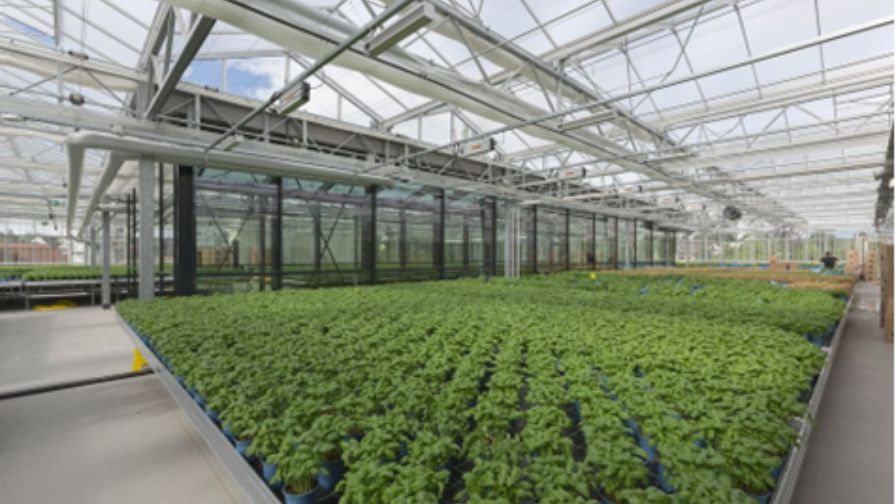
Glass gutter-connected greenhouse. | Ceres Greenhouse Solutions
Horticultural glass transmits 88-92% of photosynthetically active radiation (PAR) with minimal spectral distortion, which is important for crops whose premium pricing depends on light quality. It doesn’t yellow or degrade over time, and diffuse glass options can improve canopy uniformity enough to lift yields 5–10% without any change in cultivation practice.
The tradeoff is thermal performance. R-value is a measure of a material’s resistance to heat transfer: the higher the number, the better the material insulates. Double-pane glass achieves roughly R-2, and so in cold climates, winter heating becomes the dominant operating cost. Glass also carries the highest structural load of the three materials, requiring more robust framing. Breakage, while infrequent, is a real production disruption.
Best fit: High-value specialty crops, mild-to-moderate climates, operations where light quality is a direct revenue driver, and operations with aesthetic and architectural priorities (particularly for retail-facing or visitor-facing facilities).
Polycarbonate: The Operational Workhorse
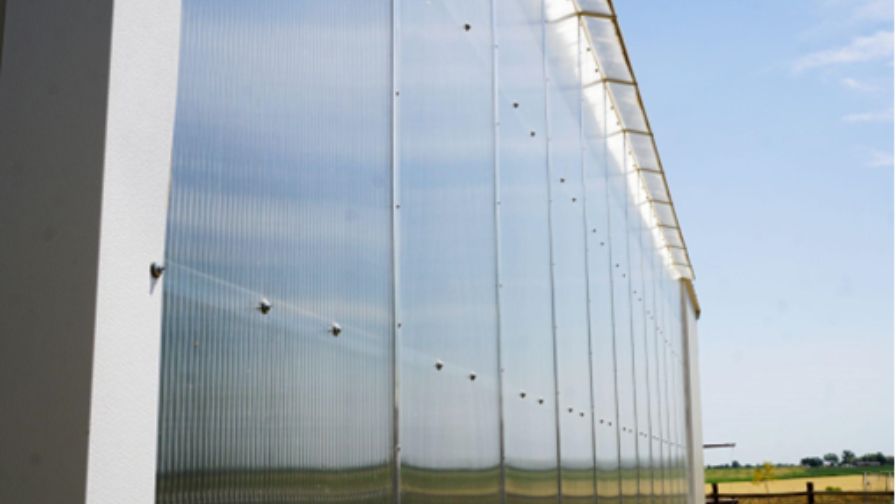
Triple-wall polycarbonate south wall. | Ceres Greenhouse Solutions
Multi-wall polycarbonate remains the dominant glazing choice globally. An 8mm twin-wall achieves approximately R-1.5 to R-2; 16mm triple-wall reaches R-2.5 to R-3, reducing the need for heating energy when compared to double-pane glass. It’s dramatically lighter than glass, reducing structural requirements, and its impact resistance makes it the clear choice in hail-prone regions.
The core tradeoffs are light and longevity. Polycarbonate transmits 74–82% of PAR, depending on wall count, which is a meaningful reduction from glass. And despite UV coatings, it yellows over time, with measurable transmission loss beginning around years 10-15. A facility that plans to operate for 30 years should budget for at least one reglazing cycle.
Best fit: Leafy greens, cold climates, operations prioritizing energy cost reduction, hail-prone regions, and projects with smaller upfront capital.
ETFE: High Performance at Scale
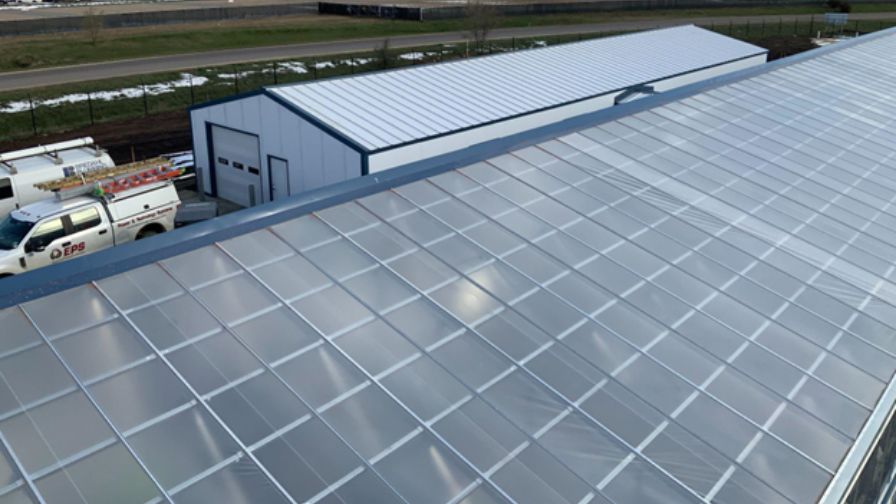
ETFE diffused glazing on the roof of a research greenhouse. | Ceres Greenhouse Solutions
ETFE film is the newest of the three to reach mainstream commercial use, and its performance profile is compelling. Single-layer ETFE transmits 87–95% of PAR — matching or exceeding the best horticultural glass — while inflated cushion systems deliver thermal performance competitive with polycarbonate (R-1 to R-3 depending on layer count). Its expected service life of 25–35 years means no reglazing cycle within a typical facility lifespan, and its self-cleaning surface reduces maintenance labor.
Other benefits of ETFE include its durability. Its resistance to UV degradation and chemicals commonly used in greenhouse operations, plus its stability across a wide temperature range, means that it wears far slower than other glazing materials.
The barriers are upfront cost and installation capabilities. ETFE film sheets and cushion systems require specialized installation and repair expertise that most general construction crews don’t carry. And the continuous blower systems that maintain cushion pressure are an additional mechanical system to manage. For smaller or remotely located operations, these are meaningful considerations.
Best fit: Large-scale operations, vegetable production that benefits from a lot of sunlight, long-term operations where lifecycle cost outweighs capital cost.
How to Choose
Four questions narrow the decision: How severe is your heating load? What does your crop and market require in terms of light quality? What is your project’s lifespan? And how sophisticated is your operations and maintenance team?
If hot days dominate your climate, thermal performance should lead. If crop quality justifies a premium price, light transmission should lead. Scale and lifespan tip the balance between polycarbonate’s accessible economics and ETFE’s lifecycle value.
Case Study: Glass to ETFE in a High-Wind Region
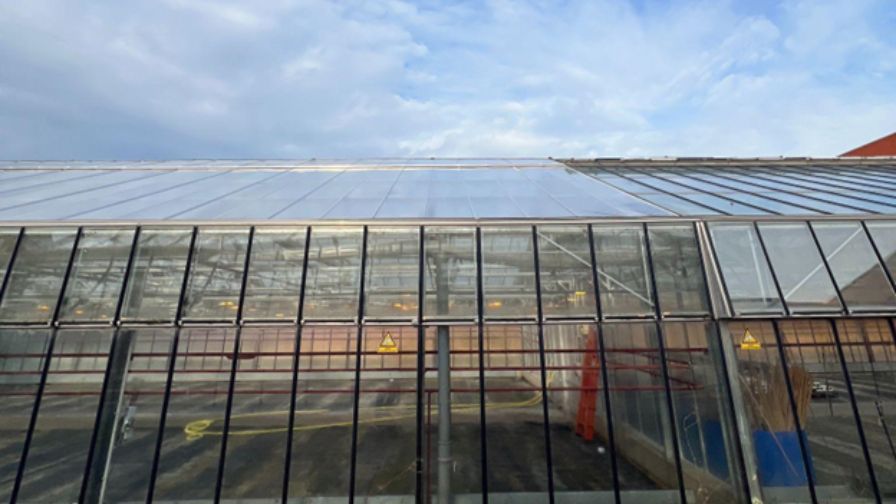
ETFE High-wind case study structure. | Ceres Greenhouse Solutions
A commercial greenhouse grower in Germany was facing a familiar crossroads: 30-year-old glass glazing that was increasingly damaged, difficult to maintain, and no longer meeting the operation’s standards for durability, worker safety, or plant performance — particularly in a region with high wind exposure.
Rather than a full rebuild, Ceres Greenhouse Solutions designed a targeted material switch. A custom track system was engineered to allow ETFE film to be installed directly onto the existing frame, avoiding major structural modifications entirely. The retrofit was completed one greenhouse at a time, allowing the grower to maintain production throughout the process.
The results reflect what the material comparison above predicts. ETFE’s higher light transmission and UV permeability improved the growing environment and plant quality relative to the aging glass it replaced. Its 25–30 year service life means the grower is unlikely to face another re-glazing decision within their planning horizon. And the installation approach — working within the existing structure rather than replacing it — kept both cost and downtime well below what a full rebuild would have required.
In conclusion, there is no universally optimal glazing material. The right answer depends on running a lifecycle analysis, not a capital cost comparison, before construction decisions are locked in.
Subscribe to eNewsletter