



From Palm Pilots to AI: A Grower’s Perspective on Technology
 June 18, 2026
  Not long ago, Greenhouse Grower Editor Brian Sparks asked me a simple question: What’s the next big thing growers should be watching?
The truth is, I don’t know. And that’s exactly the point.
After that conversation, I started thinking. I’ve lived through a lot of technological change in our industry, and most of the advances that shaped my career weren’t things I saw coming. They were things I learned to use once they arrived.
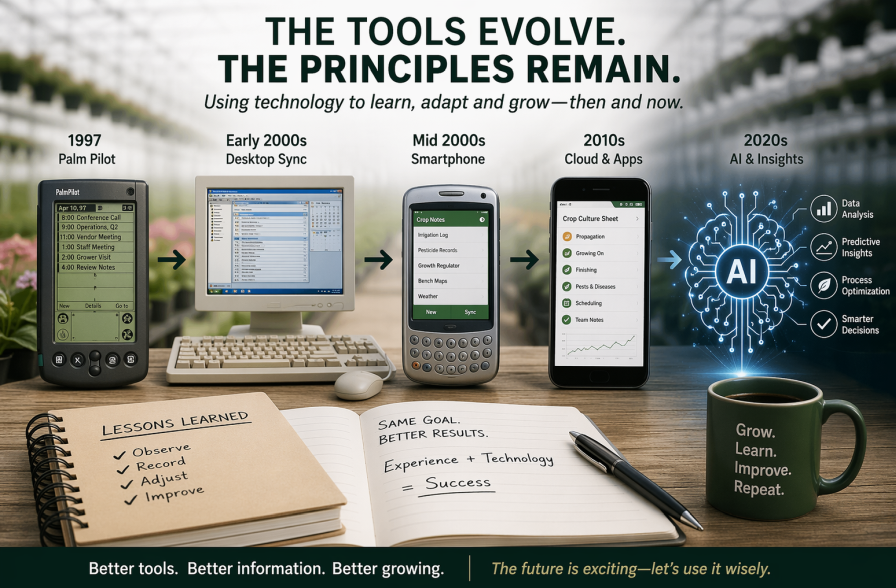
That realization took me back to 1997, when I bought my first Palm Pilot.
At the time, I was a young grower learning how to produce plugs and liners. Like many growers, I was trying to capture everything I was learning — notes from consultants like Roger Styer and Royal Heins, observations from the greenhouse, and lessons learned the hard way. I carried notebooks everywhere and filled dozens of them.
At first, I made the mistake of writing in pen. That worked fine until I dropped a notebook into a water puddle and watched everything run together. After that, I switched to pencil. Lesson learned.
But the bigger problem wasn’t how I recorded the information — it was what happened to it afterward.
Like many growers, my notebooks eventually ended up buried in a desk drawer or locker, rarely to be seen again unless I was forced to clean out the growing pile of paper we all accumulate over time.
Then came my Palm Pilot. (You should hear angels singing at this point)
This little device fit in my pocket, but more importantly, it organized my thinking in a way that I could actually use. For the first time, my notes weren’t just stored — they were accessible. I could stand at the bench, pull up my information instantly, and make decisions in real time.
I no longer had to dig through drawers or lockers that smelled like stinky watering boots and PPE to find what I needed.
Every crop became a chance to learn and improve crops such as 288-Cell Impatiens:
- Remember, you hammered them with growth regulator last year and they never grew out for the finished grower.
- Remember, you kept them too wet and they were stretched and could not be planted with the STS. (Some of you may remember that reference)
- Remember, you watered too late at night and ended up with tip abortion.
Those lessons don’t leave you, but having them organized and accessible changed everything.
All my wins and losses were right there, in my pocket, ready when I needed them. That single advancement made me a better grower, crop after crop.
Over time, that personal system evolved into crop culture sheets that the entire team could use. Instead of relying on individual memory, we created a shared system. It aligned the team, reduced repeated mistakes, and helped everyone improve together. It also allowed me to delegate more effectively and focus on growing my career.
Today, I’m doing the same thing with modern tools — Microsoft Lists, Microsoft Loop, and Microsoft Copilot — organizing my years of experience in a way that can be shared more efficiently with my clients.
The tools have changed, but the principle hasn’t.
Throughout my career, I’ve tried to embrace new technology not blindly, but intentionally. I’m not afraid of advances like artificial intelligence because I understand both their strengths and their limitations.
A recent experience reinforced that. I used an AI tool to help update DNS settings for my website. It made a mistake and took the entire site down. It took me nearly six hours to fix it.
That’s not a reason to fear the technology, but it’s a reminder not to trust it blindly as I did in this case.
AI can be incredibly useful. It saves time, accelerates research, and helps organize information. But it also makes mistakes and can present incorrect information with complete confidence.
That’s where experience still matters. Your brain is far superior to any system simply processing and regurgitating data. Technology doesn’t replace good decision-making; it enhances efficiency when used correctly.
If there’s anything to be cautious about, it’s not the tools we have today, but where they might lead.
My concern isn’t the “AI” of today, Artificial Intelligence. It’s the possibility of “AI” of tomorrow, Autonomous Intelligence, or systems making decisions without human judgment. That may come someday. But before we allow any system to control our growing environments or production protocols, we need to be absolutely sure it’s delivering the right information.
Technology isn’t something to fear. It’s something to learn, test, and use carefully.
But the moment we stop questioning it is when we should start worrying.
And yes, I used AI to review my grammar, punctuation, and flow of this article.
Subscribe to eNewsletter
